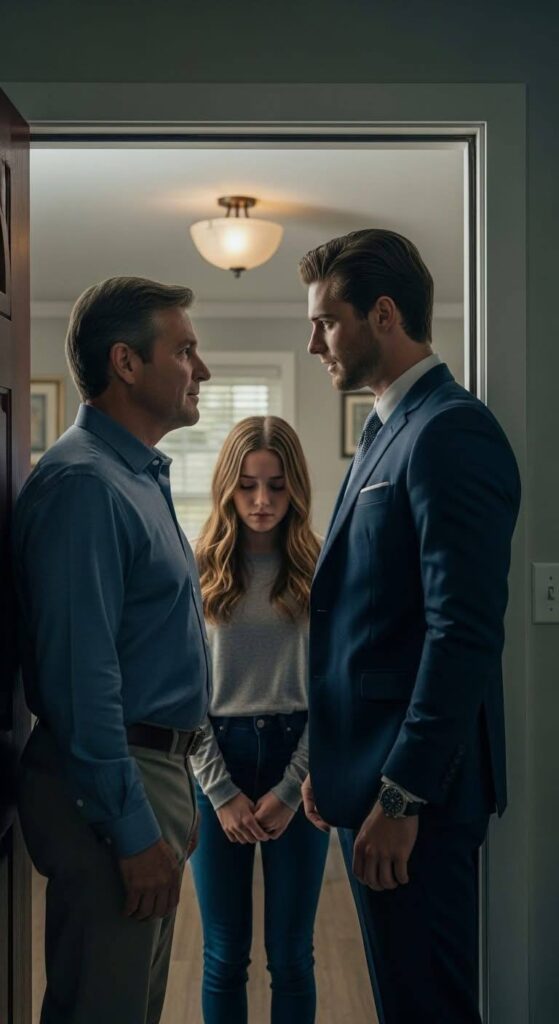
I, by nature, a quiet man. At sixty, I find my greatest pleasures in simple things: the satisfying heft of a well-seasoned cast iron pan, the sharp, clean scent of sawdust in my workshop, the specific shade of emerald green the lawn takes on after a good rain. I raised my daughter, Sandra, in the same modest three-bedroom house my parents left me. It’s a good house—sturdy, honest, and free of pretension.
I own a company, a successful one in a field most people find excruciatingly dull: high-precision industrial components. We make the tiny, vital things that go inside the big, impressive things. I’ve never seen the need to live like a king. The money, to me, is just a number on a screen; it’s not real in the way the grain of a freshly sanded piece of oak is.
Sandra, my only child and the undisputed center of my universe, gets it. Or at least, I thought she did.
Then she brought Matthew home for dinner.
He rolled up in a pearl-white monstrosity of a car that looked like it was designed to intimidate smaller vehicles into pulling over. He stepped out wearing a watch that cost more than my entire kitchen renovation. Sandra was beaming, a little star-struck. I get it. At twenty-two, shiny things can be distracting.
The evening was a masterclass in condescension, subtle at first, then anything but.
“This is a… cozy neighborhood, Daniel,” Matthew said, his eyes scanning my living room as if he were a health inspector cataloging violations. He ran a single, manicured finger over a bookshelf I built myself. “Lots of character.”
At dinner, he poked at the pot roast I’d spent four hours slow-cooking. “Is this, like, a family recipe?” he asked, in the same tone one might use to ask about a charming local superstition.
He spent the next hour detailing his life, which seemed to consist primarily of spending his father’s money. There were ski trips to Verbier, a summer internship on a yacht in Monaco, and the current, pressing trouble he was having deciding between a slate gray or midnight black color for his next car. His father, he made sure to mention multiple times, was the COO of some major player in the manufacturing space. “A real titan of industry,” he called him.
Sandra was mostly quiet, shooting me nervous, apologetic glances. I just kept smiling, refilling his water glass, letting the rope of his own arrogance spool out, giving him enough to hang himself with.
The grand finale came as they were leaving. He put his arm around Sandra, pulling her close and giving me a look of profound, theatrical pity.
“It’s been an experience, Daniel. Really,” he said, his voice dripping with false sincerity. “But don’t you worry. I’ll be taking care of her now. She won’t have to live like this anymore.” He gestured vaguely at my home, at my life, at me.
The air went still. Sandra froze, her face pale with mortification. The hurt was a sharp, physical thing in my chest. Not for me, but for her—that this glittering, hollow fool was what she thought she deserved. But on the surface, a strange and wonderful calm descended over me. The kind of focus you get right before you make a very precise, very critical cut in the workshop.
I looked at this preening child, this boy playing dress-up in his father’s success, and gave him a small, placid smile.
“Good luck,” I said.
After they left, I didn’t rage. I didn’t pour a stiff drink. I went to my home office, sat down at my uncluttered oak desk, and turned on my computer. I typed in the name of the “major player” Matthew’s father worked for. And there he was: Anthony Pierce, Chief Operating Officer.
Anthony Pierce was the COO of my company.
I pulled up his employee file. Performance reviews, salary, benefits, start date. I read through his contract, paying special attention to the termination clauses and the section on executive conduct. His contract, I noted, was due for its biennial review in six weeks. Or, as the clause stated, “if circumstances warranted sooner.”
I spent the next two hours on a deep dive. Sales figures from his division. Production efficiency reports. Client retention rates. He was adequate. Competent, but complacent, coasting on the momentum others had built. He was coded in the same lazy entitlement as his son. He’d gotten comfortable.
The boy had said he’d be taking care of my daughter now. It seemed only fair to give him the opportunity to do so without a safety net. The calm was still there. It wasn’t anger. It was clarity.
The meeting was scheduled for Monday at 10:00 a.m. I didn’t summon Anthony to my office; that would have been too personal. I had our head of HR, a formidable woman named Lisa, set it up in a neutral conference room on the executive floor.
I was there when he walked in, all smiles and expensive cologne. He clearly thought it was a preliminary contract negotiation.
“Daniel! Good to see you! I didn’t realize you’d be joining. To what do I owe the pleasure?” he boomed, extending a hand.
I didn’t take it. “Please, have a seat, Anthony,” I said, gesturing to the chair opposite me and Lisa.
The smile on his face didn’t vanish, but it faltered. It was like watching a light bulb flicker before it dies. I kept it brief, professional, and entirely devoid of emotion. I didn’t mention his son. I didn’t mention the disrespect. I didn’t need to. This was about business.
“Anthony,” I began, “we’ve reviewed the Q2 performance metrics from your division, and frankly, they’re not in line with the aggressive growth targets we’ve set for the next five years. We’re seeing stagnation in key markets and a worrying decline in new client acquisition.”
I slid a one-page summary across the polished table. It was all true, if perhaps framed in the harshest possible light.
“As a result,” I continued, my voice perfectly level, “we’ve decided to go in a different direction with our operational leadership. Effective immediately, we are terminating your employment. Lisa has your severance package here. It is compliant with the terms of your contract.”
The silence in the room was heavier than a lead weight. Anthony stared at the paper, then at me, then at Lisa, searching for a tell, a hint that this was some bizarre negotiation tactic. He found none.
“You’re… you’re firing me?” he whispered, as if the words themselves were foreign.
“We are exercising the company’s right to terminate your contract,” I corrected gently. “Security will escort you to your office to collect your personal belongings. Your corporate accounts and access have already been suspended.”
He left in a daze. No shouting, no scene, just the quiet, shuffling exit of a man whose world had just been pulled out from under him.
The first call came at 4:15 p.m. It was not from Anthony, but from Matthew. The caller ID flashed with Sandra’s picture, which meant he was using her phone. Smart boy.
I answered. “Hello?”
“WHAT DID YOU DO?” The voice was a screech, a complete breakdown of the suave, condescending persona from dinner.
“Matthew, I believe you have the wrong number.”
“DON’T PLAY DUMB WITH ME!” he shrieked. “My dad just came home! He said you fired him! Over nothing! My cards are already declined! The main account is frozen! This is YOUR FAULT!”
The sudden, raw terror in his voice was pathetic. The lifestyle he’d flaunted, the identity he’d built—it wasn’t his. It was a subscription service, and the primary member had just cancelled it.
“I made a business decision regarding an underperforming employee,” I said calmly. “Your father’s employment status is a confidential matter between him and the company. It has nothing to do with you or my daughter.”
There was a choked sob on the other end. “He cut me off! He said I pissed off someone important and that I had to fix it! He’s taking my car back! Daniel—Mister… your last name… please, you have to give him his job back! I’ll apologize! I didn’t know who you were!”
There it is, I thought. The core of it all. He wasn’t sorry for insulting the humble owner of a “cozy” home. He was sorry for insulting the owner of the company that funded his existence. The crime wasn’t the disrespect, but the miscalculation.
“Matthew,” I said, and I allowed a small, sharp edge into my voice. “At my dinner table, you assured me that you would be taking care of Sandra. You seemed very confident. This sounds like an excellent opportunity for you to demonstrate that capability, don’t you think?”
I hung up. A small, deep part of me felt a tremor of something ugly and satisfying. This wasn’t just business. It was personal, and it felt correct.
I called Sandra on her actual number a few minutes later. She answered on the first ring, her voice small. “Dad?”
“Hey, sweetie. Just checking in. Are you okay?”
“Matthew just blew up at me and stormed out! He was screaming about his dad and credit cards,” she said, her voice trembling. “Dad, what’s going on?”
I took a deep breath. “It’s complicated, honey. It’s business. But I need you to know that I love you, and you are not in the middle of this. You are on my side. Always.”
“Okay,” she was confused, but she said, “Okay.” For now, that was enough. The pieces were in motion. The consequences were just beginning to land.
The initial shockwave passed, replaced by a campaign of strategic desperation. It was fascinating to watch, like a nature documentary on a very inept species of predator.
First came the official letter from Anthony’s lawyer, full of bluster and thinly veiled threats, alleging wrongful termination and demanding a settlement triple the amount stipulated in his contract. It also mentioned his “deep personal relationships” with key clients. I scanned it, circled the relevant passage, and forwarded it to my corporate legal team with a two-sentence email: Standard response. Please also remind his counsel of the 18-month non-compete clause he signed.
The real drama, however, came from the source. A week later, Anthony requested a meeting. Not through lawyers, but via text to my personal phone. Daniel, we need to talk. Man to man. No suits, please.
Curiosity got the better of me. We met at a sterile coffee shop halfway between his downsized life and my own. He looked tired. The expensive suit was gone, replaced by a golf shirt that seemed a size too big.
“Daniel, thanks for coming,” he began, stirring a coffee he wouldn’t drink. “Look, I’ll get straight to it. I messed up. My kid, he’s an idiot. He’s arrogant. He gets it from me, I guess. I am formally apologizing for his behavior in your home.”
It was a good opening. Humble, direct. I nodded for him to continue.
“I’ve been with the company for twelve years,” he said, his voice taking on a pleading tone. “My whole life is tied up in it. You can’t just throw that away over a stupid comment from a stupid kid.”
“The decision wasn’t about your son’s comment, Anthony. It was about declining performance and a lack of strategic vision,” I said, reciting the official line. We both knew it was only partially true.
He leaned forward, his voice dropping. “Okay. Let’s be real. A lot of our biggest clients, they’re with us because of me. We have relationships. We play golf. If I walk, they might just walk with me. It would be a shame for everyone if business got… disrupted.”
It was the threat I’d been waiting for, the ace he thought he had up his sleeve.
I took a slow sip of my water. “It’s funny you should mention that,” I said, setting my glass down with a soft click. “I thought you might be worried about client disruption, so I got ahead of it. I spent the last two weeks personally calling the VPs at our top fifteen partners. I explained that we were restructuring our sales leadership to provide more direct, responsive service. They were all incredibly understanding, especially after I offered them a 5% discount on their next order to compensate for any potential transitional friction. Your name never even came up.”
The look on his face—the dawning horror of a man realizing he wasn’t the lynchpin he thought he was, but just a cog designed to be replaced—was worth the price of every coffee in that café.
“Your non-compete is ironclad, by the way,” I added cheerfully. “Our lawyers are quite proud of it.”
Meanwhile, the Matthew situation was deteriorating. Sandra called me, distraught. “Dad, he won’t leave me alone! He shows up at my apartment, he calls twenty times a day. He keeps saying I owe him, that I have to convince you to fix his life! Last night, he told my friends that I was a gold digger who was just using him for his family’s money!”
The irony was so thick I could have cut it with a knife.
“Sandra, listen to me,” I said, my voice firm but gentle. “He is showing you exactly who he is. Are you listening?”
“He said he loves me,” she whispered.
“No, sweetie. He loves what he’s lost. There’s a difference.”
That was the turning point for her. The absurdity of his accusations finally broke the spell. She blocked his number. When he showed up at her apartment again, she called campus security. A formal warning was issued. His own friends, who had flocked to his flashy lifestyle, abandoned him the second the money dried up. He was no longer the fun party host; he was the desperate, whining guy who couldn’t pay his bar tab.
The final move of this act was a text from an unknown number on Sandra’s birthday: I hope you’re happy. My dad is selling our house. This is what you do to people.
It wasn’t signed, but it didn’t need to be. I screenshotted it, saved it, and felt nothing at all. He wasn’t a villain. He was just a boy whose gravitational field had collapsed.
It’s been seven months. The divorce from reality for the Pierce family is final. Anthony’s legal challenge went out with a whimper. He did have to sell the big house. Word through the industry grapevine is that he took a significant step down, landing a regional sales manager position at a smaller competitor in a different state, the non-compete having locked him out of any leadership roles in our sector. From COO to middle manager. A brutal fall.
Matthew is the true cautionary tale. After being cut off, his life unraveled with astonishing speed. The pearl-white car was repossessed. Without his father’s name to open doors, he had to get an actual job. I heard from one of Sandra’s friends that he’s now working at a mobile phone kiosk in a mall. Apparently, he spends his breaks complaining to anyone who will listen about his vindictive ex-girlfriend and her horrible father.
Sandra and Matthew broke up for good about a week after my last update. Her seeing him for who he was—a hollow shell built of money and entitlement—was the best thing that could have happened. She apologized profusely for that night, for her silence. I told her the only thing she was guilty of was being twenty-two. She’s now dating a very nice, very normal grad student who thinks my workshop is the coolest thing he’s ever seen.
The last I heard of Matthew directly was about two months ago. He sent Sandra one final, pathetic email. It was a long, rambling screed about how she’d taken everything from him. He ended it by asking if she thought I, her father, might be able to help him get a decent job, since I was so “well-connected.” The sheer lack of self-awareness is still breathtaking. She deleted it without a reply.
As for me, life is quiet again. The company is thriving under a new, hungrier COO who sees opportunities instead of entitlements. My relationship with Sandra is stronger than ever, forged a little tighter by the absurdity of it all.
Last weekend, Sandra and her new boyfriend came over for a barbecue. I was at the grill, wearing an old apron, and he was genuinely asking me about the difference between briquettes and lump charcoal. There were no flashy watches, no talk of yachts, just laughter and the smell of burgers.
I never wanted revenge. I don’t think of it that way. I simply facilitated an audit. Matthew and his father presented a version of themselves built on a fraudulent foundation. All I did was check the receipts. They thought my simple life was a weakness, a liability. They didn’t understand that living modestly when you don’t have to is the ultimate position of power. It means you have nothing to prove.
I looked at my daughter, laughing and happy in the fading sunlight, and felt a profound sense of satisfaction. The house is still sturdy, still honest, and now, peaceful.