“Dad!”
Lance bounded down his porch steps, his arms spread wide for a hug. But something was terribly wrong. His smile was like plastic wrap stretched too tight over yesterday’s leftovers. He was thirty-five, but his hands trembled as he reached for my suitcase.
“Here, let me get that.” He fumbled the handle.
“I’ve got it.” I held on, studying his eyes as they darted away from mine. “You okay, son?”
“Perfect.” His voice was too high. “Just… really glad you’re here. Come on, Lucinda’s making that lasagna you love.”
Through the window, I saw my daughter-in-law, a blur of auburn hair and genuine warmth. At least her smile was real. As we walked, Lance gripped my elbow, his fingers digging in.
“Dad, we need to talk. Seriously.”
I stopped on the walkway. “Let’s talk now.”
“No, no.” He shook his head, that brittle smile snapping back into place. “After dinner. We’ll… we’ll figure it out.”
Figure what out? The question burned in my throat. I’d run an auto parts business for forty years; I knew the look of a man drowning in trouble. This was it.
Dinner was a masterpiece. Lucinda had lit candles, the table set for a celebration. But the tension was a physical presence in the room. Lance poured wine with a hand so unsteady that red drops splattered the white tablecloth.
“Rough day?” I asked.
“Something like that.”
He picked at his lasagna, cutting it into smaller and smaller pieces he never ate. Finally, he dropped his fork with a sharp clink.
“Dad.” His voice cut through Lucinda’s story. “We need to have that talk. Now.”
Lucinda’s smile faltered. “Lance, maybe after—”
“No, now.” He turned to me, his face pale in the candlelight. “I need money. A lot of money.”
I set my own fork down. “How much is ‘a lot’?”
“More than a million dollars.”
The words sucked the air from the room. I stared, searching his face for a joke. There was none. “A million?”
“I’ve done the calculations,” he steamrolled on, his voice gaining a desperate speed. “Your business is worth about 600k. The house in Portland, another 400k. Plus your savings, your retirement…”
“You want me to liquidate my life?” My voice was a strangled whisper. “Sell everything I’ve ever worked for?”
Lucinda’s face had gone white. “Lance, what are you talking about?”
“They aren’t just mistakes, Dad!” he snapped, ignoring his wife. “This is life and death. I borrowed money from the wrong people.”
“Who?”
“It doesn’t matter! What matters is they want it back, with interest. And they want it fast. You’re the only one who can help me.”
I pushed back from the table. “I’m not destroying my life to fix yours.”
“Dad, please!” His voice cracked. “You don’t understand what these people will do.”
“Then you should have thought of that!” I kept my voice level. “I can lend you 200,000. Cash. No questions asked. That is my limit.”
His face twisted. “Two hundred thousand? That’s nothing! That’s an insult!”
“It’s what I can do.”
“You never supported me!” His fist slammed the table with explosive force. Dishes rattled, wine jumping from the glasses. “You missed my games for inventory! You left my graduation early for an emergency order! Now, when I am facing real danger, you offer me scraps!”
“Those ‘scraps’ paid for your college!” I shot back, rising to my feet. “They built the business that’s giving you this chance!”
“You know what Mom would say?” he sneered, leaning across the table. “She’d tell you to help your son. She’d say family comes before business!”
The mention of Martha was a low blow. “Your mother would also tell you to take responsibility for your actions.”
“My actions? What about yours? Maybe if you’d been there more, I wouldn’t have—”
“Wouldn’t have what?” I cut him off. “Chosen to borrow from criminals? That’s your decision, Lance. Own it.”
“Enough!” Lucinda’s voice cracked through the argument. She was sobbing, her hands shaking. “Both of you, just stop. Please.”
The silence that fell was heavy and cold.
“She’s right,” I said, my anger fading to exhaustion.
“Fine.” Lance spat the word. He stalked out of the room and up the stairs. A moment later, his bedroom door slammed shut, rattling the pictures in the hall.
Hours later, my mouth was dry. I crept downstairs for a glass of water, the house steeped in a tense silence.
“Dad.”
Lance emerged from the living room shadows. His face was different—the anger was gone, replaced by a soft, vulnerable shame.
“I’m sorry,” he whispered, stepping into the kitchen light. “I was cruel. I said things… I didn’t mean any of it.”
The apology hit me harder than his anger. This was the boy I remembered. “We both said things, son.”
“No, listen.” He stepped closer. “You’re my father. You’ve given me everything. I… I was desperate.” He hesitated. “Would you… would you come out with me? Grab a beer? I know a quiet pub nearby, The Foggy Lantern. We can just talk. Like friends.”
The request was a lifeline. “All right,” I said, hope flickering. “That sounds good.”
His smile was radiant. He wrapped me in a hug that felt sudden and desperate. “Thank you, Dad. This means everything to me.”
The Foggy Lantern was dim, smelling of stale beer and sawdust. We sat at the bar, a baseball game playing silently on the TV. It felt… normal. We talked about the old days, about my shop, about the infield fly rule.
“I miss this,” I admitted over my beer.
“Me too, Dad. Really missed it.”
But as he said it, I saw his fingers tapping a nervous rhythm on his glass. His eyes kept darting to the door.
“Dad, excuse me for a minute,” he said, standing abruptly. “Need to use the restroom. Maybe make a quick call.”
I watched him walk to the back. Something felt wrong.
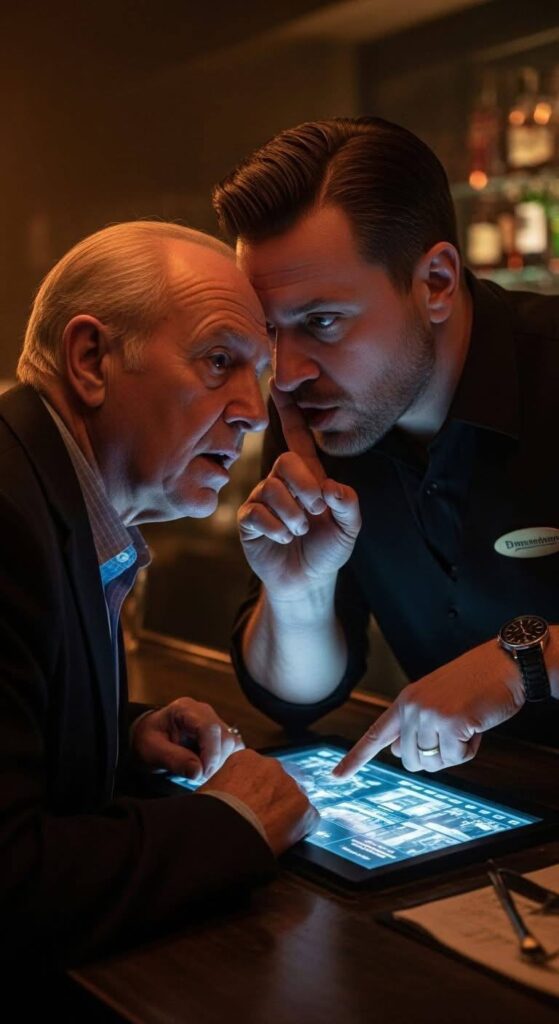
“Your boy seems restless tonight.”
The bartender, a stocky man named Marvin, was wiping the already-clean bar in front of me. His casual tone dropped. He leaned in, his voice a low, urgent whisper.
“Listen, old-timer. Listen to me very carefully.” His hand clamped around my forearm, his grip like steel. “Your son was in here earlier today. With three men. I overheard them. They were discussing your… removal.”
The word hit me like ice water. “What? That’s impossible.”
“Look for yourself.” Marvin pointed to a small security monitor built into the bar.
He toggled a switch, and my blood ran cold. The screen showed the pub’s entrance from an hour ago. There was Lance, handing a thick envelope to three men who looked like they’d stepped out of a crime movie.
“Jake Reed, Rico Sanchez, and Tony Vespa,” Marvin said, his voice flat. “Local muscle. They handle… arrangements. Permanently.”
On the screen, I watched in horror as Lance pointed into the pub, clearly giving instructions. The three men nodded and began to split up.
“They’re positioning themselves,” Marvin said, his military past showing. “Creating a perimeter. Whatever he told them, this is an operation.”
The desperate demands. The fake apology. The invitation for a “reconciliation” beer. It wasn’t a truce. It was a trap.
“He owes serious money,” Marvin said grimly. “I heard them. He decided your life insurance is an easier payout than your savings.”
My son. My son was having me executed.
“What do I do?” I whispered.
“You get out. Now.” Marvin nodded toward the back. “The men’s room window. It opens to the alley. Go.”
“Why are you helping me?”
“A man’s father saved my life in a firefight outside Kandahar,” Marvin said, his eyes on the monitor. “And some things are just right or wrong. Now go.”
From the corner of my eye, I saw Lance walking back from the hallway, that same loving, fraudulent smile on his face.
I didn’t run. I walked, my legs stiff, into the men’s room. I locked the door. The window was high and narrow, caked with grime. My knee screamed as I hauled myself up, squeezing my 65-year-old body through the opening.
I fell, dropping hard onto the wet pavement of the alley. The air stank of garbage and rain.
I didn’t run. I crept along the brick wall, my heart hammering. I had to know the whole plan. I reached the corner of the building and peered around, hiding behind a large dumpster.
Lance and the three men were gathered under a streetlight.
“Tomorrow at 8,” the one called Reed was saying. “Make it look like an accident. Brake failure, steering problem. Something mechanical.”
Lance nodded eagerly. “He always parks in the same spot behind his shop. Creature of habit.”
“What kind of car?” asked Sanchez.
“Old Ford pickup. Blue. He maintains it himself. Stubborn.”
“Cameras?”
“None that cover that parking area,” Lance said. “The shop’s system only covers the front.”
They had thought of everything.
“200k is cheap for this kind of work,” Rico grumbled.
“It’s what I have in cash!” Lance said quickly. “You’ll get double once the inheritance comes through. We’re talking over a million in total assets.”
“And if the old man changed his will?” Reed asked.
Lance laughed. A cold, sharp sound. “He didn’t. I’ve seen it. He’s too sentimental to cut out his only son.”
“What about the wife?” the third man, Vespa, asked quietly.
Lance’s casual cruelty froze my blood. “Lucinda? She barely balances the checkbook. And if she does ask questions… she’s not a problem we can’t handle.”
They were going to harm Lucinda, too.
The envelope changed hands. “Pleasure doing business,” Reed said.
“This means everything to me,” Lance replied, his voice full of gratitude.
The men dispersed. Lance turned and headed back into the pub, ready to sit at the bar and wonder where his “dear old dad” had gone.
I had maybe five minutes. I didn’t walk this time. I ran.
I got to my Ford, parked three blocks down, and slid behind the wheel. The engine turned over. I drove back to Lance’s house, my mind a frozen, silent void.
Lucinda was asleep upstairs. I packed my bag in the dark.
I found a pen and a notepad in the kitchen. I couldn’t tell her the whole truth. But I could save her.
Lucy, I wrote. Your husband is in danger. If you love him, take the children and go to your mother’s house tomorrow morning. Don’t ask questions. Just leave. Trust me. O.
I left the note on the counter and walked out, locking the door behind me.
I-5 South was dark and empty. Twenty minutes outside the city, my phone rang. Lance. I let it ring.
Five minutes later, it rang again. And again.
By the time I crossed the Columbia River into Portland, I had 37 missed calls. By the time I pulled into my own driveway, the count had reached 47.
Forty-seven desperate calls from the son who had just tried to have me erased. He was panicking. His plan had failed. His target was gone.
I turned off the phone and dropped it into my jacket pocket. I was tired in a way sleep couldn’t fix. But I was alive. And I knew exactly what was planned for 8 AM.