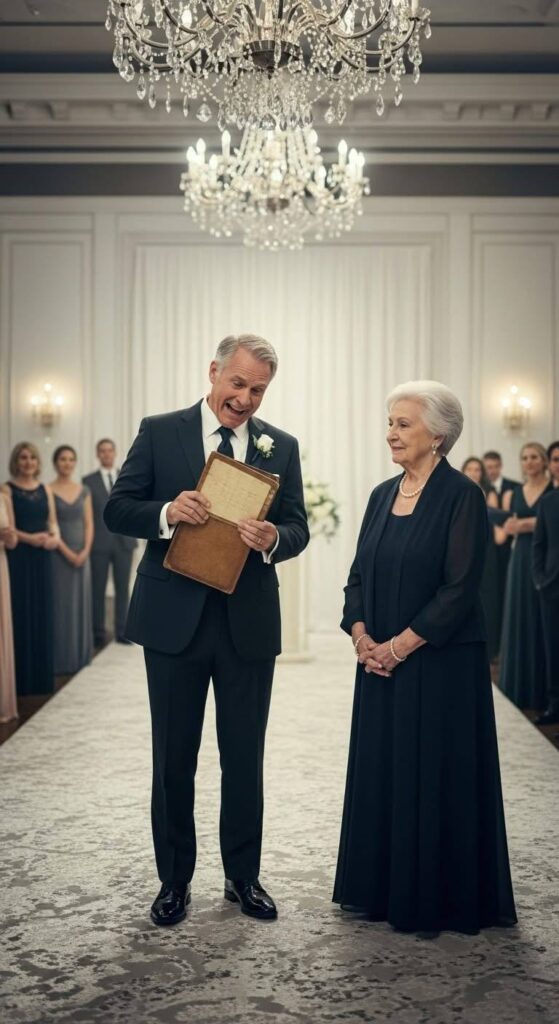
I am 72 years old. For most of my life, I have lived quietly. My husband, Edward, used to say that silence is a kind of power that loud people never understand. Last Saturday night, at the River Oaks golf club, I proved him right.
My lovely granddaughter, Grace, was marrying into the Sterling family. Richard and Catherine Sterling. You’ve probably heard of them—”new money” tech moguls who shot to fortune so fast they are now desperately trying to buy class with lavish parties and ostentatious donations. They are the sort of people who believe a person’s worth is measured by the label on their suit.
I arrived at the reception alone. I wore a navy blue cashmere dress Edward had given me on our 30th anniversary. It is not fashionable, but it is perfectly tailored. I wore no jewelry except my wedding band and a pair of small pearl earrings.
The ballroom was a symphony of excess. Glistening crystal, flowing champagne, and the hollow echo of empty conversations. I felt like a sparrow in a flock of peacocks.
Grace saw me and rushed over, her eyes full of anxiety. “Grandma, you made it! You look beautiful.” But she kept glancing over her shoulder at her new mother-in-law.
And then, Catherine Sterling approached. She glided over like a battleship, clad in a glittering sequin gown and a carefully plastic-surgerized smile.
“Oh, Eleanor,” she said, her voice sweet as honey but her eyes cold as ice. She took my arm, her voice loud enough for those nearby to hear. “We’re so glad you could come. We’ve arranged a special table for you in the back, so you can have some peace and quiet away from all this noise.”
She didn’t wait for my reply. She publicly escorted me, past tables of CEOs and politicians, to a forgotten corner of the ballroom. My “special” table was tucked behind a large marble pillar, next to the service entrance. I could hear the clatter of dishes and the bark of the head chef.
It was a perfectly executed, public humiliation. A clear message: you do not belong here.
I did not flinch. I smiled serenely. “Thank you, Catherine. That’s very thoughtful of you.”
I sat, placing my old leather handbag in my lap. My reaction seemed to fluster her. She had expected anger, or at least embarrassment. I gave her neither.
From my vantage point, I had a perfect view. I saw the Sterlings’ ostentatious greetings of their important guests. I saw the pained, guilty glances Grace sent my way. And I heard the whispers. “Poor old thing,” one woman said. “She looks so out of place.”
I was not out of place. I was waiting.
An hour later, Richard Sterling, the father of the groom, took the stage. He was a large man with a florid face and the confidence of someone who has never been told ‘no’. He tapped the microphone.
“Welcome, everyone!” he boomed. “Looking out at all of you tonight… it’s just incredible. A lot of people ask me, Richard, what’s your secret? How does a kid from Queens with nothing in his pocket build Sterling Enterprises?”
He paused for effect. “I’ll tell you how. Hard work, grit, and never quitting! I am a self-made man, in the truest sense of the word. I built this empire with my own two hands, and I am proud to say, I have never owed a single soul a single dime.”
The room erupted in applause.
I just took a quiet sip of water.
“Never owed a single soul.” The lie hung in the air, glittering under the chandeliers. By stating it so publicly, in front of hundreds of key witnesses—his business partners, his investors, his rivals—he had just set a perfect trap for himself. He didn’t know the proof of his lie was resting quietly in my old leather handbag.
The party continued. They presented the happy couple with their gift—the keys to a luxury penthouse overlooking Central Park. More applause. They had built a magnificent stage for their drama. They didn’t know they were also building it for me.
And then, the moment came.
The emcee, after fawning over the Sterlings’ generosity, looked at his script. “And now,” he announced, “we’d like to invite a very special member of the family to the stage, the bride’s grandmother, Mrs. Eleanor Vance.”
An awkward silence fell over the room. Heads turned towards my pillar. I heard Catherine Sterling whisper to her friend, loud enough for me to hear, “Probably some dusty old souvenir.”
I stood. I made my way to the stage, my steps slow and deliberate. All eyes were on me. I was no longer the invisible old woman behind the pillar.
I reached the podium and adjusted the microphone down to my height.
“Grace, Michael,” I began, smiling at my granddaughter and her new husband. “Seeing you both so happy together is the greatest gift of all. I wish you a lifetime of love, laughter, and mutual respect.”
I paused, then turned to Richard Sterling, who was standing beside the stage looking smug.
“Richard,” I said, my voice still soft. “To celebrate your incredible success and this wonderful day, I would like, on behalf of my late husband, Edward Vance, to return a keepsake to you.”
I opened my handbag. I did not pull out a dusty souvenir. I pulled out an old leather ledger. Its cover was worn and faded.
I stepped down and handed it to him.
He took it with a look of confusion, a patronizing smile still on his face. He thought it was a joke. Then he opened it.
I wish I had a camera at that moment.
The smile froze. The color drained from his face. He stared at the yellowed page, then looked up at me, his eyes wide with panic. He looked as if he had seen a ghost.
I returned to the podium and took the microphone. My voice was still gentle, but now it carried across the dead-silent room.
“Thirty years ago,” I said, “your father, a wonderful man, came to see my husband, Edward. He came not as a partner, but as a friend with an idea. He needed seed money. The banks had all turned him down.”
I looked directly at Richard. “This ledger records that foundational loan. The seed money that started Sterling Enterprises. It was not a business transaction. It was a debt founded on a handshake and the trust between two men. No interest. No due date.”
I turned to the room. “My Edward, before he passed, told me one thing. He said, ‘Eleanor, one day, Richard will be very successful. Keep this ledger. And give it back to him on the day his success makes him forget how he started.’”
I set the microphone down. “This debt of honor… I am not here to collect.”
The room was utterly silent. You could have heard a pin drop.
Richard Sterling’s entire “self-made man” narrative had just been utterly demolished, in front of his entire world. The woman he and his wife had scorned, whom they had hidden away like a dirty secret, was the silent foundation of the very empire they flaunted.
The silence was broken by a sob.
Grace. My granddaughter.
She ran onto the stage, past her stunned husband and her stone-faced in-laws. She threw her arms around me, sobbing on my shoulder. They were not tears of shame. They were tears of relief, of pride, and of remorse. “I’m so sorry, Grandma,” she whispered. “I’m so sorry. I love you.”
In that moment, she found her own strength. She had publicly chosen me. She was reborn.
The Sterlings are the laughingstock of their social circle. The story of “The Vance Ledger” spread like wildfire. The financial papers started digging. It turns out the “self-made” lie wasn’t Richard’s only one. His reputation is in tatters.
I’m sitting in my cozy living room. Grace and her husband, Michael, visit me every Sunday for tea. Michael, after the initial shock, showed his character. He confronted his father and apologized to me in front of Grace. He looks at me with a respect I had not seen before. He chose the right side.
The old ledger now sits on my fireplace mantel, right next to my wedding photo with Edward.
Yesterday, Grace asked me why I never asked for the money back.
I smiled and told her, “Grace, money can buy a building, but it cannot buy a foundation. Character and integrity are the only true legacy. Never sell them cheap.”
I didn’t just reclaim my dignity that night. I gave my granddaughter her legacy.