
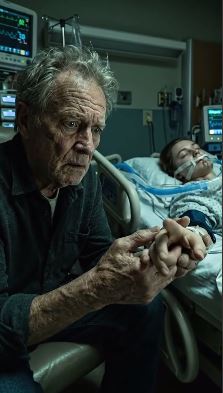
I felt it at 2:34 A.M. on a Thursday night.
Three short squeezes. Three long. Three short.
My hand was resting on my daughter Meera’s limp fingers, just as it had been for a thousand nights before. The room was dim, lit only by the green glow of the cardiac monitor and the soft hum of the ventilator that breathed for her. But this time was different. This time, her fingers didn’t just twitch with the random firing of damaged nerves. They moved deliberately. Purposefully.
S. O. S.
I jerked awake so hard I knocked over the plastic water cup on her bedside table. It hit the linoleum with a wet thwack, splashing water onto my shoes.
“Meera?” I whispered, my voice rusty from disuse.
Meera lay motionless as always. Her eyes were closed, her face pale and slack around the breathing tube taped to her mouth. She looked exactly as she had for three years, two months, and sixteen days. But her hand had moved. I was sure of it.
I pressed the call button, jamming my thumb into the red plastic until it hurt.
A nurse arrived within ninety seconds. It was Derek, the young guy with the kind eyes who usually worked the graveyard shift. He looked tired, his scrubs slightly wrinkled.
“Mr. Castiano?” he asked, stepping into the room. “Is everything okay?”
“She moved,” I said, my heart hammering against my ribs like a trapped bird. “She squeezed my hand. In Morse code.”
Derek gave me that look—the sympathetic, weary look that said he’d heard this a hundred times before from desperate family members seeing ghosts in the machinery.
“Mr. Castiano,” he said gently, moving to check the monitors. “Sometimes our minds play tricks on us when we’re tired. Muscle spasms are very common in long-term coma patients. It doesn’t mean conscious movement.”
I wanted to argue. I wanted to scream that I knew the difference between a spasm and a message. But the words stuck in my throat because… maybe he was right. Maybe I had imagined it. I’d been sitting in this room every night for over three years, holding Meera’s hand, talking to her, reading her favorite books until my voice gave out. Maybe my brain was finally cracking under the strain of grief.
Derek checked her vitals. Everything was normal. The heart rate was steady at 72. Blood pressure 110 over 70. He adjusted her IV drip, patted my shoulder, and told me to try to get some sleep.
I nodded, but I didn’t leave. I never left.
My wife, Claudia, had stopped visiting six months ago. She said she couldn’t bear seeing our daughter like this anymore—a husk of the vibrant girl she used to be. She said the doctors were right, that the accident had destroyed too much of her brain, that keeping her on life support was just prolonging everyone’s suffering.
We’d separated over it. She moved in with her sister. I stayed. Someone had to stay.
Meera was fifteen when it happened. Sophomore year. First-chair violin. Varsity soccer. Then, one October afternoon, she collapsed during practice. Just dropped on the field like a marionette whose strings had been cut. By the time the ambulance arrived, she wasn’t breathing. Anoxic brain injury. Oxygen deprivation. The neurologist said she’d likely never wake up.
I looked at her hand now, resting still and white on the blue hospital blanket.
“I’m here, baby,” I whispered. “I’m listening.”
At 3:15 A.M., I felt it again.
The squeezes were weaker this time, but the rhythm was undeniable.
…. . .-.. .–.
H. E. L. P.
My blood ran cold. I stared at her hand, waiting, barely daring to breathe. Nothing else came. My heart was pounding so hard I felt dizzy. I grabbed my phone and started recording, positioning the camera to capture both our hands.
I waited. Five minutes. Ten. The silence of the hospital pressed in on me.
Then, at 3:27 A.M., it happened again. Clear. Unmistakable.
M. E.
The recording captured it. I could see her fingers curling around mine, slight but real. I saved the video immediately, sending it to three different cloud backups before my hands stopped shaking.
Then, the final message came.
E. S. C. A. P. E.
Help me escape.
The words didn’t just frighten me; they terrified me. Escape from what? From the coma? From the hospital? Or from something else entirely?
I showed the video to Derek when he came back for his 4:00 A.M. rounds. He watched it twice, his brow furrowing deeper each time.
“I’ll get the attending,” he said, his skepticism replaced by professional concern.
Dr. Sandra Okafor arrived forty minutes later. She was Meera’s primary neurologist, a woman of sharp intellect and even sharper demeanor. She watched the video three times, asked detailed questions about the timing and frequency, and then examined Meera thoroughly. She checked her pupillary response, her reflexes, her brain activity monitor.
Everything showed no change.
Dr. Okafor looked at me with that careful, practiced expression doctors use when they are about to crush your hope.
“Mr. Castiano, what you’ve captured is interesting, but not necessarily indicative of high-level consciousness. The brain stem can trigger complex involuntary movements. The pattern you’re interpreting as Morse code could be coincidental firing of motor neurons.”
“Coincidental?” I snapped. “She spelled ‘Help me escape.’ That’s not random firing, Doctor. That’s a sentence.”
Dr. Okafor hesitated. “We can run additional tests. An EEG, an fMRI. See if there is any indication of conscious thought. But I strongly suggest you manage your expectations.”
The tests were scheduled for the following week.
I spent the next three days recording everything. Every twitch. Every breath. And I started paying attention to the hospital—really paying attention—in a way I hadn’t before.
Meera’s room was in the long-term care wing. Fourth floor. Eight patients total. All of them in vegetative states. All of them on life support. Most families had given up hope, visiting only on holidays or birthdays. I was the fixture. The ghost in the corner.
I started to notice the things I had stopped seeing because they had become background noise.
How the night nurses always came in pairs to check on Meera. How they would lock the door from the inside when they entered. How they adjusted her IV bags with movements that seemed rehearsed, secretive. How they would glance at the cameras in the corners of the room—cameras I had assumed were for security, but now felt like surveillance.
I started watching the other patients, too. All of them young. All of them female. Ages ranging from thirteen to twenty-two. All victims of sudden, tragic accidents. Car crashes. Drownings. Drug overdoses. All declared vegetative. All with families who had stopped visiting.
Except Meera. Meera still had me.
And suddenly, I wondered if that was the problem.
On Sunday night, I stayed later than usual. The hospital was quiet, a tomb of linoleum and antiseptic. Derek came in around 11:00 P.M. He had another nurse with him—a woman I’d seen before but didn’t know. Her name tag read “Nurse Ratched,” a joke scrawled in marker over her real name, Brenda.
They checked Meera’s vitals. Brenda watched me the whole time, her eyes cold and calculating. When they left, I pressed my ear to the door.
“He’s still here,” Brenda whispered. “It’s a problem. The Doctor needs to know.”
“He’s just a grieving father,” Derek replied, sounding uncomfortable.
“He’s a liability,” she hissed. “Phase Four starts tomorrow.”
My instincts screamed. I grabbed my phone and opened the recording app, slipping it into my breast pocket with the microphone facing out.
At 1:00 A.M., Dr. Okafor arrived. It was highly unusual for her to be there that late. She came into the room, closed the door, and asked if we could talk.
“Mr. Castiano,” she began, her tone professional but edged with ice. “The hospital administration is concerned about your constant presence. You are interfering with staff routines. We need to establish better boundaries.”
“Boundaries?” I asked, gripping the armrest of my chair. “I’m her father.”
“Families who cannot maintain emotional distance often make poor medical decisions,” she said smoothly. “Your insistence that Meera is conscious is a perfect example. You are seeing patterns that don’t exist. You are creating narratives that give you false hope.”
She leaned in. “I strongly suggest you go home tonight. Get some rest. Come back during normal visiting hours.”
“And if I refuse?”
“Then I will have to review the situation with administration and potentially security.”
She left. I sat there, my heart racing. The recording had captured everything.
At 2:00 A.M., Meera squeezed my hand again.
D. A. N. G. E. R.
T. H. E. Y. K. N. O. W.
R. U. N.
My daughter was telling me to run.
I grabbed my jacket. I texted my brother, Alex, a corporate lawyer who knew how to fight dirty. Check your email. If I don’t call you by morning, call the FBI.
I started for the door. It opened before I reached it.
Derek stepped in. He wasn’t alone. Two large security guards flanked him.
“Mr. Castiano,” Derek said, his voice trembling slightly. “We need you to come with us. Administration wants to speak with you immediately.”
“At 2:00 A.M.?” I stepped back, pulling out my phone and starting a livestream to my cloud storage. “I’m not going anywhere.”
“You’ve been making unauthorized recordings,” one of the guards rumbled. “That’s a violation of hospital policy and patient privacy.”
“I recorded my own daughter!” I shouted. “I have rights!”
They moved toward me.
Before they could grab me, an alarm blared. Loud. Piercing.
“Code Blue. Room 412. Code Blue. Room 412.”
Meera’s room.
My head snapped back to the bed. Her heart monitor was going crazy—the steady beep replaced by a chaotic, irregular rhythm. V-fib.
“Get the crash cart!” Derek yelled, rushing past me.
The room filled with people in seconds. Dr. Okafor appeared as if from thin air, barking orders. I tried to push through to Meera, screaming her name, but strong arms held me back.
“Clear!” Dr. Okafor shouted. They shocked her.
I watched Meera’s body convulse on the bed.
“Mr. Castiano, you need to leave!” the guard yelled, dragging me toward the door.
“What did you do to her?” I screamed. “She was fine five minutes ago!”
They dragged me into the hallway. Dr. Okafor emerged a moment later, looking grave.
“She’s stable,” she said, “but she experienced a severe cardiac arrhythmia. We need to move her to the ICU for intensive monitoring. You cannot be in the room. It’s a sterile environment.”
“I’m staying right here,” I spat.
“For her safety,” Dr. Okafor said, her voice dropping to a whisper that chilled my marrow, “you need to leave. If you care about Meera at all, you will let us do our jobs.”
It wasn’t advice. It was a threat.
I looked past her. Through the open door, I saw a nurse replacing Meera’s IV bag with a new one—a bag filled with a clear liquid that wasn’t saline.
They had induced the arrhythmia. They had caused a medical emergency to get me out of the room.
I stopped fighting. “Fine,” I said, my voice shaking. “I’ll wait in the family lounge.”
Dr. Okafor nodded to the guards. They released me.
I walked to the lounge, my legs feeling like lead. I sat down and pulled out my phone. The livestream had captured everything.
I called Alex.
“They’re trying to kill her,” I whispered. “Or worse.”
“I’m ten minutes away,” Alex said. “Stay in public view. Do not go back to that room alone.”
At 3:45 A.M., a woman sat down next to me in the empty lounge. She was older, wearing a coat over street clothes. She didn’t look at me.
“Your daughter is in a research program,” she said quietly, staring straight ahead.
I froze.
“I’m a nurse,” she continued. “Patricia Liu. I worked on the fourth floor until last month. I quit when I found the files.”
“What program?”
“They’re using coma patients for experimental pharmaceutical testing. Drugs designed to map consciousness without physical interaction. Your daughter has been conscious for two years, Mr. Castiano. They’ve been keeping her in a medically induced paralytic state while they study her brain’s response to the compounds.”
My world tilted on its axis. “She’s… she’s been awake?”
“Trapped,” Patricia corrected. “Aware, but unable to move. They suppress her motor functions. But she’s fighting it. The Morse code… that’s her breaking through the paralysis.”
She slid a flash drive across the seat between us.
“This has everything. Emails. Drug logs. Payments from Pharmanova. But you need to act now. Tonight was the final phase prep. Tomorrow, they’re going to induce a permanent vegetative state to harvest the final data set. If they do that, she won’t come back.”
“How do I get her out?” I asked, clutching the drive. “She’s on life support.”
“You take her,” Patricia said, looking at me for the first time. Her eyes were terrified. “You steal her.”
Alex arrived at 4:15 A.M. He listened to Patricia, looked at the files on the drive, and turned pale.
“This is RICO,” he muttered. “This is crimes against humanity.”
“We need to move her,” I said. “Now.”
Alex made a call. He had a contact—a private medical transport company that operated in the gray areas of the law. They could be there in an hour with a mobile ICU unit.
“We do it at shift change,” Alex said. “6:00 A.M. Maximum chaos.”
We went back to the fourth floor. The ICU transfer hadn’t happened yet; they were prepping her in the room. Only one nurse was inside.
Alex walked in first, wearing his expensive suit and projecting the arrogance of a thousand-dollar-an-hour attorney.
“I am Alexander Castiano, legal counsel for Meera Castiano,” he announced. “We are exercising our right to transfer the patient to a private facility immediately.”
The nurse blinked. “You can’t… Dr. Okafor hasn’t authorized—”
“We don’t need her authorization,” Alex lied smoothly, waving a stack of papers he had pulled from his briefcase. “This is a court order. Interference constitutes unlawful detention.”
The nurse hesitated, reaching for the phone. “I need to page her.”
“Go ahead,” Alex said.
While she dialed, I went to Meera. I took her hand.
H. U. R. R. Y.
“We’re going, baby,” I whispered.
At 6:00 A.M., the transport team arrived—two paramedics pushing a specialized gurney loaded with portable life support. They moved fast. They disconnected Meera from the wall and hooked her into their systems in seconds.
We were rolling toward the elevators when Dr. Okafor sprinted down the hall, flanked by security.
“Stop!” she screamed. “You are endangering this patient! She is unstable!”
“She’s leaving,” Alex said, stepping between the gurney and the doctor. He held up his phone, recording. “Touch my client, and I will have you arrested for assault.”
“You’re killing her!” Okafor yelled, her composure cracking.
“We know about Pharmanova,” I said.
Okafor froze. Her eyes went wide. The color drained from her face.
In that second of hesitation, the elevator doors opened. We shoved the gurney inside. I jumped in. Alex followed. The doors slid shut just as security reached us.
We hit the ground floor running. The ambulance was waiting at the emergency bay, engine running. We loaded Meera in sixty seconds.
As we peeled out of the parking lot, I saw Dr. Okafor standing on the curb, furiously dialing her phone.
We drove for two hours to a private clinic Alex knew—a place that specialized in discretion and detox.
Dr. Leslie Hammond took over Meera’s care. She reviewed the files from the flash drive with a look of growing horror.
“They’ve been dosing her with a neuro-inhibitor,” Hammond said. “It paralyzes the body but leaves the mind active. It’s… it’s torture, Mr. Castiano. Absolute torture.”
Over the next two weeks, Dr. Hammond slowly weaned Meera off the drugs. It was a terrifying process. Her heart rate spiked; her body shook with tremors.
But on day sixteen, she opened her eyes.
Not the blank stare of a coma patient. Real, focused eyes. She looked around the room. She looked at me.
And then, she squeezed my hand.
D. A. D.
I broke down. I buried my face in the sheets and wept until I couldn’t breathe.
The FBI investigation, led by Agent Victoria Reyes, was swift and brutal. With Patricia’s testimony and the flash drive, they had everything. They raided the hospital. They raided Pharmanova’s headquarters.
Dr. Okafor was arrested trying to board a flight to Mexico. The hospital administrators were indicted on charges ranging from medical fraud to kidnapping.
The story broke international news. “The Silent Ward.” Eight young women, trapped in their own bodies, used as lab rats for a billion-dollar drug trial.
Meera’s recovery was long. She had to relearn how to speak, how to walk, how to eat. The drugs had left scars on her nervous system—tremors, memory gaps. But her mind… her mind was sharp.
She testified at the trial. She sat in her wheelchair, facing the doctor who had enslaved her, and she spoke into the microphone. Her voice was raspy, but it didn’t waver.
“I heard you,” Meera said to Dr. Okafor. “I heard you talking about the dosage. I heard you laughing about your bonus. I was screaming in my head for two years. And you knew. You knew I was in there.”
Okafor got thirty years.
Five years later.
I sat in the front row of a university auditorium. On stage, a young woman stood at the podium. She walked with a cane, but she stood tall.
Dr. Meera Castiano.
She had just finished defending her dissertation in neuroscience. Her research focused on detecting consciousness in non-responsive patients—giving a voice to the voiceless.
“We often think of communication as words,” Meera said to the hushed room. “As speech. But sometimes, it’s just a signal in the dark. A squeeze of a hand. A refusal to let go.”
She looked at me then. She smiled.
“My father taught me a secret language when I was ten,” she said. “We thought it was a game. But it saved my life. It taught me that as long as you can send a signal, you are not alone.”
The audience applauded. I wiped my eyes.
I still keep a copy of the Morse code chart in my wallet. I teach it to my grandkids—Meera’s twins. I tell them it’s a superpower.
Because you never know when the darkness will come. You never know when you’ll need to speak without words.
And you never know who might be listening, waiting for three short squeezes to tell them it’s time to fight.