
My name is Nora, and on the night I turned eighteen, I learned that love in my family was a finite resource, and I was not the primary shareholder. I had spent the entire week whispering to myself like a prayer that this day would mark the beginning of my real adult life. I imagined agency, freedom, a celebration that was finally, irrevocably mine.
Instead, I stood in the center of our kitchen, the linoleum cold against my bare feet, holding a tray of vanilla cupcakes with lavender frosting. Across the room, my mother, Karen, stared at her phone screen, her thumbs flying in a rhythmic tap-tap-tap that sounded like nails on a coffin. She wasn’t texting me happy birthday. She was mass-texting my guest list to tell them not to come.
The demolition of my milestone began that morning when my brother, Ethan, stormed into the house like a localized hurricane. He slammed the front door so hard the family photos in the hallway rattled against the drywall. He was supposed to be three hours away, deep into a legendary road trip with his friends—a concert he had been bragging about for months, a pilgrimage to see some indie band that was “going to change his life.”
But the universe had other plans. His car had broken down forty miles outside of Seattle. The radiator blew, the friends bailed, and the trip disintegrated on the side of a rainy highway.
He came home not just disappointed, but incandescent with rage. He didn’t ask how my party planning was going. He didn’t glance at the streamers I had meticulously taped to the ceiling fan or the snack table I had organized by color. He walked straight past me, threw his keys on the counter, and pointed a shaking finger toward the backyard where I had strung up cheap, twinkling fairy lights.
“If I can’t have fun,” he spat, his voice thick with venom, “then neither can she.“
He didn’t say my name. He didn’t have to. I was just “she,” the collateral damage in the tragedy of his inconvenience.
My mother went quiet. It was a silence I knew well—the silence of a woman recalibrating the atmosphere to accommodate her son’s mood. It was like someone had flipped a breaker switch in her brain. By the time I processed the cruelty of his words, the decision had already been made.
“It’s for the best,” she muttered, already unlocking her phone. “Ethan isn’t in a good place right now. We can’t have a house full of laughing teenagers while he’s suffering.”
Nobody asked me. Nobody looked at me.
Hours later, the backyard was a ghost town of flickering lights. The cupcakes sat on the counter, the frosting beginning to sweat. My phone remained painfully, brilliantly silent. No doorbell rang. No cars pulled into the driveway. Just my dad, Mike, aggressively avoiding eye contact while pretending to read a newspaper from three days ago.
That was the exact moment something inside of me fractured. It wasn’t a loud break. I didn’t scream. I didn’t throw the cupcakes against the wall, though the urge surged through my veins like electricity. I didn’t cry in front of them.
I simply turned around, walked to my room, and shut the door.
I pulled my old duffel bag from the top of the closet. I started packing. Not the fun kind of packing for a sleepover or a trip. I packed with the ruthless efficiency of a soldier retreating from a lost battle. Jeans. Hoodies. My journal. The old DSLR camera I had bought with my own money.
If they wanted a life where Ethan’s mood dictated the weather, they could have it. I was done begging for a seat at a table where I was only served leftovers.
I was halfway through shoving my socks into the side pocket when my mom yelled up the stairs. Her voice had that sharp, serrated edge—the tone that meant get down here now.
I walked into the kitchen to find a tableau of dysfunction. My mom stood with her arms crossed, defensive and tight. My dad leaned against the counter, looking like he wished he could dissolve into the granite. And Ethan sat at the kitchen table like a miserable king on a throne of self-pity, sulking as if the universe owed him a cash refund for his existence.
“We need to talk,” my mom said.
She looked at me as if I were the problem. She launched into a monologue about how hard Ethan’s day had been. The towing fees. The missed concert. The exhaustion. The stress of working full-time at my dad’s coffee shop. My dad nodded along like a bobblehead, following a script they had clearly rehearsed while I was upstairs.
I waited for her to finish. When she finally paused for breath, I asked one simple question.
“And that is why you canceled my eighteenth birthday without even telling me?”
My mom sighed, a long, dramatic exhale that suggested I was being impossibly difficult.
“I messaged everyone saying you were sick,” she said, her voice devoid of shame. “I told them you had a fever and couldn’t host. It was a mercy, Nora. You’ll have plenty of other birthdays. Ethan only has this week to recover. You need to think about the family.“
I stared at her. In that second, the phrase think about the family translated in my head to its true meaning: Think about Ethan.
It wasn’t just today. It was the movie nights where I sat on the floor because Ethan needed the recliner for his “bad back.” It was the road trips where he controlled the playlist because my music “gave him a headache.” It was last Christmas, when he got a brand-new MacBook Pro for his “career” and I got his old, virus-riddled laptop because “his is still perfectly fine, and you don’t need anything fancy.”
“So,” I said, my voice shaking but the words clear as glass. “In eighteen years, has there ever been a single day that was actually about me?”
Ethan snorted. He leaned back in his chair, looking at me with pure disgust. “Oh my god, Nora. You are seriously making this about you right now? I just lost my entire trip. My week is ruined. Work is killing me. And you are whining about cupcakes? You don’t see how selfish that is?”
I turned to my dad. “What do you think?”
He wouldn’t meet my eyes. He stared at the backsplash tiles. “I just want everyone calm,” he murmured. “Your brother isn’t in a good place. A loud party would make things worse. We can make it up to you later.”
“I am not in a good place either,” I said. “Does that matter at all?”
“You’re fine,” Ethan snapped before Dad could answer. “You always are. You’re tough. I’m the one carrying the real pressure. I’m the one working at the shop, dealing with rude customers, worrying about the bills. I deserve a break more than you deserve a party.”
I looked at my mom. “So, because he missed a concert, I don’t get a birthday. Is that the lesson?”
“It’s about empathy!” she shouted, losing her composure. “Ethan feels things deeply. He’s sensitive. You’ve always been stronger, Nora. More independent. It’s an adult decision.”
“Lying to everyone that I’m sick is an adult decision?” I shot back.
“I was protecting you!”
The room shrank. Ethan and I started yelling over each other. He called me toxic. He said I was the reason the family was stressed. Our voices climbed higher and higher, a crescendo of eighteen years of resentment boiling over.
Right in the middle of the screaming, the doorbell rang.
Nobody moved. The silence that followed was heavy, suffocating. It rang again. Then a third time, insistent and sharp.
Finally, my dad pushed himself off the counter. He walked to the door, probably hoping it was a delivery driver he could pay off and send away. I heard the lock click, the door creak open, and then his voice, filled with genuine shock.
“Lisa? What are you doing here?”
I stepped out of the kitchen and looked down the hallway. Standing on the front porch, with a sleek carry-on suitcase by her side, was my Aunt Lisa. My mom’s older sister. She was looking past my dad, her eyes scanning the interior of the house.
From where she stood, she could see everything. The half-hung banner drooping in the hallway. The untouched cupcakes on the counter. My red, blotchy face. My brother slouched at the table like a storm cloud.
She didn’t need a roadmap. She didn’t need an explanation. One look at the scene, and she knew.
And in that instant, I realized this night was no longer just about a canceled party. It was about to become the night the foundation of this house finally cracked.
Aunt Lisa rolled her suitcase over the threshold, the wheels rumbling on the hardwood like thunder. She didn’t hug my dad. She just walked past him, her eyes locking onto the sad display of uncelebrated joy in the kitchen.
My mom appeared a second later, plastering on a smile so bright and fake it looked painful.
“Lisa! We didn’t know you were coming!” she chirped, her voice up an octave.
Lisa raised a perfectly sculpted eyebrow. “I texted you yesterday. And this morning,” she said coolly. “No reply. So I thought I’d surprise my niece for her eighteenth birthday.” She looked straight at me, her expression softening. “Happy birthday, Nora.”
I opened my mouth to speak, but my mom cut in, swift as a viper.
“She’s sick,” Mom announced. “Fever. Chills. It came on suddenly. We had to cancel the party. We didn’t want to drag you all the way up from Portland for nothing.”
Lisa’s eyes flicked over my jeans, my packed bag by the stairs, and the complete lack of tissues or medicine in the vicinity.
“Sick,” she repeated. “Right.”
My dad jumped in, rambling nervously. “It’s been a stressful week, Lisa. Ethan’s trip fell apart… the car broke down… everyone is on edge.”
Lisa lifted a hand, silencing him. She turned fully toward me.
“Nora,” she said, her voice steady. “What actually happened?”
No one in my house ever asked me that. They told me what happened. They told me how I felt. They never asked.
I took a breath. “My party was canceled because Ethan had a bad day,” I said. “Mom texted everyone and told them I was sick because Ethan came home and said, ‘If I can’t have fun, neither can she.‘”
The kitchen went dead silent.
“She’s exaggerating,” my mom said quickly, a nervous laugh bubbling up. “You know how teenagers are. Ethan works so hard at the shop. He’s under so much pressure. We just try to support him emotionally.”
From the table, Ethan scoffed. “We’re really doing this? In front of Aunt Lisa? Over cupcakes?”
Lisa didn’t look at him. She looked at my parents.
“Support him emotionally,” she repeated. “Interesting choice of words.”
“Lisa, that’s not fair,” my dad stammered.
“What’s not fair,” Lisa cut in, her voice dropping to a dangerous, icy volume, “is that for the past two years, I have been wiring you money every single month to keep Mike’s coffee shop from going under.”
My brain stuttered. I looked at my dad. His face had gone gray.
“Rent. Inventory. Extra this month because you said you wanted to do something special for Nora’s eighteenth,” Lisa continued. “And I walk in here and see this.”
“You… you’ve been paying for the shop?” I asked.
“Since the pandemic,” Lisa said, looking at me. “Your mom called me crying. Said she didn’t want you and Ethan to lose your home. I believed her. I thought I was helping a family doing their best.”
She turned back to my parents, her posture rigid. “I did not sign up to fund a system where one kid’s tantrum matters more than the other kid’s milestone.”
“You don’t understand!” Mom cried. “Ethan is sensitive! We have to be careful with him. Nora is strong. She doesn’t need that kind of coddling!”
“Being strong doesn’t mean she doesn’t need support, Karen!” Lisa shouted.
She turned to Ethan. “You’re twenty-two. You missed a concert. That sucks. It does not justify erasing your sister’s existence. Grow up.”
Ethan rolled his eyes. “I didn’t ask you for anything. I work there. I’m the one keeping it running.”
“No,” Lisa said, a humorless laugh escaping her. “I’m the one keeping it running. And I’m done. As of right now, I’m cutting off the money. No more monthly deposits. No more emergency transfers. If you want to keep the shop, figure it out yourselves.”
My mom grabbed Lisa’s arm, panic breaking through her mask. “You can’t! We have bills! The lease! You can’t just walk away!”
“I’m not walking away from the kids,” Lisa said. She turned to me. “Nora, I can’t erase what they did tonight. But I can give you an exit. Pack your things. Come live with me in Portland. I have a spare room. We’ll find you a college. You deserve a home where your birthday isn’t canceled because your brother needed a nap.”
My parents started shouting—accusations of theft, of bribery, of destroying the family. But their voices sounded distant, muffled by the ringing in my ears.
A door had opened. A real door.
“You’re not going anywhere,” Mom snapped at me. “You’re emotional. We’ll throw a party next weekend. You aren’t tearing this family apart.”
“She’s eighteen,” Lisa said. “She gets to choose.”
I looked at the sagging balloons. I looked at Ethan, who was staring at his phone, bored by the drama he had caused. I looked at my parents, terrified not of losing me, but of losing the status quo.
“Okay,” I said. “I want to go.”
“If you walk out that door,” my mom hissed, her face twisting, “don’t expect us to be waiting when you decide to come back. We aren’t going to chase you.”
A few months ago, that threat would have paralyzed me. Now, it sounded like permission.
“Okay,” I said. “Then don’t expect me to keep pretending this is normal.”
I grabbed my bag. My dad didn’t move to hug me. Ethan didn’t look up. Lisa put a hand on my back and guided me out into the cool night air. The door clicked shut behind us, and it sounded exactly like a guillotine blade dropping on my childhood.
The drive to Portland was a blur of highway lights and silence. At first, I was waiting for the regret to hit. I waited for the panic. But all I felt was the hum of the tires and the strange, unfamiliar sensation of being safe.
Lisa’s house in Hillsdale was small, filled with books and plants that were actually alive. “It’s yours as long as you need it,” she said, showing me the guest room.
That first night, we ate burgers on the couch and watched TV. Nobody asked if Ethan would like the show. Nobody checked the volume. It was painfully ordinary, and it felt like a revolution.
Over the next few weeks, my life shifted from reacting to planning. Lisa helped me apply to Portland State. I got a job at a dusty independent bookstore with crooked shelves and a register that jammed if you pressed ‘Enter’ too hard. I met Jake, an engineering student who came in for a textbook and stayed for two hours just to talk about sci-fi novels.
My phone, however, was a war zone.
My mom sent paragraphs of text. At first, they were apologetic. I’m sorry you felt hurt. Then, they became manipulative. Ethan is spiraling. He needs his sister. Finally, they became transactional. The shop is struggling without Lisa’s help. If you talk to her, maybe she’ll reconsider. She listens to you.
One night, after reading a message about how they “couldn’t survive” without the funding, I put the phone down on the kitchen table.
“They don’t miss me,” I told Lisa. “They miss what I can get them.”
Lisa sipped her tea. “When people show you who they are, Nora, believe them the first time.”
The spam continued. Ethan is under so much pressure. The family is falling apart. Where is your loyalty?
I got tired of wondering where I ranked. I decided to find out. I typed a message to the family group chat.
If you really want me to consider coming back, then Ethan needs to move out. He is 22. He can live on his own. I will only consider coming home if he leaves.
It was harsh. It was an ultimatum. But I wasn’t negotiating; I was testing the waters.
The typing bubble appeared. Then it vanished.
Silence.
For two days, my phone was a brick. No answer.
Meanwhile, my life in Portland expanded. I went on walks with Jake through Forest Park. I smelled like old paper instead of burnt espresso. I was happy.
Then came the gray Tuesday afternoon.
Jake and I were walking out of the public library, laughing about a professor’s bad toupee, when the hair on my arms stood up. I looked across the street.
Leaning against a dark sedan, hood up, arms crossed, was Ethan.
My brain refused to process it. Ethan belonged in the kitchen in Seattle, sulking. He didn’t belong on a sidewalk in Portland.
He pushed off the car and strode into the crosswalk, ignoring the red hand signal.
“Nora,” he barked.
Jake stopped, his hand tightening on his backpack strap. “You know him?”
“That’s my brother,” I whispered.
Ethan stopped three feet away. He looked rough—bags under his eyes, his shirt wrinkled. He looked like a man who was losing control and didn’t know how to handle it.
“We need to talk,” he said. “Alone.”
“How did you find me?”
“Mom gave me the address,” he sneered. “And your schedule. She said you’re hiding out in this library. They’re worried sick. So I came to talk some sense into you.”
Of course. When the guilt texts failed, send the Golden Child.
“I’m not going anywhere with you,” I said. “Say what you need to say here.”
Ethan laughed, a sharp, bitter sound. “Fine. They told me about your little ultimatum. You said you’d only come home if I moved out? Do you have any idea how insane you sound? You’re trying to blow up the family because you didn’t get a birthday party.”
“I gave them a choice,” I said, my voice steady. “To put me first. Just once. So… what did they decide?”
His jaw tightened. “They decided not to throw their son onto the street to satisfy your ego. They picked their sanity.”
It hurt. Even though I knew the answer, hearing it out loud—that they explicitly chose him—felt like a physical blow.
“So now what?” I asked. “You came here to gloat?”
“No,” he said, stepping closer. “I came to take you back. You’re going to call Mom and Dad, apologize, and tell Aunt Lisa you made a mistake. This ends now.”
He reached for my wrist.
In that split second, I knew a line was being crossed that could never be uncrossed. His fingers closed around my arm, tight enough to bruise.
“Let go,” I said.
“You’re coming with me,” he hissed.
“She said let go.“
Jake stepped forward. He didn’t shove Ethan. He just placed a hand on Ethan’s forearm and applied steady, unyielding pressure. “Touch her again, and I’m calling the police.”
Ethan jerked back as if he’d been electrocuted. He stared at Jake, then at me, baffled that the world wasn’t obeying him.
“Wow,” he spat. “You’re going to call the cops on your brother? You are so far gone, Nora. Brainwashed.”
“You crossed the line,” I said, rubbing my wrist. “Do not come to my job. Do not follow me. If I see you again, I will call the police.”
“You’re hurting everyone!” he shouted, backing away. “Mom is devastated! The shop is dying! And you’re playing the wounded princess!”
“I didn’t break the family, Ethan,” I said, my voice cutting through the damp air. “I just stopped covering the cracks for you.“
He stormed off, shouting insults, but he didn’t turn back.
That night, I showed Lisa the red marks on my wrist. She went very still.
“We should file a report,” she said.
“If he shows up again, we will,” I promised. “But I think he knows I’m serious now.”
Two days of peace followed. Then, the final text from my mom arrived.
We heard Ethan tried to talk to you. We cannot believe you threatened him. This is not who you are. We have prayed about your ultimatum. We will not throw Ethan out. Asking him to leave so you can feel prioritized is cruel. It has become clear you only want to punish us.
I scrolled down to the end.
If you choose to stay there, do not expect us to keep reaching out. We are done begging. We will focus on the child who still cares about this family.
There it was. Written in black and white pixels. We pick him.
I waited for the grief. I waited to crumble. Instead, a strange, deep quiet settled over me. It was the feeling of a heavy pack being lifted off my shoulders after an eighteen-year hike.
I typed three words.
Thank you. Goodbye.
Then I blocked my mom. I blocked my dad. I blocked Ethan. I blocked the cousins who took their side.
My thumb hovered over the button, trembling slightly. But when I pressed it, the world didn’t end. The sun didn’t go out. The silence wasn’t empty; it was full of possibility.
Blocking them didn’t erase them from my mind, but it did erase them from my daily life.
I kept working at the bookstore. Jake and I fell into a rhythm of study dates and cheap dinners. Life became small, manageable, and mine.
Months later, I was scrolling through social media when a notification popped up from a distant cousin I hadn’t blocked. She had tagged me in a photo.
It was a picture of my dad’s coffee shop. But the familiar logo was gone. The windows were papered over. A bright orange sign taped to the glass read: UNDER NEW MANAGEMENT.
The caption read: Crazy how fast things change. 
I went to the comments. The story unfolded in bits and pieces. Without Lisa’s money, the shop had folded. My parents had tried to sell it as a “business decision,” but everyone knew it was a fire sale to pay off debts.
A few weeks later, I overheard Lisa on the phone. My parents were downsizing to an apartment. They were selling furniture. The perfect suburban image had dissolved.
As for Ethan? Karma, it turns out, is a patient teacher.
I checked his public profile once, in a moment of weakness. He was posting vague, angry quotes about “snakes in the family” and “loyalty.” There was a photo of a mattress on the floor of a cramped apartment.
I heard through the grapevine that without the shop, he had no job. He got hired as a barista at a chain cafe but was fired three weeks later for “attitude problems.” Without the bank of Mom and Dad—who were now broke—his credit card debt swallowed him whole. He was living with three roommates he hated, complaining to anyone who would listen that the world was unfair.
The guy who once said, “I’m the one who matters,” was now struggling to matter to anyone at all.
I’d like to say I felt nothing. But I felt a mix of ugly satisfaction and a tired sadness. Sadness not for the brother who grabbed my wrist, but for the brother who might have existed if my parents hadn’t taught him that he was the center of the universe.
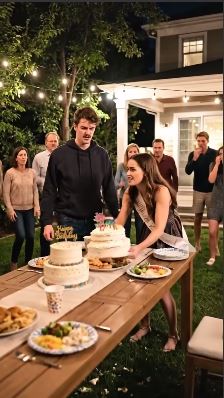
On my nineteenth birthday, Lisa and the bookstore staff threw a small party in the backyard. There were dollar-store streamers. The cupcakes were lopsided. Jake gave me a first edition of a book I loved.
When they sang “Happy Birthday,” I didn’t flinch. I wasn’t waiting for a door to slam. I wasn’t waiting for a tantrum to suck the oxygen out of the room.
It was quiet. It was simple. And it was mine.
I realized then that I hadn’t destroyed my family. I had simply stepped out of the way and let gravity take over. The moral isn’t to cut people off the moment they mess up. It’s this: Pay attention to what they do when you tell them you are hurting.
Do they listen? Or do they blame you for bleeding on their carpet?
If you were standing in that kitchen, holding a tray of cupcakes while your mother canceled your joy to soothe someone else’s temper, what would you do? Would you stay and beg for a crumb of affection? Or would you walk out the door and trust that your worth isn’t something your family gets to vote on?
I made my choice. And looking at the life I’ve built—the peace, the friends, the safety—I know it was the only one that mattered.