
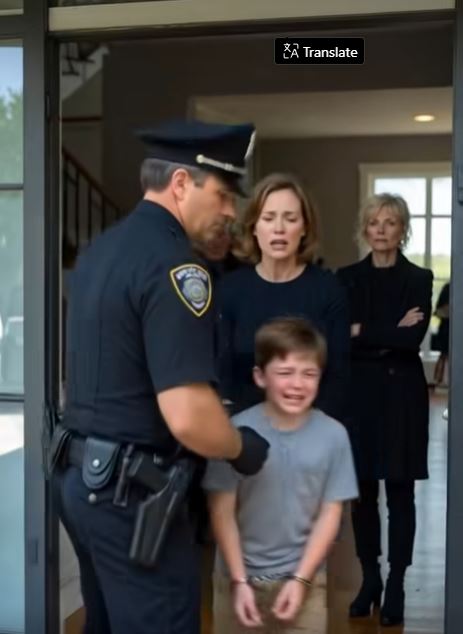
“Arrest him,” my sister said, her finger pointing at my son like a loaded weapon. Her voice was terrifyingly calm, a velvet sheet draped over jagged glass. “He’s a thief. I want him processed.”
The officer, a young man with a sweat-dampened brow, hesitated. He looked between the weeping eleven-year-old boy and the woman in the impeccable Chanel suit. “Ma’am, he’s just a child. We can—”
“He stole my diamond bracelet,” she snapped, the facade of civility cracking just enough to show the predator beneath. “It’s worth twenty thousand dollars. Check his backpack. Do it now.”
I stood frozen at the edge of the porch of my parents’ sprawling estate, clutching my purse so tightly my knuckles turned the color of bone. My son, Eli, was shaking, his small frame vibrating with a terror no child should ever know. He looked at me, eyes wide and swimming in tears, whispering, “Mom, I didn’t take anything. I promise.”
My parents, Robert and Martha, stood in the doorway. The oak door was open, framing them like a portrait of complicity. They said nothing. Not a word to defend their grandson. Not a single syllable to de-escalate the madness. They just watched, their faces masks of uncomfortable neutrality, unwilling to upset the golden child, my sister, Vanessa.
The officers looked uncomfortable, but in this neighborhood, money gave orders and badges obeyed. The younger officer unzipped Eli’s little superhero backpack. He rummaged past the comic books, the bag of half-eaten pretzels, and the spare hoodie.
Then, he stopped. He pulled out a glittering chain of white fire.
“No,” I gasped, the air rushing out of my lungs. “That wasn’t there before. I packed that bag myself.”
Vanessa folded her arms, a smirk playing on her lips—a small, satisfied curvature that I wanted to slice off her face. “Guess you shouldn’t have raised a criminal, Lena. It runs in the blood, doesn’t it?”
The officers cuffed Eli’s tiny wrists. The sound of the metal ratcheting shut—click, click, click—shattered something deep inside my chest. It was the sound of a structural failure, the collapse of the person I used to be.
He turned toward me, snot and tears streaming down his face. “Mommy! Mommy, please! I swear I didn’t!”
I stepped forward, but the older officer held up a hand. “Stay back, Ma’am.”
“I know, baby,” I whispered, my voice breaking into a thousand shards. “I know.”
As the patrol car pulled away, taking my heart with it, I turned to look at Vanessa. The driveway seemed to stretch for miles between us.
“Why?” I asked. It was barely a sound.
She smoothed her hair, checking her reflection in the window of her silver BMW. “Because you’ve always thought you were better than me, Lena. With your simple life and your ‘good’ son. I needed to remind you of your place.”
That was the moment Lena Hart died.
The woman who stood on that porch, the nice sister, the peacemaker, the doormat—she evaporated into the humid afternoon air. In her place, something else was born. Something cold. Something focused. Something unforgiving.
I am thirty-one years old. And that day, I realized that being good doesn’t save you. Being precise does.
The moment the police cruiser disappeared around the bend of the elm-lined street, the spell of silence on the porch broke. My parents turned to go back inside, their movements casual, as if they had just witnessed a parking violation rather than the abduction of a child.
“Mom!” I shouted. The sound tore from my throat, raw and animalistic. “You just watched them handcuff your grandson! You stood there and watched!”
My mother, Martha, sighed, adjusting her pearl necklace. She looked annoyed, not devastated. “Lena, lower your voice. The neighbors are gardening. Your sister wouldn’t lie about something like this. Maybe the boy made a mistake. He’s been… active lately.”
“A mistake?” I laughed, but it was a dry, broken sound, like stepping on dead leaves. “That is what you call it when my son is dragged away in a cage? A mistake?”
My father, Robert, mumbled without making eye contact, his gaze fixed on his loafers. “We’ll sort it out quietly, Lena. No need for drama. We can hire a lawyer in the morning. Let Vanessa cool off.”
“Drama?” I stepped closer to him, and for the first time in my life, I saw him flinch. “You let him get arrested on a lie to protect her ego.”
Vanessa stood by the door, leaning against the frame like a queen surveying her kingdom. “Face it, Elena,” she said sweetly, using my full name as an insult. “You’ve always been the mess of this family. It was only a matter of time before your chaos rubbed off on your son. He needs ‘scared straight,’ or he’ll end up a nobody. Like his father.”
My hands trembled. Not from fear, but from the effort of not strangling her. “You planted that bracelet. I saw you near his bag when we arrived.”
Her eyes glimmered with malice. “Prove it.”
She turned and walked back inside, the heels of her Louboutins clicking a rhythm of victory on the hardwood. She began humming, a light, airy tune, as if she hadn’t just nuclear-bombed a child’s life.
Mom followed her, tossing a glance over her shoulder. “Don’t make things worse, Lena. Go home.”
The door shut. The lock clicked.
I stood there for a long time. The sun began to set, casting long, bruised shadows across the lawn. I didn’t cry. Tears are for people who still have hope that the world is fair. I knew better now.
That night, I sat alone in my car outside the police station. Eli was inside. I couldn’t reach him yet; the processing took hours. But in the silence of that parking lot, illuminated by the sickly orange glow of streetlights, I replayed every interaction of the last decade.
I remembered every smirk Vanessa gave when she undermined me. I remembered the way my parents always covered her tracks—her DUI in college that vanished, the money she “borrowed” from their retirement fund that was never spoken of again.
She thought she had broken me. She thought this was the final blow that would send me scurrying into a corner, begging for her forgiveness so she would drop the charges.
But what she really did was wake me up.
By morning, Eli was released into my custody. The officers had confirmed his age and realized the absurdity of booking an eleven-year-old for grand larceny without more evidence, though the charges technically remained pending. But the stain was already there. The whispers would start. The sideways glances at school. Son of the accused thief.
I watched him sleep on the couch wrapped in his favorite blanket, his little wrists still marked with red abrasions from the cuffs. He whimpered in his sleep.
My stomach twisted into a knot of iron. This wasn’t about a bracelet anymore. It wasn’t even about family. It was about power. That was Vanessa’s favorite currency. She hoarded it, spent it, and used it to bludgeon anyone who got in her way.
But she had a weakness. People who love power this much usually steal it.
I went to my home office and opened my laptop. I didn’t go to sleep. I started to dig.
—————-
For the next forty-eight hours, I was a ghost.
I called in sick to my job as a data analyst. It was fitting, really. My entire career was built on finding patterns, spotting anomalies in spreadsheets, and locating the truth hidden in mountains of numbers. Vanessa thought I was just a “boring office drone.” She never realized that my “boring” skills were exactly what you needed to dismantle a fraudulent life.
I started with what I knew. Vanessa ran the Hastings Foundation, a high-profile charity dedicated to “underprivileged youth in the arts.” It was the crown jewel of her social standing. Galas, photo ops, designer dresses—all expensed to the foundation.
I spent the day gathering screenshots. I dug through her public Venmo history (stupidly left public). I cross-referenced her “business trips” posted on Instagram with the foundation’s event calendar.
Trip to Cabo: October 12th-15th. Tagged: “exhausting work retreat.”
Foundation Calendar: No events. No partners in Mexico.
Background of photo: The reflection in her sunglasses showed a man. Her boss, the married Chairman of the Board.
But that was just petty dirt. I needed concrete. I needed prison time.
I remembered a dinner three years ago. Vanessa had been drunk on expensive champagne, bragging about her “ghosts.” at the time, I thought she meant ghostwriters. Now, looking at the 990 tax forms of her charity which are public record, I realized she meant employees.
There were three salaries listed for “consultants” that totaled nearly half a million dollars annually. The names were generic. Smith Consulting. J.D. Associates.
I ran the LLCs. They were registered to a P.O. Box in a strip mall in Nevada. A strip mall that, according to Google Maps, contained a dry cleaner and a vape shop.
By evening, I had a digital folder so thick it felt heavy on the hard drive. I had bank statements she had carelessly left on my parents’ counter months ago which I had photographed, thinking I might need to help them budget. I had texts where she admitted to “fudging the numbers” to Mom, who had simply replied with a thumbs-up emoji.
My eyes burned. My coffee was cold. But I had her.
Then, I picked up my phone and dialed a number I hadn’t touched in five years.
Detective Rowan.
He was a good cop, a man who had once investigated Vanessa’s previous company for embezzlement. That case had gone away mysteriously—my father had called in favors, and evidence had “disappeared.” Rowan had been furious. He had looked at me back then, apologetic, telling me, “Your sister is dangerous, Lena. Keep your distance.”
The phone rang three times.
“This is Rowan.”
“Detective,” I said, my voice steady. “It’s Lena Hart.”
A pause. A heavy sigh. “Lena. I haven’t heard that name in a while. I heard about your boy. I’m… I’m sorry. I wasn’t on shift, or I would have stopped it.”
“I know,” I said. “But I don’t need an apology, Rowan. I need a partner.”
“I can’t interfere in an active investigation, Lena. You know that.”
“I don’t want you to interfere with Eli’s case,” I interrupted. “I want to give you the case you lost five years ago. I have something you’ll want to see. It involves the Hastings Foundation, a shell company in Nevada, and a twenty-thousand-dollar bracelet that wasn’t stolen, but planted.”
Silence stretched on the line. I could hear the hum of the precinct in the background.
“Talk to me,” he said, his voice dropping an octave.
“Not over the phone. Meet me. Tonight.”
“If you’re playing games, Lena…”
“She used the police force to humiliate an eleven-year-old boy,” I cut in, letting the cold rage bleed into my tone. “Now I’m going to use the truth to bury her. Do you want the shovel or not?”
He didn’t hesitate this time. “The diner on 4th. Twenty minutes.”
I hung up and looked at Eli sleeping on the couch. He looked so small.
“This time, baby,” I whispered to the dark room. “Mommy isn’t staying quiet.”
I grabbed the flash drive. As I walked to the door, a text message popped up on my screen. It was Vanessa.
Hope you’ve found a lawyer. I’m pressing full charges tomorrow morning unless you apologize publicly on Facebook. Tick tock.
I stared at the screen. Then, I typed back.
Do what you have to do.
I deleted the message and walked out into the night. She had no idea that the clock wasn’t ticking for me. It was ticking for her.
Detective Rowan looked older than I remembered. His hair was greyer, and the lines around his eyes were etched deeper by years of dealing with the city’s lies. He sat in a booth at the back of the diner, nursing a black coffee.
When I slid into the seat opposite him, he didn’t smile. He just looked at the manila envelope in my hands.
“You look like hell, Lena,” he said bluntly.
“I feel like clarity,” I replied. I slid the envelope across the chipped Formica table. “It’s all there.”
He opened it. He scanned the first page—a spreadsheet I had compiled linking the “consulting fees” to a bank account that I had traced back to an offshore holding company. The holding company was managed by Vanessa’s husband.
“These are felony fraud charges,” Rowan muttered, flipping the page. “Wire fraud. Tax evasion. Conspiracy.”
“Keep reading,” I said.
He turned to the next section. It was the proof of the planted evidence. I had found the receipt for the bracelet. She hadn’t bought it years ago like she claimed. She bought it two days ago at a pawn shop in the city, paid in cash, but she was foolish enough to use her loyalty card for points. The time stamp was one hour before she came to my parents’ house.
“She filed a false police report,” Rowan said, looking up, his eyes hard. “She wasted police resources to frame a minor.”
“She’s been siphoning money through her own charity for three years,” I explained, leaning in. “Millions, Rowan. She takes grants meant for art supplies and scholarships, funnels them into these shell companies, and buys cars, jewelry, and influence. The bracelet she ‘lost’? It was bought with stolen money to begin with.”
Rowan closed the folder. He placed a heavy hand on top of it.
“This is solid. But if we move on this, it’s going to be a war. Your family…”
“My family stood on the porch and watched my son get cuffed,” I said, my voice devoid of emotion. “They chose their side. I’m choosing mine.”
Rowan nodded slowly. A grim smile touched his lips. “I’ve wanted to nail the Hastings operation for years. They hide behind charity to wash dirty money. You just gave me the keys to the castle.”
“I have one condition,” I said.
“Name it.”
“I want it public. I don’t want a quiet plea deal in a back room. I want the sponsors to know. I want the board to know. I want the world to see her in handcuffs exactly the way my son was.”
Rowan tapped the table. “I can’t control the press, Lena. But… if we execute a raid on the Foundation’s headquarters tomorrow morning, the press usually listens to the police scanner. They tend to show up.”
“Tomorrow morning,” I confirmed.
“I’ll need you to stay quiet until then. Can you do that?”
I smiled. It was the same smile Vanessa used to wear when she thought she had checkmated me. “Quiet is what I do best, Detective.”
I left the diner and drove past Vanessa’s house on my way home. Her silver BMW was parked in the driveway, gleaming under the moonlight. The lights were on inside. I could see her silhouette moving past the window, wine glass in hand, probably celebrating her victory.
She was laughing on the phone, sipping her overpriced vintage, completely unaware that she was standing on a trapdoor.
She didn’t notice me drive by. But she would. Because in less than twelve hours, every company she had ever worked with, every investor she had ever lied to, and every parent she had ever looked down upon would see her for exactly what she was.
I went home and slept for the first time in days. It was a dreamless, peaceful sleep.
The next morning, I woke up at 6:00 AM. I made Eli pancakes. I packed his lunch.
“Mom?” he asked, pushing a piece of pancake around his plate. “Do I have to go to school? Everyone knows.”
I knelt beside him, brushing the hair back from his forehead. “You don’t have to go today, sweetheart. But if you do, I want you to hold your head up high. Because by lunchtime, nobody is going to be talking about you.”
He looked at me, confused. “Why?”
“Because,” I said, kissing his forehead. “The truth is a very loud thing.”
At 8:00 AM sharp, Detective Rowan texted me a single word.
Moving.
At 8:05 AM, I hit send on an email I had drafted the night before. It was addressed to the entire Board of Directors of the Hastings Foundation, the major donors, and three major local news outlets. The subject line was simple: Evidence of Embezzlement and Fraud regarding Executive Director Vanessa Hart.
At 8:15 AM, my phone began to vibrate.
By 8:30 AM, the story broke.
I sat in my living room, sipping coffee, watching the local news. The banner at the bottom of the screen turned red. BREAKING NEWS: POLICE RAID HASTINGS FOUNDATION HEADQUARTERS.
The footage was shaky, shot from a helicopter. Police cars surrounded the glass office building downtown. Uniformed officers were carrying out boxes of files. And then, the camera zoomed in.
Vanessa was being led out.
She wasn’t wearing her Chanel suit. She was wearing gym clothes, looking disheveled, clearly pulled from a morning workout she had been enjoying in her private office gym. She wasn’t wearing handcuffs yet, but two officers were gripping her arms tightly. She was screaming at them, her face twisted in ugly, primal rage.
My phone rang. It was my mother.
I stared at the caller ID: “Mom”. I let it ring.
It rang again. And again. Finally, I picked up.
“What have you done?” Mom screamed. Her voice was hysterical, shredding the speaker. “Lena! The police are at the office! They’re taking Vanessa! They say she stole millions! What did you do?”
“I didn’t do anything, Mom,” I said, my voice calm, contrasting her panic. “I just turned on the lights. It’s not my fault the roaches are scattering.”
“You ruined her!” she shrieked. “You ruined her career! You vindictive, jealous little—”
“She arrested my son!” I snapped back, cutting her off. “She tried to ruin an eleven-year-old boy to feed her ego. Did you care then? Did you scream for justice then?”
“That was a misunderstanding!”
“No. That was a choice. And so is this.”
I hung up.
By noon, it wasn’t just a scandal. It was an earthquake.
The Hastings Foundation accounts were frozen. The Board of Trustees issued a statement resigning en masse to distance themselves. Reporters were camped outside Vanessa’s gated community, interviewing neighbors who were all too happy to share stories of her arrogance.
Every channel played the same clip: Vanessa trying to shield her face with a designer handbag that we all now knew was purchased with stolen grant money.
At 2:00 PM, my phone rang again. This time, the ID said Unknown Caller.
I answered.
“You think this makes you better than me?”
It was Vanessa. She must have used her one phone call, or maybe she had made bail already. Her voice shook—not from guilt, but from pure, unadulterated fury.
“You humiliated your own family,” she spat. “You destroyed everything I built.”
I held the phone to my ear, looking out the window at Eli, who was playing in the backyard with the dog. He was laughing.
“You destroyed it yourself,” I said softly. “The moment you called the police on my child.”
“You don’t understand, Lena!” she shouted. “It was just supposed to scare him! I wasn’t going to let him go to jail! I just wanted to teach you a lesson!”
“A lesson?” I felt a cold smile touch my lips. “Well, consider the tuition paid. You wanted to teach me about power? You succeeded.”
“I will fix this,” she hissed. “Mom and Dad will hire the best lawyers. I will bury you.”
“Listen to me carefully, Vanessa,” I said, my voice dropping to a whisper. “You always thought you were untouchable because Mom and Dad covered for you. But the FBI is involved now. The IRS is involved. Mom and Dad can’t ground the federal government. You are done.”
Silence.
“And Vanessa?” I added. “I hope the handcuffs are tight.”
I hung up.
A moment later, Eli peeked into the room. He looked worried, sensing the tension in the air.
“Are you okay, Mom?”
I looked at him. I really looked at him. The fear was gone from his eyes. He saw me not as a victim, but as a protector.
I smiled, and this time, it reached my eyes.
“Yeah, baby,” I whispered. “I think we both are finally outside.”
The next few days felt like a movie in slow motion.
Every hour brought a new headline. Investigators confirmed that Vanessa had forged grant receipts and funneled over $4.3 million into offshore accounts. Her husband, who was listed as the CFO, tried to flee the state but was apprehended at the airport.
My parents tried to reach me. Text after text. Voicemail after voicemail. They ranged from begging to threatening.
Family shouldn’t destroy family.
We can still fix this.
You are being cruel.
But they had already chosen a side long ago. They had worshipped the golden calf, and now they were surprised when it melted down.
When a reporter showed up at their doorstep, sticking a microphone in my father’s face, I watched it on the evening news. My father looked old. Frail. He stammered, claiming ignorance. For the first time, the shield of respectability they had used to protect Vanessa was gone. They were exposed as enablers.
Mom called one last time, sobbing. “She’s your sister, Lena. Blood is blood.”
“Tell that to the eleven-year-old you watched being dragged out in handcuffs,” I replied, my voice trembling but firm. “You called that discipline. I call it betrayal. Do not contact us again.”
I blocked the number.
Later that evening, as the sun dipped low, painting the sky in hues of purple and gold, I stood at the window watching Eli build a Lego tower on the rug. He was humming to himself—a calm, safe sound I hadn’t heard in months.
My phone buzzed. A message from Detective Rowan.
She took a plea deal. Five years. Reduced for cooperation against her partners. She’s giving up everyone.
I read it twice. Then I locked the screen and exhaled deeply.
For the first time in years, the house didn’t feel haunted by my inadequacy. It didn’t feel like a waiting room for Vanessa’s next attack. It felt like ours. Peaceful. Steady. Whole.
Eli looked up, holding a red Lego brick. “Mom? Can we bake cookies tonight? The chocolate chip ones?”
I smiled back. “Yeah, baby. We can.”
The trial came and went faster than anyone expected. Vanessa went to prison in October. Her husband lost his teaching license and faced his own sentence. My parents sold the estate; the legal fees and the shame were too much for them to stay in the neighborhood. They moved to a condo in Florida, quiet and alone.
A month later, I visited the police station. This time, I wasn’t sitting in a car crying. I was walking through the front doors, holding Eli’s hand.
Detective Rowan met us in the lobby. He smiled—a genuine, warm expression that erased the years of cynicism from his face.
“Eli,” he said, bending down to eye level. “You’re quite the brave kid. I heard you’re doing well in school. Honor roll?”
Eli grinned shyly, clutching his report card. “Mom helps me study.”
Rowan stood up and looked at me. He extended a hand. “And you… you helped deliver justice. We closed three other cold cases based on the files you found in her ledger.”
“I just wanted my son back,” I said, shaking his hand.
“You did more than that, Lena. You took down a kingdom.”
As we walked out of the station, the sunlight felt different. It wasn’t the harsh glare of that terrible afternoon on the porch. It was warm. Clean.
For years, I thought peace was something you waited for. I thought it was something you begged for, something you earned by being compliant and “nice.”
But that day, as I walked my son to the car, free from the shadow of my sister and the silence of my parents, I realized the truth.
Peace isn’t something you wait for. It’s something you build. Brick by brick. Truth by truth.
I sat in the driver’s seat and looked at Eli.
“Ready to go home?” I asked.
“Ready,” he said.
I put the car in drive and didn’t look back. Some battles destroy you. Others set you free. And when you finally stop protecting the people who hurt you, you discover what peace truly sounds like.
It sounds like the engine of a car driving away from the past, carrying a future that belongs only to you.