
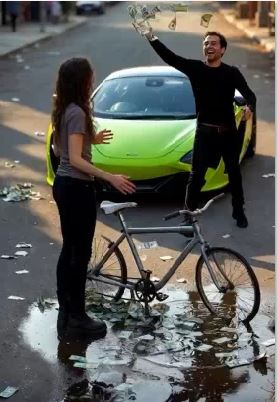
The Titanium Crash
The impact didn’t feel like pain, at least not at first. It felt like the world had suddenly decided to rotate ninety degrees to the right.
One moment, I was pedaling down 5th Avenue, enjoying the rare crispness of the autumn air. The next, there was a roar—the distinct, aggressive growl of a twin-turbo V8 engine—and then a force like a sledgehammer hit my rear wheel.
I flew.
For a split second, I was airborne, watching the city skyline tilt. Then, gravity reclaimed me. I hit the asphalt hard. My shoulder took the brunt of it, followed by my hip. I rolled, scraping skin off my palms, before coming to a stop in the gutter.
Silence. Then, the ringing in my ears started.
My name is Aria. I am twenty-four years old, a junior engineer at Vanguard Aerospace. I look like a college student—messy bun, oversized hoodie, worn-out sneakers.
I pushed myself up. My body screamed in protest, but I ignored it. My eyes locked onto the wreckage in the middle of the intersection.
My bike.
It was twisted into a shape that geometry shouldn’t allow. The matte-grey metal frame was snapped in two. The rear wheel was tacoed.
And sitting behind it, its bumper barely scratched, was a neon green McLaren 720S.
The driver’s door butterfly-ed open. A man stepped out.
He was the cliché of “new money.” Slicked-back hair, a suit that was too tight, and sunglasses that cost more than my rent. He didn’t run to me. He didn’t ask if I was breathing.
He walked to the front of his car. He crouched down, inspecting his bumper.
“You have got to be kidding me,” he shouted. “A scratch! You scratched the carbon splitter!”
He stood up and glared at me. I was still sitting in the gutter, picking gravel out of my bleeding hand.
“Are you blind?” he roared, marching over. “You cut me off!”
“I… I was in the bike lane,” I wheezed, the wind knocked out of me.
“You were in my way!” he spat. “Do you know how much this car costs? Do you know who I am?”
I looked up at him. I didn’t know his name, but I knew his type. He was a bully with a bank account.
He reached into his jacket pocket. He pulled out a money clip. It was thick.
He peeled off five one-hundred-dollar bills. He crumpled them into a ball and threw them at me. They hit my chest and fell into the dirty water of the gutter.
“Here,” he sneered. “Five hundred bucks. Go buy a new bike. Buy two. And get out of my sight before I sue you for the paint damage.”
He turned around, adjusting his cuffs, ready to get back into his pristine supercar.
I looked at the money floating in the muck. Then I looked at the twisted grey metal of my bike.
I stood up.
I didn’t just stand; I rose. I wiped the blood from my hand onto my jeans. I brushed the dust off my shoulder.
“Wait,” I said.
My voice wasn’t loud, but it was sharp enough to make him stop.
He turned, looking bored. “What? You want more? Greedy little—”
“Pick it up,” I said, pointing to the money.
“Excuse me?”
“Pick up your money,” I repeated. “And keep it. You’re going to need it.”
“Need it for what?” he laughed.
I walked past him to the wreckage of my bike. I picked up the top tube. It was incredibly light.
“You’re going to need it,” I said, “to pay for the deductible. Because you just destroyed the only Hyper-Titanium Lattice Prototype in existence.”
Chapter 1: The Scarp Metal
The man—let’s call him Slick—stared at me. Then he burst out laughing.
“Hyper-Titanium what?” he cackled. “Honey, look at that thing. It’s gray. It’s ugly. It doesn’t even have a logo. It looks like you welded it together in a junkyard.”
“It looks like that on purpose,” I said calmly. “It’s called industrial camouflage. We didn’t want to draw attention to the material engineering.”
“We?” he raised an eyebrow.
“My team,” I said.
A crowd was gathering. People were holding up phones. A police siren wailed in the distance.
“Listen,” Slick said, stepping closer, his voice dropping to a menacing whisper. “I don’t have time for your sci-fi fantasies. Take the cash. Walk away. Or I will make sure you never work in this town again. I’m Julian Thorne. I own this block.”
“Julian Thorne,” I repeated. “Real estate developer?”
“That’s right.”
“I’ve heard of you,” I nodded. “You cut corners on concrete to save money. I read the engineering report on your last high-rise. It has structural shear issues on the 14th floor.”
Julian’s face went pale. “Who are you?”
“I told you,” I said. “I’m an engineer.”
The police cruiser pulled up. Two officers stepped out. One was holding a notepad.
“Alright, break it up,” the older officer said. “What happened here?”
“She swerved into me!” Julian lied instantly, putting on a charming smile. “Cyclists, right officer? They think they own the road. I tried to brake, but…”
“He hit me from behind,” I said. “While speeding. There are skid marks.” I pointed to the road. The long black streaks clearly showed the McLaren had been going way over the limit.
“It’s just an accident,” Julian interrupted, waving his hand. “I’ve already compensated the lady. She’s just trying to extort me for more.”
The officer looked at the crumpled bills in the gutter. He looked at Julian. He didn’t look impressed.
“Is this your bike, Ma’am?” the officer asked me.
“It is,” I said. “Or it was.”
“Value?” the officer asked, pen poised over the paper.
I took a deep breath.
“The material cost alone is one point two million dollars,” I said.
The officer stopped writing. Julian choked on air. The crowd went silent.
“Excuse me?” the officer asked. “Did you say million?”
“One point two,” I clarified. “Not including the R&D hours, the patent filing, or the proprietary 3D printing calibration. If you include the intellectual property loss… we are looking at closer to ten million.”
Julian stared at me. His eyes were bulging. “You are insane. It’s a bike! A bicycle! It doesn’t even have gears!”
“It uses a magnetic drive train,” I explained. “It’s frictionless. And the frame isn’t steel. It’s a graphene-infused titanium alloy printed in a vacuum chamber. It was built for the Mars mission mobility test.”
“Mars?” Julian screamed. “She’s crazy! Officer, arrest her for filing a false report!”
“I can prove it,” I said.
I pulled my phone from my pocket. The screen was cracked, but it worked.
I dialed a number.
“Mr. Vance?” I said when he answered.
“Aria?” the voice on the other end was sharp. “Where are you? The test run was supposed to be finished ten minutes ago. The investors are waiting.”
“I’m at the corner of 5th and Main,” I said. “There’s been an accident.”
“Are you hurt?”
“I’m banged up. But the Chimera… the Chimera is destroyed.”
Silence. A heavy, terrifying silence.
“Destroyed?” Mr. Vance whispered.
“Total loss,” I said. “Rear impact. High velocity.”
“Don’t move,” Vance ordered. “I’m bringing the security team. And the legal team. And don’t let anyone touch the pieces.”
Chapter 2: The Convoy
“Who did you call?” Julian sneered. “Your boyfriend?”
“My boss,” I said. “Harrison Vance. CEO of Vanguard Aerospace.”
Julian’s arrogance flickered. Everyone knew Harrison Vance. He was the defense contractor who built the drones the military used. He was a man who had the President on speed dial.
“You work for Vance?” Julian asked, scanning my hoodie. “Dressed like that?”
“I’m a field tester,” I said. “I dress for aerodynamics, not for the catwalk.”
Ten minutes later, the cavalry arrived.
It wasn’t just one car. It was a convoy. Three black SUVs with tinted windows screeched to a halt, blocking the intersection completely.
Men in suits jumped out. They didn’t look like lawyers. They looked like secret service. They formed a perimeter around the wrecked bike.
Then, a silver Rolls Royce pulled up.
Harrison Vance stepped out. He was a man in his sixties, silver-haired, wearing a suit that cost more than Julian’s McLaren.
He walked straight to me.
“Aria,” he said, looking at my bleeding hands. “Medic!”
A man with a medical bag ran over and started cleaning my cuts.
Vance turned to the bike. He looked at the snapped frame. He looked at the crushed wheel. He sighed, a sound of profound disappointment.
“Three years,” Vance murmured. “Three years of printing. Gone.”
He turned to Julian.
Julian was no longer leaning against his car. He was standing up straight, looking like a child who had broken a vase.
“Mr. Vance,” Julian stammered. “I… I’m Julian Thorne. We met at the gala last year. This is… this is a misunderstanding. Your employee swerved…”
“My employee,” Vance cut him off, his voice ice cold, “is the Lead Structural Engineer of the Mars Mobility Project. She designed that frame. And you just ran it over.”
Vance looked at the skid marks. He looked at the McLaren.
“You were speeding,” Vance stated.
“I… maybe a little,” Julian admitted. “But look at the bike! It’s just metal! I can pay for it! How much can a bike be? Five thousand? Ten?”
Vance laughed. It wasn’t a happy laugh.
“Arthur,” Vance called out to one of the men in suits. “Show him the invoice.”
Arthur opened a briefcase. He pulled out a document. He walked over to Julian and handed it to him.
“This is the bill of materials,” Vance said. “Raw titanium dust. Graphene sheets. The energy cost of the particle accelerator we used to bond them.”
Julian looked at the paper. His hands started to shake.
“This… this says four million dollars.”
“That’s the cost to make it,” Vance said. “Now, add the contract penalties. We were supposed to demonstrate this to NASA on Monday. Because of you, we will miss the window. The contract is worth fifty million. You just cost my company fifty-four million dollars, Mr. Thorne.”
Julian dropped the paper. It fluttered into the gutter, landing next to his five hundred dollars.
“Fifty… million?” he squeaked.
“Insurance won’t cover this,” Vance said calmly. “I know your policy limits, Julian. You’re capped at two million for property damage. The rest? The rest comes out of your pocket.”
Chapter 3: The Liquidation
Julian looked at his McLaren. It was his pride and joy. It was worth $300,000. Suddenly, it looked like a toy car.
“I… I don’t have fifty million liquid,” Julian whispered.
“I know,” Vance said. “I know about your leverage. I know you’re overextended on the High-Rise project. I know you borrowed against your assets.”
Vance stepped closer.
“You insulted my engineer,” Vance said. “She told me you threw money at her. Is that true?”
Julian looked at me. He looked at the medic bandaging my arm.
“I… I offered assistance,” Julian lied.
“He threw a ball of cash at me,” I corrected. “And told me to buy a new toy.”
Vance nodded. “A toy.”
He turned to Arthur, the lawyer.
“Arthur, file a lien on Mr. Thorne’s assets immediately. The car, the apartment, the development project. Freeze it all pending litigation for gross negligence and destruction of classified government property.”
“Classified?” Julian yelled. “It’s a bike on the street!”
“It’s a test vehicle for the Department of Defense,” Vance lied smoothly (it was for NASA, but DOD sounded scarier). “You just destroyed a national asset.”
“Officer!” Julian turned to the police. “You can’t let them do this!”
The officer shrugged. “It’s a civil matter now, sir. And federal, apparently. I’m just writing the ticket for reckless driving.”
Vance looked at me. “Aria, get in the car. We’re going to the hospital to check for internal injuries.”
“What about the bike?” I asked.
“The team will recover the debris,” Vance said. “We need to analyze the shear stress data. Even in failure, it provides data.”
I walked toward the Rolls Royce.
Julian ran after me. He grabbed my uninjured arm.
“Wait!” he pleaded. “Please! Talk to him! I’m sorry! I was a jerk! I’ll pay for the hospital! I’ll pay you personally! Just don’t ruin me!”
I stopped. I looked at his hand on my arm.
“Let go,” I said.
He let go instantly.
I looked at his face. The arrogance was gone. He was just a scared man who realized he had kicked the wrong person.
“You told me to pick up the money,” I said, pointing to the gutter.
“I… yes.”
“You should pick it up,” I said. “You’re going to need every penny for the bus fare.”
I got into the Rolls Royce.
As we drove away, I watched through the rear window.
Julian Thorne, the master of the universe, was kneeling in the gutter. He was fishing his soggy hundred-dollar bills out of the dirty water, while his McLaren was being hooked up to a tow truck.
Chapter 4: The Rebuild
The lawsuit was short. Julian settled. He had to sell his development project to Vanguard Real Estate (a subsidiary of our company) for pennies on the dollar to cover the damages. He lost the McLaren. He lost the penthouse.
I healed up fine. A few scars, but nothing broken.
Three months later, I was back in the lab.
“Ready?” Vance asked.
We were standing in front of the vacuum chamber. Inside, the 3D printing arms were finishing their work.
The chamber hissed open.
There it was. The Chimera Mark II.
It was sleek. It was silver. It looked like it was moving even when it was standing still.
“We reinforced the rear triangle,” I said, running my hand over the frame. “And we added a sensor suite to detect incoming collisions.”
“Good,” Vance said. “NASA is coming on Tuesday.”
“I’ll be ready,” I said.
“Are you going to test ride it?”
“Not on 5th Avenue,” I laughed. “I think I’ll stick to the closed track.”
Vance handed me a helmet.
“By the way,” he said. “We received a letter today. From Mr. Thorne.”
“Oh?”
“He’s asking for a job,” Vance grinned. “He says he has experience in project management. And he really needs the money.”
“What did you tell him?”
“I told him we have an opening,” Vance said. “In the janitorial department. We need someone to sweep the test track. I thought he might have experience with… gutters.”
I smiled.
I put on the helmet. I mounted the fifty-million-dollar bike.
I pedaled. The magnetic drive engaged. Silent. Powerful.
I flew down the track, faster than before, leaving the memory of the crash and the man who caused it in the dust.