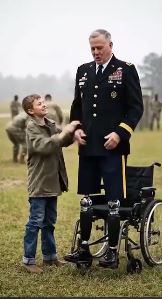
“Private Lewis, step aside. He doesn’t need assistance.”
The voice cut sharply across the training field.
But Eli didn’t move.
He was kneeling in the grass, one knee pressed into the damp earth, both hands gripping the worn straps of the general’s leg braces. His fingers were steady—too steady for a boy who slept under overpasses. Calm. Focused. Certain.
Around them, soldiers paused mid-drill. Push-ups stopped. Commands faded. Whispers spread like static. No one quite understood what they were watching.
General Robert Whitaker, silver-haired and rigid in his dark dress uniform, sat upright in his wheelchair. His hands rested flat on his thighs, unmoving. His face was carved from discipline, unreadable to anyone who didn’t know him.
Everyone knew his story.
Fifteen years earlier, during an overseas deployment, an armored convoy had been hit. The explosion shattered his spine. Medics said he was lucky to survive. The damage was permanent. No recovery. No miracles. Only the chair.
So he accepted it.
But the boy kneeling before him hadn’t read his file like a legend. He looked at him like a man.
“I checked your records,” Eli said quietly, tightening a strap with careful precision.
Whitaker’s eyes hardened. “You had no permission to do that.”
“I had reason,” the boy replied.
A murmur rippled through the watching soldiers.
Eli couldn’t have been more than fourteen. Thin. Too thin. His jacket was several sizes too big, sleeves frayed, sneakers worn down at the heels. He wasn’t a cadet. He wasn’t enlisted. He wasn’t supposed to be here at all.
“You think I haven’t been examined by the best specialists in the country?” the general said coldly.
“Yes, sir,” Eli answered evenly. “And I think some of them stopped trying.”
That landed harder than an insult.
Whitaker leaned forward slightly. “You’re out of line, kid.”
But Eli’s hands didn’t leave the brace.
“Your glute and quad muscles still respond,” he said. “Barely. But they do. Your lower motor neurons still fire. That means the pathway isn’t dead. Just weak.”
The general blinked.
No one had spoken to him like that in years. Most doctors talked around him now—pain management, maintenance, accommodation. No one talked about possibility.
“You’ve built a life around the chair,” Eli continued. “You led from it. Commanded from it. Earned medals from it. But you never finished what your body is trying to do.”
The field had gone completely still.
Whitaker’s jaw tightened. “You think I haven’t tried to stand?”
“I think you stopped trying after someone told you to stop hoping.”
The boy finally looked up, meeting the general’s eyes.
“That wasn’t me.”
For a long moment, Whitaker said nothing. Every instinct told him to shut this down. To protect the last scraps of dignity he had left.
But something deep inside him—something long buried—shifted.
“You presume a lot for a kid with no rank,” he said.
Eli stood, not arrogant, just honest. “My mom was a physical therapist before she died. I grew up in rehab centers. I watched people move fingers doctors said were gone forever. Bodies remember things scans don’t.”
“And you think mine will listen to you?”
“I think it’s already listening,” Eli said softly. “It just needs permission.”
The general exhaled slowly.
“Thirty days,” Eli said. “If nothing changes, I disappear.”
Whitaker didn’t say yes.
But he didn’t say no.
He nodded once.
That nod was the first step.
The next morning at 0600, General Whitaker rolled himself into the abandoned rehabilitation wing of the base gym. Dust coated the equipment. No one expected him—except Eli.
The boy was already there. Bars wiped down. Braces warmed. Resistance bands laid out with care.
“Thirty seconds,” Eli said. “That’s all today.”
Whitaker locked his wheelchair. Eli worked silently, securing his legs, movements precise despite his age.
“Tell me if something feels wrong.”
“It all feels wrong,” the general muttered.
Still, he let the boy help him up.
Whitaker gripped the parallel bars. Pain flared instantly—white-hot, unforgiving. His arms shook. His breath hitched.
Eli stayed close, shoulder against his side.
“Just shift,” he whispered. “Breathe.”
Ten seconds passed.
Twenty.
At thirty, Eli leaned in. “Sit.”
Whitaker collapsed back into the chair, drenched in sweat—not from effort, but from confronting fifteen years of fear.
“I didn’t move,” Whitaker said.
“You stood,” Eli replied. “Your body remembered.”
They met every day.
Some mornings were brutal. Pain. Sleepless nights. Anger. Whitaker cursed. Eli never argued. He just handed him a towel and said, “Again.”
Thirty seconds became a minute. A minute became two.
By week three, Whitaker could stabilize without Eli’s hands.
By week four, they stopped counting seconds.
They counted steps.
Two at first. Then four. Then six.
One morning, Eli walked into the gym and froze. Whitaker was already standing between the bars, braces on, waiting.
“You’re late,” the general said.
Eli grinned. “I was watching.”
At the end of the month, the base gathered on the field.
They expected a ceremony.
Instead, they watched as General Whitaker rolled forward, locked his wheels, stood—no bars, no straps—just a cane and a boy’s steady hand.
He took one step.
Then another.
He turned and saluted.
The field erupted.
Whitaker looked only at Eli.
“You didn’t help me walk,” he said. “You reminded me who I was.”
Eli shook his head. “You were never finished, sir.”
Whitaker pinned a small military medal onto the boy’s jacket.
“Not for restoring my body,” he said. “For restoring my will.”
Behind them, an entire field of soldiers stood straighter.
They hadn’t just witnessed a man walking again.
They had witnessed a man choosing to.