
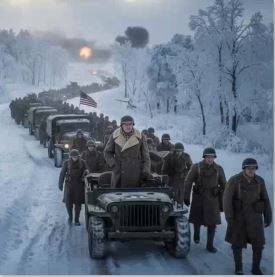
It started with a sound no soldier in the 106th Infantry would ever mistake for thunder. The Ardennes, calm just hours before, erupted as over a thousand German guns opened fire across eighty miles of forest. Snow flew from the trees, the ground bucked violently, and Private Andy Harper clutched his helmet in a foxhole near St. Vith.
“Lie still!” his sergeant yelled.
“It feels like the end of the world!” Harper shouted back.
It was, in a way. Hitler had thrown everything into a desperate winter offensive—the Battle of the Bulge—aimed at splitting Allied forces and capturing Antwerp. In those first hours, his plan worked.
Three days later, in Supreme Headquarters, Eisenhower stared at a map dotted with red arrows slicing through Allied lines. The Ardennes was supposed to be quiet, a place to rest battered divisions. Instead, German forces were carving a deep wound straight through Belgium.
He turned to Lt. General George S. Patton. “George, how long to pivot your army north and counterattack?”
“Forty-eight hours,” Patton said calmly.
The room erupted in disbelief. Move an entire army—fuel, tanks, artillery, infantry—across frozen roads in a blizzard? Impossible. Patton had already issued three contingency plans to his corps commanders. They didn’t know which one yet, but he did.
Hours later at Third Army headquarters, Patton barked, “We are moving. Not tonight. Now.” Exhausted men, frozen engines, and whiteout conditions wouldn’t stop him. Every convoy, every tank, every soldier pivoted north to save the surrounded 101st Airborne in Bastogne.
Through blizzards, knee-deep snow, and slicing wind, Patton rode in an open jeep, shouting, “Keep moving, boys! Bastogne must hold!” He refused to sit, refused to rest. “I didn’t come this far to save my skin,” he told his driver.
Then, in a remarkable stroke of faith, he requested a prayer for clear skies. The next morning, sunlight broke through. Planes thundered overhead, artillery roared, and Patton grinned. “God favors the side with the best commander.”
Inside Bastogne, the 101st was cold, starving, and surrounded. When Germans demanded surrender, General Anthony McAuliffe famously replied: “NUTS.” Still, in the freezing nights, paratroopers whispered one truth: Patton is coming.
And he did. By December 23, tanks and armored divisions pushed through snow toward Bastogne. Christmas morning, the 4th Armored Division broke through. Exhausted men cheered, some cried, some collapsed. Bastogne was saved.
Eisenhower read the message twice. “Bastogne relieved. By God… he actually did it.” Patton arrived that night, quiet, humble, walking among frostbitten soldiers. “You held. That’s the hardest part of war,” he said.
Hitler’s last offensive shattered under relentless American grit and Patton’s audacious strategy. Victory came at a cost—white crosses across snow-covered Ardennes—but it proved what determination, courage, and leadership could achieve.
Patton prayed once more before moving into Germany: “Lord, grant us clarity. Grant peace when the last round is fired.” Then he put on his helmet and walked back into history.
If this story inspired you, share it to honor the bravery and leadership that changed the course of history.