
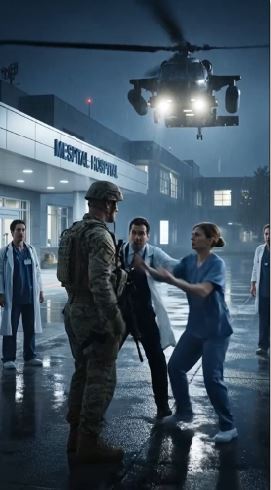
The rain outside Saint Helena Hospital was relentless, a cold, heavy downpour that seemed to wash away the color of the city. Inside, the atmosphere was no warmer.
Nurse Avery Brooks clocked out, her movements heavy with a bone-deep exhaustion that had nothing to do with the twelve-hour shift. She pulled her cheap, worn jacket tighter around her frame, shrinking into herself.
“Leaving already, Brooks?”
The voice was a sneer, familiar and unwelcome. A colleague, standing near the nurses’ station, snickered dismissively. “Just a mediocre nurse, as always. Zero initiative.”
Avery didn’t respond. She was accustomed to the contempt; she wore it like armor. It was the camouflage that masked her true identity.
Suddenly, the silence of the rainy night was shattered.
A thunderous, rhythmic thrumming vibrated through the glass doors, growing louder by the second until it rattled the teeth of everyone in the lobby. A blinding spotlight cut through the gloom, and a sixty-foot Black Hawk helicopter slammed down onto the pavement right in front of the emergency entrance, its rotors tearing at the air.
Dust, water, and debris swirled in a chaotic vortex. Pedestrians screamed and scattered. Vehicles screeched to a halt. It was a scene of total, military-grade disorder imposed upon a quiet civilian night.
Before the landing gear even settled, the side doors flew open. Special Forces soldiers—SEALs—jumped out, weapons lowered but posture ready, their movements focused and deadly.
One of them, a giant of a man built like a brick wall, sprinted toward the automatic doors. He was yelling into a tactical headset, his voice raw with urgency.
“We are looking for Lieutenant Commander Avery Brooks! Answer me! This is a medical emergency, we have no time!”
The tired nurse by the door stood frozen. Lieutenant Commander. It was her forgotten rank. The name of a hero she had tried to bury deep beneath the earth.
Avery Brooks was twenty-nine, known at St. Helena as an emergency room nurse with a gentle, soft-spoken demeanor. She deliberately kept a low profile, standing back from the spotlight. This quietness was misinterpreted as weakness or inexperience by colleagues who craved drama and recognition.
But her history was a ghost she tried to outrun.
She had been a U.S. Navy Combat Medic, serving as the indispensable medical expert for a high-tier support unit known as ‘Raven Seven.’ Her confidence was legendary, her decision-making split-second and flawless. But the legend ended in a disastrous, high-profile extraction mission in Kandahar two years prior.
Avery had managed to save her commanding officer, Captain Mason Hale, but a bureaucratic blunder—a failure to authorize critical air support due to delayed code clearance—resulted in the loss of three of her closest teammates. That loss, that systemic betrayal, broke her.
She saw the military system as tragically flawed—a machine designed to save itself, not its people. She requested an honorable discharge, sought the anonymity of a major metropolitan hospital, and deliberately falsified her civilian file to read only “Registered Nurse Trainee.” This understatement was her shield, meant to keep her far from high-stakes decision-making and the risk of catastrophic failure.
The deception worked too well.
Her colleagues, led by the arrogant Chief Resident, Dr. Miles, habitually dismissed her.
“The new nurse knows nothing about high-stakes trauma,” Miles would often say, loudly enough for her to hear. “She’s always so quiet. Zero initiative. You need loud confidence in the ER, not silent study.”
They valued visible swagger over quiet, relentless preparation. Yet, Avery’s actions consistently contradicted their scorn. She was always the first to comfort a crying child, the one who patiently cleaned and dressed the neglected wounds of difficult patients. She had an uncanny ability to spot distress before the monitors did—a skill honed by years of reading nonverbal cues in combat zones.
Just that evening, Dr. Miles had criticized her “slow processing time” during a routine check. Moments later, that same patient went into severe, rapidly progressing anaphylactic shock. While Dr. Miles fumbled with his prescription pad, paralyzed by the sudden shift, Avery calmly grabbed the epinephrine pen, confirmed the dosage, delivered the shot in the correct quadrant, and managed the airway—all within the critical sixty-second window.
She saved the patient. But the reaction from Miles was chilling.
“Lucky guess, Brooks,” he had snapped, his face contorted by suppressed panic and envy. “You got extremely lucky. But next time, you wait for a physician’s explicit order.”
She didn’t argue. She simply whispered, “I apologize, Doctor.”
It only reinforced their belief that she was meek. But every night, Avery lingered in the staff lounge, pulling a worn canvas backpack onto her lap. Inside were military field manuals: Advanced Combat Trauma, Austere Surgery Techniques, and High-Pressure Wound Management. She studied them not to practice for the ER, but to maintain the quiet, razor-sharp edge that civilian life threatened to dull. She knew that edge was the only thing that kept the nightmares at bay.
Now, standing in the harsh glare of the helicopter spotlight, the nightmares had found her.
The hospital’s security guard, a man named Ted who had often seen Avery cleaning up late, pointed a trembling finger at the small figure standing in the doorway.
“That’s her,” Ted stammered. “She just finished her shift. But… she’s just a nurse.”

The entire SEAL team—a group of silent, intense operators—instantly turned their attention to Avery. Their eyes swept over her exhausted face, her cheap jacket, and her worn shoes.
Then, a collective shift happened. Their guarded, professional intensity dissolved into profound, almost ceremonial respect. This wasn’t a search; it was a recovery.
The lead officer, a man named Miller, strode purposefully toward her. He stopped exactly three feet away and clicked his heels together in perfect, rigid attention.
“Ma’am,” Miller said, his voice cutting through the rain. “Our team needs you. We have a Code Zero critical casualty.”
Avery stepped backward, her civilian facade cracking. Panic warred with confusion in her eyes. “Sir… you—you have the wrong person. I’m just Avery Brooks. I’m a nurse here.”
“We are not mistaken, Lieutenant Commander,” Miller replied firmly. “Captain Mason Hale is dying. And he specifically requested you.”
The name was a thunderclap.
Mason. The Captain. The man she had pulled from the flaming wreckage in Kandahar. The only one who knew the full, terrible extent of her training and the pain she carried.
Miller, seeing her distress, lowered his voice to a desperate rasp. “He sustained massive internal trauma from an IED blast. His pressure is plummeting. The base physician cannot locate the bleed source—it’s too complex. A crush injury to the thoracic wall coupled with a specific deep laceration to the intercostal artery.”
“Why me?” she pleaded, the fear of returning to that life clutching at her throat. “You have military surgeons. They have better equipment.”
“Because, Ma’am,” the SEAL replied, his eyes pleading. “He said two things. First: ‘She thinks faster than a scalpel.’ And second: ‘Only she knows where my other scar is.’ He says the new trauma is adjacent to an old wound. Only you touched the one near the fifth rib lateral margin. He said it needs the ‘Brooks Touch.’”
Avery felt a cold dread wash over her. It was true. Years ago, under heavy fire, she had performed an emergency thoracic patch on Hale—a procedure so precise and unconventional that only she would know the exact anatomical coordinates of the compromised tissue.
Mason was staking his life on her unique, dangerous knowledge.
From the emergency room entrance, Dr. Miles and two other nurses appeared, drawn by the commotion. Miles saw the scene—the soldiers, the helicopter, the spotlight—and his jaw dropped. But his arrogance immediately resurfaced. He saw a chance to assert his fading authority.
He shouted over the rotor blades, stepping forward with his chest puffed out. “Soldiers! You have the wrong woman! She’s a mediocre civilian nurse. You need a real doctor. Her certification is limited—this institution disavows any claims of her surgical ability!”
Lead SEAL Miller spun around. His movement was not panicked; it was fueled by controlled fury. His uniform was spotless, his presence dominating. He was the perfect, deadly opposite to Dr. Miles’s bluster.
“Doctor,” Miller stated, the title dripping with scorn. “This woman, Lieutenant Commander Brooks, is responsible for pioneering the current Navy triage protocol used by every Special Operations team worldwide. She saved an entire Raven Seven detachment in a full-scale ambush while simultaneously evacuating casualties. She operates outside your certification because her skill transcends your entire institution.”
Miller stepped closer, looming over the doctor. “Now, which one of you has the audacity to stand in the way of a Priority One medical extraction requested by a decorated Captain?”
The hospital staff froze, utterly silenced. Dr. Miles, his face turning ash-gray, swallowed his words. The truth—the real rank, the real history, the real competence—had been laid bare by a soldier who treated Avery as nobility.
Avery looked at the helicopter. Then she looked back at the hospital, the place where her competence had been mocked, where she was made to feel small. She looked at her trembling hands—the hands that had shaken in Kandahar.
She had run from this life once. But Mason hadn’t run from her.
She took one deep, ragged breath. The civilian panic finally yielded to the cold, professional calm she had cultivated in the desert.
“All right,” she stated, her voice suddenly strong, resonant, the years of meekness melting away. “Get me on the comms. I need a clean feed of his vitals, and I need to know the atmospheric pressure at the insertion point. I’m coming.”
She gave a quick, final tug to the fabric patch hidden in her pocket—a silent commitment to her lost team. I won’t leave anyone behind again.
The Black Hawk executed an aggressive vertical climb, the violence of the ascent confirming the gravity of the mission. Pinned back in her seat, Avery’s mind was already at the Forward Operating Base (FOB).
Miller handed her a field surgical headlamp. “Fourteen minutes to the FOB, Ma’am. The mission is called Operation Red Hand. We are severely undermanned and under-equipped. Hale is the lynchpin.”
Avery didn’t waste time on pleasantries. She was inside the zone, inspecting the field surgical pack with the hyper-focus of a diamond cutter.
“I need a high-flow fluid warming system,” she barked, her voice clear over the headset. “If you don’t have one, I need two medics on standby to manually pump warm saline. I’ll need a chest retractor—not a civilian version, the compact military-grade one. Give me a clean surface and keep the rotor wash minimal for five feet around the triage zone.”
Miller, now fully respectful, relayed the precise orders to the pilot. He watched her, recognizing the transformation. The “mediocre nurse” was gone. In her place sat a commander who could perform complex surgery based entirely on memory and touch.
The Black Hawk landed hard at the temporary desert landing zone. The air was thick with the acrid smell of burnt earth and jet fuel. Smoke billowed from a nearby mortar impact site. Over twenty heavily armored SEALs rushed to meet them, their faces etched with desperation.
“She’s here! Brooks is here! Clear the zone!”
As Avery stepped down, the soldiers parted, forming an immaculate, respectful pathway—a spontaneous gesture reserved for high-ranking officers or indispensable assets.
Mason Hale lay on a metal stretcher, strapped down. His face was ghostly white, his breath shallow and sporadic. His eyes were barely open, but they held a spark of desperate relief when he saw her.
“Avery…” he wheezed. “I knew… you’d think outside the box. I am the box now.”
“Mason,” she said, kneeling instantly, her hands already running an assessment pulse and checking the trauma profile.
A towering military trauma physician, Major Davies, rushed forward. He was the base’s primary surgeon, and his face was flushed with professional outrage and the embarrassment of his own failure.
“I am the Trauma Lead!” Davies shouted. “You are civilian personnel! You do not have the clearance to operate on a senior officer!”
Avery didn’t even look at him. Her hands were already on Mason’s chest, applying precisely calibrated pressure. Her voice, ice-cold and utterly decisive, cut through the Major’s bluster like a scalpel.
“Major, I was specifically requested. He is compromised at the fifth rib lateral margin. The internal hemorrhage is occult, adjacent to a fibrous scar. If you attempt a traditional surgical opening, you will cause uncontrollable systemic exsanguination. You lack the necessary intel. Stay back.”
The Major froze. The specificity of her knowledge—the exact location and complication—was an impossible detail for an outsider to know. She was reading the patient’s body like a map she had personally drawn.
Avery started working.
It was a ballet of emergency medicine. She identified the exact point of the bleeding using only palpation, instructing the base medics where to apply localized pressure. She prepared the thoracotomy setup and controlled the hemorrhage using an advanced technique she had personally developed in the field—a procedure designed to repair complex trauma with minimal tissue disruption.
Every movement was economical. Every order was crisp.
A seasoned SEAL medic watching her work muttered, “She’s faster than any trauma surgeon I’ve ever seen. Look at her control. She’s anticipating two steps ahead.”
In a terrifying, concentrated seven minutes and forty seconds, Mason’s vitals stabilized. His breathing deepened. His pulse returned to a manageable rate.
She had pulled him back from the precipice, not with luck or heavy machinery, but with sheer, undeniable surgical competence.
Just as Avery finished securing the dressing, Colonel Reynolds, the FOB Commander, approached her. He had been observing the entire scene. His expression was a mixture of profound relief and dawning recognition.
“Lieutenant Commander Brooks,” he said, his voice rough with emotion. “I know you. I was the communications officer during the Kandahar incident. I saw the aftermath. You are the sole survivor of Rescue Nine.”
A silence descended on the field. Rescue Nine. The unit whose demise was classified. The one the Navy had written off.
Avery stood up, her face streaked with blood and sweat. She looked the Colonel directly in the eye, her gaze holding all the pain and pride of her past.
“I only do what I must, Sir.”
The Colonel, overcome by the weight of her past sacrifice and present confidence, turned to the dozens of soldiers gathered. His voice rang out across the base.
“All Navy SEALs and Combat Support! Attention! Present arms! Salute Lieutenant Commander Brooks! This is the standard of care we live and die by!”
Dozens of elite soldiers snapped into a perfect, simultaneous salute. The sound of their boots clicking together was a thunderclap of reverence, acknowledging the authority of skill over rank.
Avery’s eyes welled up—not with pride, but with the heavy sorrow of being recognized for a life she had paid dearly to leave behind. She returned the salute with a perfect military precision she hadn’t used in two years. The vindication was absolute.
The news reached Saint Helena Hospital within the hour. The incident was too spectacular, the Black Hawk too audacious, and the sight of a SEAL team publicly saluting a civilian nurse too viral to be contained.
The staff lounge buzzed with horrified whispers.
“Lieutenant Commander? She was a middle-rank naval officer? She was the sole survivor of a classified team… and we told her to mop the floors?”
The collective realization of how profoundly they had misjudged her was a crushing blow to the hospital’s carefully manicured ego. The Hospital Director was left utterly speechless, frantically reviewing the disciplinary reports signed by Dr. Miles. He watched a news report showing Colonel Reynolds publicly thanking a “decorated combat medic” and criticizing the “civilian bureaucracy that nearly allowed one of our greatest assets to be discarded.”
The man he had allowed Dr. Miles to humiliate was now the epicenter of a national incident.
The following day, the truth was formalized.
The Black Hawk returned. This time, it landed on the hospital’s designated helipad. The roar was less frantic, but the purpose was absolute.
SEAL Team members, led by Captain Hale—now mobile and stable—marched into the main lobby. They were not there for treatment. They were there for a statement.
“Where is Lieutenant Commander Brooks?” Hale demanded, his voice projecting the authority of a senior officer. “We are here to thank her formally. And to ensure this institution understands the error of its judgment.”
The staff members who had mocked her, including Dr. Miles—who was now attempting to hide in a supply closet—were forced to witness the scene. They shuffled their feet, looking down in shame. Last night they had called her mediocre. Today, giants walked in her shadow.
When Avery finally arrived to finalize her exit paperwork, she walked through the main doors in a simple civilian outfit. The moment she appeared, Captain Hale and the entire SEAL team snapped to attention, executing a crisp, flawless salute right there in the civilian lobby.
The public and the assembled media snapped pictures. Avery flushed, overwhelmed by the display.
A young resident physician, Dr. Evans, who had quietly admired her from afar, stepped forward. His eyes were genuinely tearful. He bowed his head.
“Ma’am… I speak for the good people here. I apologize for our blindness. We mistook your quiet professionalism for inexperience. We let our ego drive policy.”
Avery looked at him, her eyes soft, conveying no bitterness.
“Your apology is accepted, Doctor. But please, don’t apologize to me. Just stop mistaking arrogance for confidence. Never dismiss a patient’s silent need because it doesn’t fit your preferred protocol. The greatest risk is always hesitation.”
She didn’t stay long. She signed her exit papers and left Saint Helena for the last time. As she walked out, the SEAL team formed a silent, disciplined honor guard, escorting her to the military vehicle.
The hospital staff watched, realizing they hadn’t just lost a nurse; they had publicly betrayed a hero.
One week later, a formal invitation arrived from the Department of the Navy, bypassing all normal bureaucratic channels. Avery Brooks was invited to return to service with an immediate promotion to Commander, to serve as the Chief Architect and Director for Advanced Field Medical Doctrine.
It was a role created for her—a mandate to rewrite the rules she had been forced to break.
Avery stood on the expansive airport tarmac of a major military base, the afternoon sun casting a calm, golden light on her face. She was dressed in her formal Navy uniform, the insignia of Commander gleaming.
Mason Hale stood waiting near a new, gleaming medical Black Hawk.
“Welcome home, Commander,” he said softly. “Thank you again. You gave me back my life. Twice.”
Avery smiled, a genuine, easy smile that had been absent for two years. “I just did what I always do, Mason. I refused to leave a man behind.”
Under her guidance, the military overhauled their combat medicine curriculum. They established a new, highly advanced training program for Special Operations Medics, dedicated to making split-second decisions. The syllabus was named The Brooks Protocol.
During her inaugural address to the first class of new medics, a young recruit raised his hand.
“Ma’am, what is the most important rule in saving a life? Is it the technique, or the training?”
Avery looked at the eager young face.
“It is neither,” she replied. “It is the conviction. Respect the life, not your ego. Confidence is silent, but saving a life is the loudest statement you can make. Never hesitate because of fear of failure. Hesitation is the only true failure.”
As the sun dipped below the horizon, Commander Avery Brooks looked up at the sky, toward the place where her three teammates had been lost forever. She whispered a promise to the wind.
“I’m back. We teach the lesson now. The dead command the living.”
The life she had tried to bury became the extraordinary legacy she chose to build. Avery Brooks went from a forgotten nurse to a national hero, not by changing who she was, but by forcing the world to acknowledge her true self.