
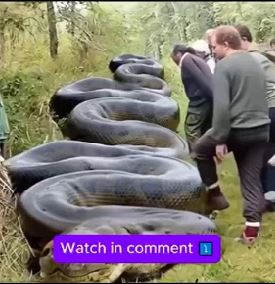
The wilderness has an undeniable ability to astonish us, offering unpredictable encounters, particularly along hiking trails where wildlife flourishes undisturbed. One such remarkable incident took place at Jeffries Creek Park in Florence, South Carolina. Here, hiker Meredith Langley had a breathtaking encounter with what she described as a massive snake, seamlessly camouflaged within its vibrant natural habitat. This unexpected sighting not only captivated the attention of online communities but also ignited conversations about the importance of trail safety, wildlife awareness, and the sheer beauty of observing animals in their natural environments.
The Unexpected Discovery by the Creek
During a recent family outing, Langley and her children stumbled upon something peculiar near the creekside. Initially, the creature appeared to be just another element of the forest floor, perfectly blending in with the fallen leaves and the damp earth beneath their feet. Upon closer inspection, it was revealed to be a substantial brown water snake stretched across the trail. Excited by the encounter, Langley shared her experience on social media with a local hiking group, emphasizing how the snake’s natural camouflage allowed it to merge so effortlessly into its surroundings.

[the_ad id=”12986″]
This experience became more than just an unexpected encounter; it transformed into a
teaching moment for Langley and her children about the importance of respecting wildlife and adhering to proper trail etiquette. In her social media post, she shared, “It was a good teaching opportunity and example for my own children who forget not to overtake on the trails!” This statement underlined the educational aspect of their outing, highlighting how nature can serve as an incredible classroom.
Expert Insights on the Serpent
As the images of the serpent circulated across various platforms, wildlife specialist Greg Lucas from the South Carolina Department of Natural Resources (SCDNR) stepped in to clarify the situation. He identified the creature as a non-venomous brown water snake, belonging to the genus Nerodia. According to Lucas, these water snakes are often mistaken for their venomous counterparts due to their thick, muscular bodies and intimidating appearance. However, despite their formidable look, they do not pose any venomous threat to humans.

[the_ad id=”12986″]
Lucas elaborated that brown water snakes typically measure between 30 and 60 inches in length, with Langley’s encounter likely featuring a specimen close to four feet long when fully extended. This dimension adds to the perception of the snake’s enormity, particularly when considering its robust build. Brown water snakes are notably heavy-bodied, making them appear larger compared to other snake species. When motionless, their rich brown coloration and earthy patterns enable them to blend almost invisibly into the creek banks, logs, and surrounding foliage. This natural camouflage is vital for their survival, allowing them to evade predators and startle unsuspecting hikers who may come too close.
Diverse Serpent Species of South Carolina
South Carolina hosts an extensive variety of snake species. Among these are harmless water snakes like the one discovered at Jeffries Creek and potentially dangerous species such as water moccasins, also known as cottonmouths. Langley pointed out that the vicinity is home to both categories of snakes, emphasizing the necessity for caution when hiking in areas adjacent to creeks, swamps, or wetlands. It is crucial to be able to distinguish between the species, especially since brown water snakes, while non-venomous, will defend themselves aggressively if threatened. Conversely, water moccasins can inflict severe bites that require immediate medical attention.

[the_ad id=”12986″]