
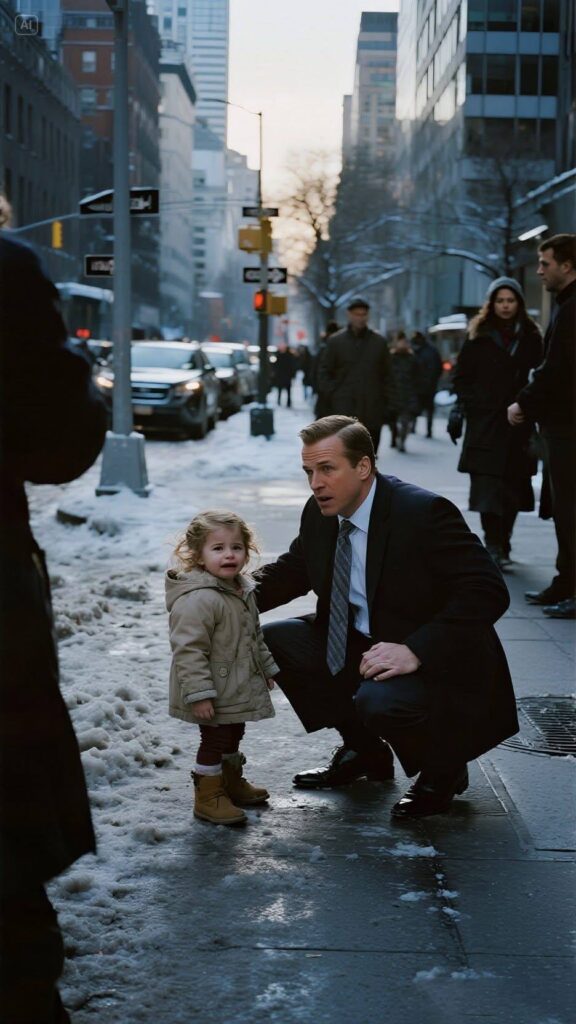
The snow fell on Fifth Avenue with the hush of a secret being kept.
My name is Jonathan Blake. At thirty-seven, I had become a man defined by the skyline I helped shape. I dealt in steel, glass, and air rights. My life was a series of acquisitions and mergers, measured in square footage and net yields. Standing outside the board room that evening, pulling my cashmere coat tighter against the biting wind, I was a king in a kingdom of cold surfaces.
I had just closed a deal that would redefine the Midtown skyline, a victory that should have tasted like champagne. Instead, it tasted like ash. Success had come early for me, but it had arrived with a bill I was only just beginning to realize I couldn’t pay. I was surrounded by people, yet I had never been more alone.
I reached for my phone to summon my driver, the screen illuminating the snowflakes that landed on the black glass. That was when I heard it. A sound so small it was almost swallowed by the city’s roar.
“Excuse me, sir?”
I looked down.
Standing on the sidewalk, obstructing the path of a man who stopped for no one, was a child. She couldn’t have been more than four years old. Reddish-blonde curls escaped from a knit cap that had been washed one too many times. Her cheeks were wind-burned, pink contrasting with the pale anxiety in her face. She wore a puffy beige coat that was visibly second-hand, and boots that looked two sizes too big for her feet.
But it was her eyes—wide, blue, and terrified—that stopped me cold.
“Are you lost, sweetheart?” I asked. I surprised myself by crouching down, ignoring the damp slush seeping into the knees of my tailored trousers.
The little girl shook her head slowly. Her lower lip trembled, a tiny fault line in her bravery. “I can’t wake up my mom.”
The words hit me with the force of a physical blow. The city noise seemed to drop away.
“What do you mean you can’t wake her up?” I asked, keeping my voice steady. “Where is she?”
“At home,” she whispered. “I tried and tried. She’s on the floor by the couch. She won’t open her eyes.” Tears began to track hot paths down her cold cheeks. “I got scared. Mommy said if there’s ever an emergency, go find help. So… I walked. But everyone keeps walking past me.”
My mind, usually reserved for calculating risk ratios and leverage, shifted gears instantly.
“What is your name?”
“Sophia,” she hiccupped. “Sophia Martinez.”
“Okay, Sophia. I’m Jonathan.” I held out a gloved hand. “Can you take me to your mom?”
She nodded and reached out. When her small, mitten-clad hand grasped mine, I felt a sudden, fierce tightening in my chest. It was a trust I hadn’t earned, a trust that terrified me more than any board of directors ever could.
“Lead the way,” I said.
And just like that, I walked away from my empire and followed a four-year-old into the storm.
The Descent
Sophia led me away from the glittering storefronts of Fifth Avenue. We walked for blocks, the neighborhood changing around us like a scene fading in a film. The doormen and marble lobbies gave way to cracked sidewalks and buildings with peeling paint. The air here smelled different—less like exhaust and expensive perfume, more like old brick and impending snow.
We stopped in front of a narrow brownstone that looked weary, its stoop sagging under the weight of years. Sophia pulled a key on a shoelace from inside her coat. Her fingers were clumsy with cold.
“Let me help,” I said gently.
I unlocked the door, and we climbed two flights of stairs. The hallway smelled of boiled cabbage and floor wax. The wallpaper was peeling in strips, revealing the plaster beneath like old wounds.
“It’s here,” Sophia said, pushing open a door.
The apartment was tiny—maybe five hundred square feet—but it was aggressively clean. That was the first thing I noticed. The second was the love. It was plastered on the walls in the form of children’s drawings held up by colorful tape. A small, sad Christmas tree sat in the corner, adorned with handmade paper ornaments.
And there, just as Sophia had said, was a woman.
She lay motionless on the rug beside a worn beige sofa.
I rushed to her side, stripping off my gloves. “Ma’am? Can you hear me?”
No response.
I pressed two fingers to her neck. Her pulse was there, but it was thready, fluttering like a trapped bird. She was young, perhaps thirty, with light brown hair braided back. Even in her unconscious state, exhaustion was etched into her features—dark circles bruising the skin under her eyes, her cheeks gaunt.
I touched her forehead. She was burning up.
“Sophia,” I said, my voice sharp with urgency. “I need to call for help.”
“Okay,” she whispered, standing by the door, clutching her backpack straps.
I dialed 911. As I barked the address to the dispatcher, my eyes scanned the room for clues. On the small kitchen table, a stack of envelopes sat ominously—medical bills, all stamped PAST DUE in angry red ink. On the counter, an empty prescription bottle. And on the wall, a calendar.
I stepped closer. The calendar was a grid of endurance. Every single day was marked with shift times. 7a-7p. Night Shift. Double. The handwriting was precise, careful.
The paramedics arrived in six minutes. It felt like six hours.
I stood back, holding Sophia as she buried her face in the wool of my coat. She was trembling, silent tears soaking into the fabric. I rubbed her back, whispering nonsense meant to soothe myself as much as her.
“Diabetic shock,” the lead paramedic announced, checking the woman’s vitals. “Looks like she’s been sick—maybe the flu—and couldn’t keep her food or meds down. Her blood sugar bottomed out.”
He looked at me. “Are you the father?”
“No,” I said. The word tasted strange. “I… her daughter found me on the street.”
The paramedic paused, looking from the small girl to me in my suit, then back to the unconscious woman. He nodded, understanding the gravity without needing the details. “She’s lucky. Another hour, and she wouldn’t have made it.”
They loaded Rebecca Martinez—I saw the name on the prescription bottle—onto the stretcher.
“We’re taking her to St. Mary’s,” the paramedic said.
“I’ll follow you,” I said. I looked down at Sophia. “We’ll follow you.”
The Waiting Room
The emergency room waiting area was a purgatory of fluorescent lights and plastic chairs. I sat there for hours, Sophia asleep on my lap, her small hand gripping my thumb like a lifeline.
A nurse had given her juice and crackers earlier, which she had eaten with a mechanical hunger that broke my heart. Now, she was just a heavy, warm weight against my chest.
“Do you have family, Sophia?” I had asked her before she drifted off. “Grandma? Grandpa?”
She had shaken her head against my lapel. “Just Mommy. Daddy went away before I was born. Mommy says he wasn’t ready.”
I felt a fissure open in my chest. This child was entirely alone in the world, save for the woman fighting for her life behind those swinging doors.
Around midnight, a woman with a clipboard and tired eyes approached.
“Mr. Blake?”
“Yes.”
“I’m Mrs. Patterson, Social Services. The hospital staff told me how you came to be here.” She looked at Sophia, sleeping soundly. “We need to discuss placement.”
“Placement?”
“Rebecca is stable, but she’s going to be in the ICU for at least a few days. She’s severely malnourished and her system has crashed. Since there is no other family on record…” She took a breath. “I need to place Sophia in emergency foster care tonight.”
“No.”
The word came out of me before I had processed it. It was the same tone I used when killing a bad merger. definitive. Final.
Mrs. Patterson blinked. “Excuse me?”
“You are not putting this child in the system,” I said, keeping my voice low so as not to wake her. “She walked into a snowstorm to save her mother. She is traumatized. You are not handing her off to strangers.”
“Mr. Blake, I appreciate your kindness, but you are a stranger. There are protocols.”
“I have lawyers who eat protocols for breakfast,” I said, the steel of my profession sliding into my voice. “I am the only person she trusts right now. She feels safe with me. I have a penthouse ten minutes from here. I have resources. I will hire a private nanny for the daytime if needed. But she is coming with me until her mother wakes up.”
The social worker studied me. She looked at my coat, my watch, and then at the way my hand was protectively cupping the child’s head.
“It is highly irregular,” she sighed.
“It’s necessary,” I countered. “Check my background. Call my firm. I’m not going anywhere.”
It took two hours, three phone calls to my legal team, and a lot of flexing of influence I usually reserved for zoning permits. But by 2:00 AM, I was walking out of the hospital with a temporary guardianship paper in my pocket and a sleeping four-year-old in my arms.
The Nest
My apartment was a masterpiece of modern design. Floor-to-ceiling windows overlooking the park. Italian marble floors. Art that cost more than most houses.
It had never felt so cold.
Sophia stood in the center of the living room, her backpack still on, looking at the vaulted ceilings. She looked like an astronaut on a hostile planet.
“Are you hungry?” I asked, realizing with a jolt of panic that I had no idea what children ate. My fridge contained a bottle of vintage champagne, takeout containers of Thai food, and sparkling water.
She shook her head. “I’m sleepy. But… I don’t have my bed.”
“Right.”
I led her to the guest room. It was stark white and grey. The bed was a California King, massive and imposing. Sophia looked at it, then at me, her eyes welling up.
“It’s too big,” she whispered. “I’ll get lost.”
I looked at the bed. She was right. It was ridiculous.
“Okay,” I said. “New plan.”
I went to the linen closet and pulled out every duvet, pillow, and throw blanket I owned. I brought them back to the guest room and dumped them on the floor.
“We build a nest,” I announced.
For the first time that night, a tiny ghost of a smile touched her lips. We arranged the blankets into a circle, piling pillows high to create walls. It was soft, contained, and safe.
Sophia crawled into the center. “Mr. Jonathan?”
“Just Jonathan.”
“Jonathan… will you stay? Until I fall asleep? I get scared in new places.”
I hesitated. I had a conference call at 7:00 AM with Tokyo. I had emails to answer.
“Of course,” I said.
I sat on the floor, my back against the designer wallpaper, my legs crossed. Sophia reached out and took my hand.
“My mommy sings to me,” she said drowsily. “But you probably don’t know the songs.”
I felt a lump form in my throat. My own mother had sung to me. She had been a single mother too, working herself to the bone in a small apartment in Queens, singing to me to drown out the sound of the neighbors fighting. She had died ten years ago, cancer taking her before I could buy her the house I had promised.
“I might know one,” I said.
And there, in the dark of my multi-million dollar apartment, I began to hum. A lullaby I hadn’t thought of in decades. The melody cracked a little, rusty from disuse, but Sophia didn’t mind. Her breathing evened out. Her grip on my hand relaxed.
I watched her sleep, and I felt the walls of my carefully constructed life begin to tremble. I had spent years building a fortress to keep the world out, to keep the pain of my mother’s death at bay. And it had taken one little girl with too-big boots to breach the perimeter.
The Proposition
The next five days were a blur of dissonance.
I cleared my schedule. My assistant thought I had lost my mind. I took Sophia shopping. I learned that “sparkly” is a color. I learned that cutting sandwiches into triangles makes them taste better. I learned that a four-year-old’s laughter is the most expensive sound in the world.
We visited Rebecca every day. Slowly, the color returned to her face. She was awake, though weak.
During those visits, while Sophia drew pictures on the hospital tray, Rebecca told me her story. It was a story I knew well. The father who left. The nursing school she dropped out of to pay rent. The double shifts. The rationing of insulin to afford Sophia’s shoes.
“I try so hard,” she told me on the fourth day, tears sliding down her face. “I want to give her the world. Dance classes. Books. A safe place. But I’m drowning, Jonathan. I’m just drowning.”
“I know,” I said. And I did. I saw my mother in her. I saw the ghost of the woman who had died worrying about electricity bills.
On the fifth day, Rebecca was discharged.
I drove them to the brownstone to pick up their things. But I didn’t leave.
“I have a proposition,” I said, standing in her tiny, clean kitchen. “And I need you to listen before you say no.”
Rebecca looked wary. She was a woman used to the world taking, not giving. “Jonathan, you’ve done enough. You paid the hospital bill. You watched Sophia. I can’t repay you.”
“I don’t want repayment,” I said. “I have a building in Brooklyn. Park Slope. It’s a good neighborhood. Good schools. I have a three-bedroom unit there that’s sitting empty. I want you and Sophia to live there.”
“I can’t afford Park Slope,” she said, shaking her head.
“No rent,” I said. “And… I need a property manager. Someone to handle tenant relations, coordinate maintenance. It’s a job you can do largely from home. It pays a salary that means you work one job, not three. Full benefits.”
Rebecca stared at me. “Why? Why are you doing this?”
“Because Sophia saved your life,” I said. “But I think… I think maybe she saved mine, too.”
I looked at the little girl in the living room, packing her toys into a box.
“I’ve spent ten years making money and forgetting how to be a person,” I admitted, my voice rough. “These last five days… making dinosaur nuggets, reading bedtime stories… it woke me up. I’m not offering charity, Rebecca. I’m offering a correction. You are working yourself to death, just like my mother did. I couldn’t save her. But I can help you.”
“I can’t just take it,” she whispered.
“Then earn it,” I said. “Pay a reduced rent if it makes you feel better. Do a great job managing the building. But let me do this. Let me be part of your lives. Not as a savior. Just… as family. The kind you choose.”
Rebecca looked at me, searching for the catch. Finding none, her face crumpled. She reached out, and I took her hand.
“Okay,” she sobbed. “Okay. But you have to come to dinner. Once a week. Real food. Not Thai takeout.”
“Deal,” I said. “And fair warning… Sophia says I have to come to her dance recital next month.”
Rebecca laughed through her tears. “Well, she’s the boss.”
The Recital
Three months later, the snow was gone, replaced by the tentative green of spring.
I sat on a metal folding chair in an elementary school gymnasium that smelled of floor wax and sweat. My phone buzzed in my pocket. It was an email about a twenty-million-dollar acquisition in Chicago.
I looked at the screen. Then I looked at the stage.
A group of four-year-olds in sparkly blue tutus stumbled onto the stage. They were chaotic, out of step, and absolutely perfect. In the center, Sophia spotted me. Her face lit up like a supernova. She waved frantically, breaking character.
I waved back, a grin splitting my face.
Beside me, Rebecca squeezed my arm. She looked healthy now. Radiant. The shadows under her eyes were gone.
“Thank you,” she whispered. “For being here.”
“I wouldn’t be anywhere else.”
I took my phone out of my pocket and turned it off. The deal in Chicago could wait. The skyline would still be there tomorrow.
But this? This was fleeting.
As Sophia spun in the wrong direction and crashed into another dancer, giggling, I felt a sense of peace settle over me—a warmth that no cashmere coat could ever provide.
Later, as I drove them home to the apartment in Brooklyn, snow began to fall again—a late spring flurry, soft and quiet.
“It’s like that night,” Sophia said from the backseat, pressing her nose against the glass. “The night I found you, Jonathan.”
I looked at Rebecca in the rearview mirror. She smiled at me, a look of profound understanding.
“No, sweetheart,” I said softly. “That was the night you both found me.”
I turned the car onto the street lined with brownstones, heading toward a home that finally felt like one. I realized then that for all my millions, for all my empire of glass and steel, I had been a pauper my whole life.
Until now.
Now, finally, I was a rich man.