
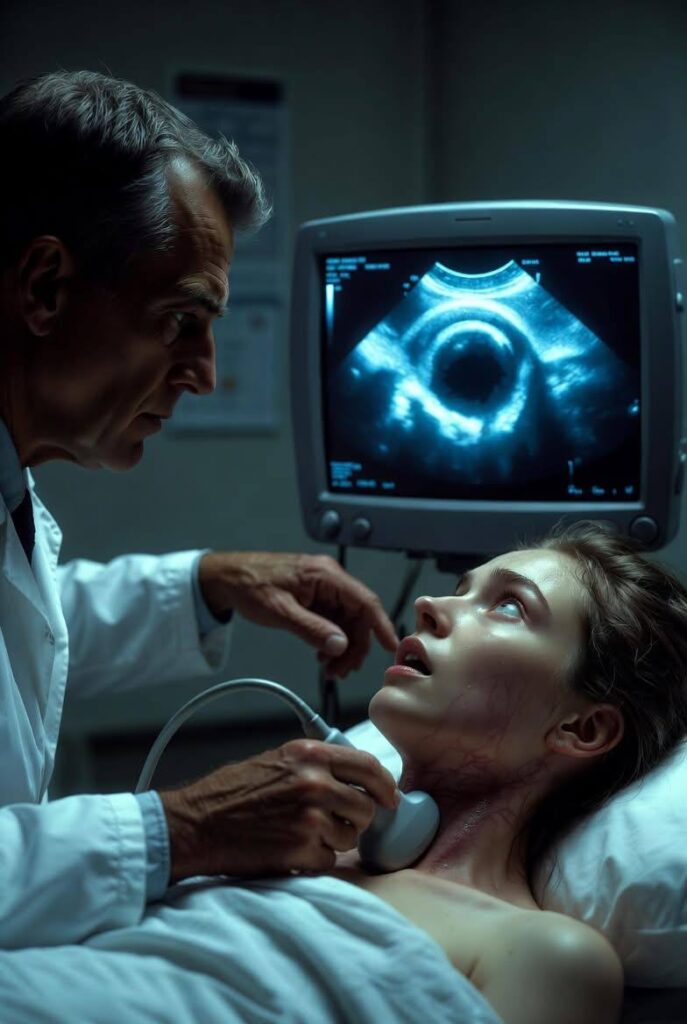
I didn’t expect my entire life to shift in the span of a single breath, but that’s exactly what happened the moment Dr. Nathan Keller looked at my ultrasound screen and went completely, terrifyingly still.
His office smelled of industrial disinfectant and burnt coffee—the kind that sits too long in those metal pots until it becomes sludge. The low hum of the fluorescent lights buzzed against my eardrums, making the sterile room feel even colder. I sat on the edge of the paper-covered exam table, my Marine Corps service boots polished to a mirror shine, my collar straight. No matter how sick I felt inside, I couldn’t shake the discipline drilled into me since boot camp. Posture is armor.
Dr. Keller wasn’t the excitable type. He had the weathered calm of a man who had stitched up soldiers and delivered bad news for decades. But that day, he frowned so deeply I saw the lines carve into his forehead like canyons.
“Who treated you before this?” he asked quietly, not looking away from the screen.
“My father,” I said, the words tasting strange in my mouth. “He’s a doctor.”
He didn’t nod. He didn’t respond. He just went silent in a way that sucked the air out of the room until he finally muttered, “We need to run some tests right away. What I’m seeing shouldn’t be there.”
That was the moment I realized something was terribly wrong. That was the moment the ground beneath my feet turned to quicksand.
People assume Marines are fearless. They think we walk through life without second-guessing anything, immune to the tremors of doubt. But the truth is, fear hits us the same as anybody else. It just tends to arrive in the quiet moments, not the battlefield. It hits you when you’re staring at a grainy grey image on a monitor, feeling the cold ultrasound gel drying on your neck, realizing that the man you trusted most in this world—the man who taught you to ride a bike and bandage a scrape—might have been hiding the truth from you for years.
I had gone in for a simple thyroid check. That was all it was supposed to be. I’d been tired for months—bone tired, the kind of exhaustion that caffeine can’t touch and sleep can’t fix. My hands trembled sometimes, subtle tremors that made holding a rifle steady a conscious effort. My heart would skip weird little beats, fluttering like a trapped bird against my ribs.
I chalked it up to deployment stress, long hours, maybe age finally catching up to me. Thirty-one isn’t old by anyone’s standards, but the military ages your body in dog years. Still, something about this fatigue felt different. Deep. Wrong. Almost hollow.
My father, Dr. Robert Whitman, had been my doctor practically my whole life. He brushed it off every time we talked.
“Just overworked, Sarah,” he’d say, his voice thick with paternal reassurance. “Your labs are fine. Every Marine hits this wall eventually.”
He always sounded confident. Too confident.
But when my schedule finally aligned, I decided to get a second opinion at the base-affiliated clinic near Dayton. Nothing dramatic, just routine diligence. I didn’t expect trouble. I didn’t expect Dr. Keller to freeze like he’d seen a ghost in my throat. And I definitely didn’t expect to feel my faith in my own father start to unravel, thread by painful thread.
Dr. Keller cleared his throat and stepped back from the screen. He wasn’t a tall man, but his presence filled the room—steady, grounded, the way older American men carry themselves when they’ve lived enough life to know what matters.
“Sarah,” he said, insisting on using first names with service members. “I’m going to need you to answer this honestly. Has your father been managing your thyroid care entirely on his own?”
I nodded. “Since I was a teenager.”
He exhaled slowly, rubbing the back of his neck. “I’m concerned. What I’m seeing on this scan… it doesn’t match the numbers your father recorded on your previous labs.”
“My previous labs?” I blinked at him. “I’ve never seen them. He always said he’d call if something was off.”
Dr. Keller’s eyes sharpened at that. Not in a dramatic TV doctor way, just a subtle shift, like a man recognizing a pattern he hoped he’d never see again.
“Let me ask carefully,” he said. “Did he ever suggest a biopsy or refer you to an endocrinologist?”
I shook my head. “No. He said everything was normal. Every time.”
That’s when Dr. Keller stepped to his desk, pulled out a folder, and laid a printout in front of me. A grayscale image, grainy but clearly marked with a red circle around a small, irregular shadow. It was in my thyroid. A mass. Not large, but undeniably present.
My breath caught. Not because I thought it was cancer—though even Marines fear that word—but because this was the first time I had ever seen an image of my own health history that didn’t come directly through my father. For the first time, the picture didn’t match the story.
Dr. Keller lowered his voice, the way you do when delivering bad news to family. “Sarah, this didn’t grow overnight. This has been developing for a long time. Possibly years.”
The silence that followed was deafening. Years.
My father was meticulous. Controlling, yes, but always meticulous. He kept our small Ohio town healthy for decades. He delivered babies, stitched up farmers, treated retirees. He was respected. Trusted. People sent him Christmas cards and pies. My father wasn’t the kind of man who made mistakes.
Or so I thought.
By the time I walked out of the clinic that afternoon, the Ohio air felt sharper, colder, even though it was late spring. Cars hummed down the highway, kids biked on the sidewalk, and life moved normally. But inside me, something had cracked open.
If Dr. Keller was right—if this mass had been there for years, if my father had known—then this wasn’t just about fatigue. This wasn’t just medical. This was personal.
And as I sat in my truck, staring at the steering wheel, I realized with a sick dread that I didn’t just need a second opinion. I needed an investigation.
The next morning, I woke up with a heaviness in my chest that had nothing to do with my thyroid. It was the weight of suspicion, sitting like a stone on my lungs. I’d slept maybe three hours, tossing and turning with every worst-case scenario my mind could conjure.
When Dr. Keller’s office called and asked me to return immediately for follow-up testing, the unease deepened into alarm. Base clinics didn’t move quickly unless something was genuinely wrong.
I arrived in my off-duty clothes—jeans, a worn Marines t-shirt, and a lightweight jacket. Part of me felt bare without the uniform, vulnerable. I was just a patient now, Sarah Whitman, stripped of rank and armor.
Dr. Keller was already in the exam room, glasses perched low on his nose, reviewing paperwork with the focused look of a hawk scanning for movement.
“Sarah, good. We’ll get started right away,” he said. No small talk. That alone put my nerves on a razor’s edge.
A nurse drew more blood—four vials this time—and another performed a detailed ultrasound. The room was quiet except for the clicking of keys and the faint rhythmic hum of the machine. Finally, Dr. Keller pulled up a chair and sat across from me.
“All right,” he said softly. “Let’s talk.”
He laid out two pages. One showed the scan he took yesterday. The other, a photocopy of my most recent lab report submitted by my father’s office.
“Do you see this?” he asked, pointing to a hormone level. “According to your father’s records, your TSH levels were completely normal nine months ago.”
“And now?” I asked, my voice tight.
“Now they’re extremely elevated,” he said. “But not in a way that suggests a sudden change. This looks chronic. Years in the making.”
I stared at the numbers as if they belonged to a stranger. “But I was fine last year. I ran a six-mile course on base without issue.”
He nodded. “Your symptoms are catching up now. That happens. The body compensates until it can’t.”
“So, you’re saying this mass… it’s been there for a while?”
“Longer than you’ve been told,” he said gently. “Possibly since your late teens.”
My stomach tightened. My late teens were when my father became ten times more protective. When he insisted only he should handle my medical care. At the time, I thought he was just old-fashioned, maybe a little overbearing. Now, the memory felt sinister.
Dr. Keller continued, his voice dropping an octave. “I’m also concerned about the medication levels we found in your blood.”
That caught me off guard. “Medication? I’m not taking anything except a daily multivitamin.”
He pushed a sheet forward. “This is what we detected. Low traces of a thyroid suppressant. Something you would never be prescribed for your condition. Something that actively masks symptoms while worsening the underlying issue.”
I stared at the paper. Methimazole.
“I… I don’t take these,” I whispered.
His eyes searched mine, cautious but unwavering. “Has your father ever given you injections at home? Supplements? Adjusted your prescriptions himself?”
Memories flickered like a strobe light. My father handing me little white pills to help with “stress” before finals. Him insisting on giving me my flu shots personally. The way he always handed me bottles without labels, just his handwriting on the cap. Take these, Sarah. They’ll help you sleep.
“He always said he’d take care of everything,” I choked out.
Dr. Keller’s jaw tightened. “Sarah, I want to be careful with my words, but based on what I’ve seen so far, I’m concerned that your care hasn’t just been mismanaged. It’s been manipulated.”
I laughed once, a short, brittle sound. “That’s a polite way of saying he’s been poisoning me.”
He didn’t correct me. He stood and opened the door. “Before we go further, there are two specialists I want you to see today. Not next week. Today.”
I walked out of that room feeling like the floor was tilting. My father—my hero, the pillar of the community—hadn’t just missed a diagnosis. He had orchestrated a lie. And I had swallowed it whole.
Driving back to my hometown felt like slipping into a pair of boots that no longer fit. The Ohio highways stretched long and straight under a pale spring sun, the farms passing by like frames from a movie I used to love but now found disturbing.
I rolled into town just before noon. The old grain silo still towered beside Route 23, a sentinel of a slower time. My father’s clinic sat on the corner of Main and Willow, a brick building with a faded blue sign: Whitman Family Medicine.
I parked across the street and watched. Patients walked in and out, clutching their prescriptions like lifelines. They trusted him. Just like I had.
I walked inside, the bell above the door jingling its familiar greeting. The scent hit me instantly—that mix of disinfectant, coffee, and old magazines. Mrs. Myers, the receptionist who had worked there since I was eight, gasped.
“Sarah! Well, bless your heart. We haven’t seen you in ages.”
I forced a smile. “Good to see you too, Mrs. Myers. I’m just visiting.”
I asked for copies of my records. Mrs. Myers didn’t question me. She just handed over a manila folder so thin it felt like an insult.
“This is all?” I asked.
“Your father didn’t do much digital filing back in the day,” she said apologetically. “You know how he is. Old-fashioned.”
Old-fashioned didn’t explain missing years. It didn’t explain the gaps where blood work should have been.
“Mrs. Myers,” I said slowly. “Aren’t there supposed to be more scans?”
She frowned. “Your father handled most of your visits himself. He kept handwritten notes sometimes. Maybe those are still in his office.”
“Can I look?”
“Oh, honey, you know the rules. Only staff and your father go back there.”
I nodded, thanking her, and stepped back into the sunlight. I needed to talk to someone who wasn’t on his payroll.
I drove to the outskirts of town to see Carol, a retired nurse who had worked with my father for over a decade. Her white farmhouse peeled in the sun, wind chimes singing lazily.
When I asked her about my father’s practices, she stiffened.
“Carol,” I pressed. “Do you remember him handling my tests himself?”
“Well,” she said slowly, looking at her lemonade. “Your father always preferred to manage your care personally. He didn’t trust others to handle things properly. Or so he said.”
“Did that seem odd to you?”
She hesitated. “Back then? Maybe a little. But he was your father. Parents do strange things out of protectiveness.”
“Do you think he might have missed something?”
She looked me in the eye, her expression guarded. “I think your father sometimes believed he knew best, even when the science said otherwise. He had a god complex, Sarah. A quiet one, but it was there.”
She went inside and returned with a folder of her own. “I wasn’t sure if I should ever show you this,” she said. “But I kept copies of some old lab reports. Ones that he told me to shred.”
I opened the folder. My heart stopped.
There they were. Rising hormone levels starting when I was sixteen. Notes about a “suspicious nodule” when I was twenty. And a handwritten note in the margins of a lab result from five years ago: Suppress TSH. Do not refer.
He knew. He had always known.
I felt sick. Terribly, deeply sick. Not just from what he’d done, but from the silence that had enabled him.
The sun was casting long, thin shadows across the lawn when I pulled into my parents’ driveway. The house looked exactly as I remembered—white siding, blue shutters, the picture of American normalcy.
My mother opened the door before I knocked. “Sarah!” she exclaimed, pulling me into a hug that smelled of lavender and denial. “Why didn’t you call? You look thin, sweetheart.”
“I’m fine, Mom,” I murmured, stepping past her. “Where’s Dad?”
“In his office. Working late again.”
I walked down the hall, the floorboards creaking under my boots. The door was cracked open. Inside, my father sat at his desk, reading glasses perched on his nose, bathed in the soft yellow glow of a lamp.
“Dad.”
He looked up, smiling that proud, unshakeable smile. “Sarah! What a surprise. Come here.”
I stepped inside and closed the door. “I went to see another doctor.”
His pen stopped mid-stroke. “Oh? Why? Didn’t trust my judgment?” He chuckled, but the sound was brittle.
“He found something in my thyroid,” I said, my voice steady. “A mass. He says it’s been there for years.”
A shadow crossed his face. Not surprise. Recognition.
“I see,” he said slowly. “Ultrasounds often misinterpret nodules. It’s not uncommon.”
“He said my lab results don’t match what you told me.”
His jaw tightened. “Sarah, you worry too much. I’ve handled your care for years. You’re fine.”
“That’s not an answer,” I snapped. “Did you know about the nodule?”
He exhaled, setting his pen down. “You’re my daughter. It’s my job to protect you. You don’t need the stress of every little abnormality.”
“This isn’t a rash, Dad! It’s a tumor!”
“I monitored it!” he shouted, standing up. “I kept it stable!”
“By medicating me without my consent?” I pulled the paper from my pocket—the list of drugs in my system. “Did you give me suppressants?”
He paled. “I adjusted your levels to stabilize symptoms. You wouldn’t have understood.”
“I’m thirty-one years old! I’m a Marine!”
“You’re my child!” he roared, slamming his hand on the desk. “And you were leaving! Every year, you slipped further away. The Marines, the deployments… I couldn’t protect you out there. But I could protect you here. I could make sure you needed me.”
The confession hung in the air, heavy and suffocating. It wasn’t about health. It wasn’t about medicine. It was about control. He had made me sick to keep me close.
“You poisoned me,” I whispered. “To keep me dependent.”
“I loved you,” he said, his voice cracking.
“That isn’t love,” I said, backing away. “That’s a hostage situation.”
I grabbed the stack of files from his desk—the ones Carol hadn’t had, the ones he kept hidden. He lunged for me, but I was faster.
“Don’t,” I warned. “Or I call the police right now.”
He stopped, shrinking back into his chair, looking suddenly small and old.
“You need help,” I said, my voice breaking. “But not from me.”
I walked out of that house with the evidence in my hands, leaving my father sitting in the ruins of his own ego.
The official hearing took place on a Tuesday morning. The sky was a washed-out blue, indifferent to the drama unfolding below. I wore my Marine Corps service uniform. The weight of the fabric reminded me of who I was—a survivor.
The hearing room was sterile, filled with board members who looked like they had stepped out of a medical textbook. My father sat at the table, flanked by a lawyer, looking defeated.
“Good morning,” the chairwoman said. “We are here to review concerns regarding Dr. Robert Whitman.”
They questioned him for hours. Why were the records incomplete? Why was there no referral? Why were there undocumented prescriptions?
His answers were weak. “Clerical oversight.” “Best judgment.” “Paternal discretion.”
Then it was my turn.
I stood up and told them everything. The fatigue. The tremors. The missing years. I presented Carol’s hidden files. I presented Dr. Keller’s findings.
“My father,” I said, looking directly at him, “used his medical license to manipulate my life. He chose control over my well-being. That is not a doctor. That is a predator.”
The room fell silent. My father wouldn’t meet my eyes.
The board recessed, and when they returned, the verdict was swift.
“After review, we are placing Dr. Robert Whitman’s license under immediate suspension, pending a full criminal investigation. We are also recommending a psychiatric evaluation.”
The gavel fell. Soft, but final.
My father put his head in his hands. My mother, weeping in the back row, looked at me with a mixture of heartbreak and understanding.
I walked out of that room and took the deepest breath of my life. It wasn’t a victory lap. It was a funeral for the man I thought my father was.
In the weeks that followed, the town buzzed with the scandal. Some people defended him, saying he “meant well.” Others, like Mrs. Danner and Mr. Cutter, started looking into their own medical histories, finding gaps and questions of their own.
I stayed in town for a while, volunteering at the base clinic. I found comfort in the company of older veterans—men and women who understood duty, betrayal, and the cost of survival.
My health improved. The new medication worked. The fog lifted. I started running again, my heart beating a steady, strong rhythm.
A month later, my mother called. “He wants to see you.”
I went. Not for him, but for me.
He was in his study, the desk bare. He looked frail.
“Sarah,” he said. “I’m sorry.”
“I know,” I said. “But sorry doesn’t fix my thyroid, Dad. And it doesn’t give me back the years I spent thinking I was weak.”
“I was afraid of losing you,” he admitted, tears streaming down his face.
“You lost me the moment you lied to me,” I said gently.
I didn’t hug him. I didn’t offer forgiveness, not yet. That would take time. Maybe a lifetime.
I drove away from that house, the sun setting in the rearview mirror. I was Sarah Whitman. I was a Marine. I was a daughter who had saved herself.
And as I hit the highway, leaving the grain silos and the secrets behind, I knew one thing for sure: the truth is a bitter pill, but it’s the only medicine that actually works.