
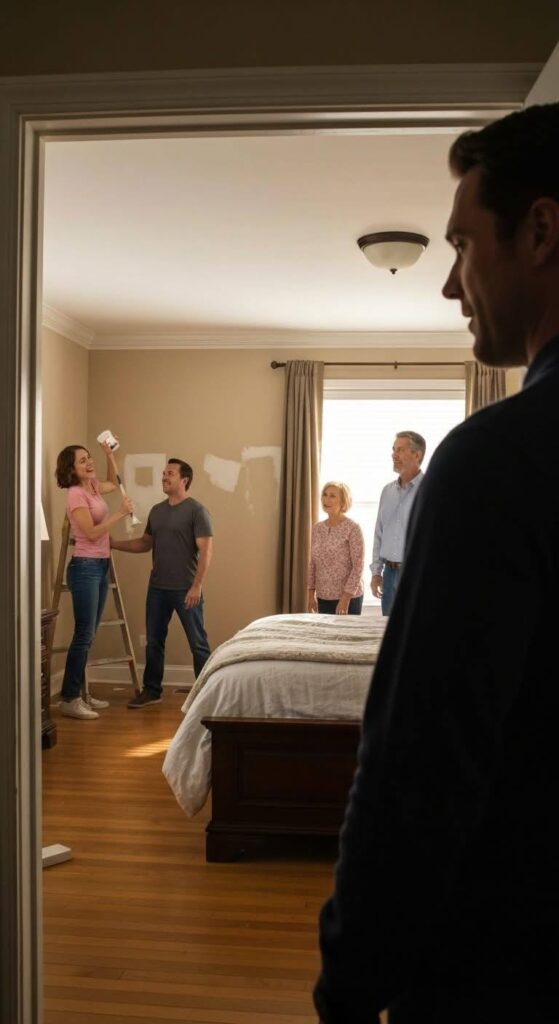
I came home early from work only to find strangers repainting my master bedroom. “We’re renovating it before moving in!” my brother’s wife chirped, brush in hand. He just nodded. My parents laughed along, as if I didn’t even exist. The next morning, Mom’s voice shook on the phone: “Why… why did the police come to us?”
I wasn’t supposed to be home that afternoon. A project deadline had been unexpectedly moved up, and the usually congested arteries of the city were, for once, clear. It felt like a rare gift, a small blessing most people would thank fate for. But I don’t believe in blessings anymore. Only signs. And the empty highway was a sign that I was being sent somewhere I needed to be, faster than anyone expected.
When I turned the key and pushed open my front door, a wave of laughter floated down the hall from the second floor. It was a sound that should have been comforting—the familiar timber of my parents’ voices, my brother Liam’s easy chuckle, and hers… my sister-in-law, Sarah. The woman who’d kissed my cheek at countless family dinners, her eyes crinkling as if she genuinely adored me, the successful older brother who always picked up the check. I dropped my briefcase by the door, the soft thud lost in their merriment. I followed the sound, my steps silent on the hardwood floors, a growing unease coiling in my gut. Step by step, I climbed the stairs until I reached the master bedroom. My bedroom.
The door was wide open. The air was thick with the acrid smell of fresh latex paint. A rickety aluminum ladder stood in the middle of the room, and my expensive Persian rug was hastily covered with crinkled, paint-splattered drop cloths. And there she was, Sarah, a roller in hand, dripping a hideous shade of beige—what real estate agents call “Agreeable Greige”—across the deep crimson walls I had spent a week choosing.
She turned, startled by my presence in the doorway, and then her face split into a smile that was too quick, too bright. “Mark! You’re home early,” she chirped, her tone a perfect imitation of pleasant surprise. “We’re just getting a head start! Renovating it before we move in!”
Her words hung in the air, audacious and absurd. Before we move in.
My brother, Liam, leaned against the far wall, a half-empty can of beer in his hand, and nodded his assent as if her statement were the most normal thing in the world. Behind them, my parents, Richard and Helen, stood in the hallway, their faces beaming with amusement, as if this were all a delightful family joke. My room, my house, my life—all just a source of entertainment for them.
In that instant, watching the four of them bathed in the afternoon light, surrounded by the evidence of their casual, breathtaking betrayal, something inside me didn’t just break; it calcified. It hardened into a cold, dense certainty. I had trusted them all, implicitly and without question. Liam, the perpetually struggling younger brother I’d protected from schoolyard bullies and bailed out of financial trouble more times than I could count. My parents, the people I believed were my unwavering bedrock, the ones who had always preached the sanctity of family. And Sarah, his wife, who had whispered to me with such sincerity that I was the brother she never had, that they would treat this house with the utmost respect while they stayed here “temporarily” to get back on their feet.
I believed them. That was my sin. My unforgivable, defining sin.
The signs had been there for months, of course. They always are. Little red flags that you dismiss as paranoia, tiny cuts you ignore until you realize you’re bleeding out. It started with my mail going missing—important financial statements, bank letters—only to reappear days later, opened and clumsily resealed. Sarah would blame the postal service with a dismissive wave of her hand.
Then came her carefully planted comments, dropped into conversation like poison seeds. “It’s such a big house for just one person, Mark. All this empty space must feel so lonely.” Or, “This neighborhood is perfect for kids. It’s a shame there are no little ones running around here.” My brother, in turn, began bringing contractors over, masons and electricians, under the flimsy excuse of “just getting some advice” for their own future home. They weren’t getting advice; they were assessing my property, my assets, my life.
The final, undeniable sign came late one Tuesday night. I’d come downstairs for a glass of water and found a manila folder left carelessly on my granite kitchen island. Inside, illuminated by the cold blue light of the microwave clock, were a stack of legal documents. Property transfer papers. Drafted, unsigned, but ready for execution. My name was listed as the grantor, and Liam and Sarah’s as the grantees. My parents, Richard and Helen, were listed as the primary witnesses.
They weren’t just painting my walls. They were preparing to erase me from them, to legally strip me of the home I had worked my entire adult life to afford. The story was all there in the fine print: a fraudulent claim that I was gifting them the house due to my “relocating for work,” a convenient fiction they had clearly been building for some time.
Looking at them now, in my paint-splattered bedroom, I didn’t argue. I didn’t scream or demand an explanation. I simply let a slow, easy smile spread across my face. I nodded, a picture of weary acceptance. “Looks like you’ve got it all under control,” I said, my voice unnervingly calm. “Don’t let me interrupt.”
I turned and walked away, leaving them to their brushes and their triumphant, oblivious laughter. Because screaming only feeds a betrayal; it gives the traitors the drama they crave, the justification for their actions. Silence, however, is a slow-acting poison. It lets them believe they’ve won, right up until the moment the world falls out from under their feet.

That evening, I didn’t go back upstairs. I sat in my home office, the door locked, and I began to build my own case. The first call was to Arthur Vance, a lawyer my firm kept on retainer. He was a ruthless, silver-haired shark who specialized in corporate litigation but had a soft spot for cases of personal treachery.
“Arthur,” I said, my voice devoid of emotion. “I have a family matter. It involves fraud, conspiracy to commit theft, and potentially illegal property transfer.”
There was a pause on the other end of the line. “This sounds more interesting than my usual contract disputes,” he finally said. “Tell me everything.”
And I did. For the next hour, I laid out the entire sordid affair, from the missing mail to the documents on my counter to the scene in my bedroom. When I was finished, the silence on the line was profound.
“Mark,” Arthur said, his voice now grim. “They are not just trying to take your house. They are trying to erase your life. We will not let that happen. We will respond not with emotion, but with overwhelming, irrefutable force. I need you to gather every document you have related to this property.”
For the next two weeks, my life became a clandestine operation conducted from within my own home. I was a ghost in the hallways, offering polite smiles and avoiding conversation. By day, I went to work. By night, I became a forensic accountant of my own life. I gathered every deed, every receipt, every bank statement and transaction record tied to the house. I found the wire transfer confirmation for the fifty-thousand-dollar loan I’d given Liam two years ago—a loan he’d sworn was for a “can’t-miss investment” but which I now suspected was seed money for this very plot. The promissory note, which he’d signed, was still in my safe, unpaid and gathering dust.
I went deeper. With Arthur’s guidance, I accessed my online accounts for the local hardware and contractor supply stores. Just as I suspected, they had been busy. They had opened a line of credit in my name, using a forged signature on the application, and had already charged over twenty thousand dollars in materials and labor for renovations. They were redoing the kitchen and two bathrooms, all while I was at work, using my good credit and my money to improve the house they intended to steal. Fraud. Theft. Collusion. The words were no longer abstract legal terms; they were the pillars of my family’s character.
The most damning piece of evidence came from a place they never would have expected. Sarah, in a moment of stunning arrogance, had been emailing photos of the renovation progress to her best friend. “Almost ours!” she had written in one email, attaching a picture of the newly installed marble countertops in my kitchen. “Just a few more weeks until Mark is out and we can finally live the life we deserve!” She had accidentally CC’d her old work email address, an account I had helped her set up years ago and whose password she had, foolishly, never changed. I logged in. The entire thread was there, a digital chronicle of their greed and deception. I downloaded everything, every word, every photo, and sent it all to Arthur in a password-protected file.
Piece by piece, document by document, I built an ironclad case. Arthur filed the reports quietly and strategically. A formal complaint with the police department’s economic crimes unit. A fraud alert with my bank, freezing the illicitly opened accounts. A cease-and-desist letter to the contractors, informing them they were working on a property under fraudulent instruction. My name, once a tool for them to use, was suddenly a fortress, ironclad and unassailable.
Then, it was time to make the final move. The checkmate.
I called my parents on a Thursday evening. “Mom, Dad,” I said, my voice warm and inviting. “I’d love to have you all over for dinner on Saturday. A proper family meal. Liam and Sarah, too, of course. Let’s celebrate the new renovations.”
There was a moment of surprised silence, then my mother’s delighted voice. “Oh, Mark, that’s wonderful! We were so hoping you’d come around. We’d love to!”
They walked in that Saturday laughing, comfortable, utterly oblivious. They brought a cheap bottle of wine as a hostess gift for a house they believed was already theirs. They toured the newly renovated kitchen, Sarah pointing out the fixtures she had chosen with my money, my father clapping Liam on the back and telling him he had “good taste.” They were celebrating their victory, right in front of me, confident in my weakness, my silence, my inability to fight back.
They didn’t know that while we sat down to a roast chicken dinner, a team of detectives was already executing a search warrant at their small, rented apartment across town. They didn’t know that the police were finding the original forged credit applications, the property transfer documents they had so foolishly kept, and the receipts for a new car Sarah had purchased just last week, a down payment made with cash she had skimmed from the contractor invoices.
The knock on my front door came just after I had served dessert. Three sharp, authoritative raps that cut through their cheerful chatter.
I stood up calmly. “I’ll get that.”
Two police officers stood on my porch, their expressions calm and professional. “Mr. Mark Hayes?” one of them asked.
“Yes, that’s me,” I said.
“Sir, may we have a word with you privately? It concerns a fraud investigation.”
I stepped aside and let them in. The atmosphere in the dining room had instantly chilled. My parents went pale. Sarah blinked, her fork hovering over her slice of apple pie, her expression one of utter confusion. Liam froze, a deer caught in the headlights. They thought the police were there for me. That is the exquisite beauty of betrayal—the betrayers always expect the downfall to befall the betrayed. They assumed my financial life had finally imploded under the weight of the debts they had incurred in my name.
But when the senior officer turned away from me and faced them, when he read their names—Liam Hayes, Sarah Hayes, Richard Hayes, Helen Hayes—when the words “conspiracy to commit fraud” and “grand theft” filled the air, I watched the color drain from their faces in a spectacular, cascading wave of horror.
My mother’s hand flew to her mouth, her voice a cracked whisper. “Why… why did the police come to us?”
I leaned back in my dining room chair, the one at the head of the table, and looked at each of them, my gaze as cold and hard as polished steel. I let the silence hang for a moment before I answered.
“Because you tried to erase me from my own life.”
Liam stammered, incoherent noises escaping his lips. Sarah started crying, a torrent of denials and pathetic, theatrical begging. My father, the man who was supposed to have been my moral compass, couldn’t bring himself to look me in the eye. One by one, the officers calmly led them out of my house, their hands cuffed behind their backs.
The house was silent again. Mine again. The half-eaten dessert, the cheap bottle of wine, the lingering scent of their perfume and betrayal—it was all that was left of them.
I didn’t celebrate. There was no triumphant fist pump, no celebratory drink. Justice, I discovered, isn’t like the fireworks of a celebration. It’s quiet. It’s the profound, hollow silence that follows a storm. It’s watching the hands that once reached for you in a false embrace, now cuffed in cold, unyielding steel.
They thought I was weak because I didn’t scream that day in the bedroom. They thought I was naive because I had trusted them for so long. But in their greed, they had taught me something they would never understand themselves.
Betrayal doesn’t end with a broken heart. It ends with strategy.
The legal fallout was swift and brutal. Faced with the mountain of evidence—the emails, the forged documents, the paper trail of their theft—they had no choice but to accept a plea deal. Liam and Sarah were convicted of multiple felonies. My parents, as co-conspirators, received suspended sentences and probation, their reputations in their small community shattered forever. The court ordered full restitution, forcing them to sell what little they had to pay me back. They lost everything because they tried to take everything.
Now, months later, when I walk past the freshly painted walls of my master bedroom, I smile. I had the room repainted, of course. A deep, rich crimson. Not because I needed to erase the memory of what they did, but because I needed to reclaim the space as my own. The color isn’t just paint on a wall; it’s a declaration. My smile isn’t one of happiness, not yet. It is a smile of ownership, of survival. A quiet acknowledgment that I chose this color, this house, this life. And no one will ever take it from me again.