
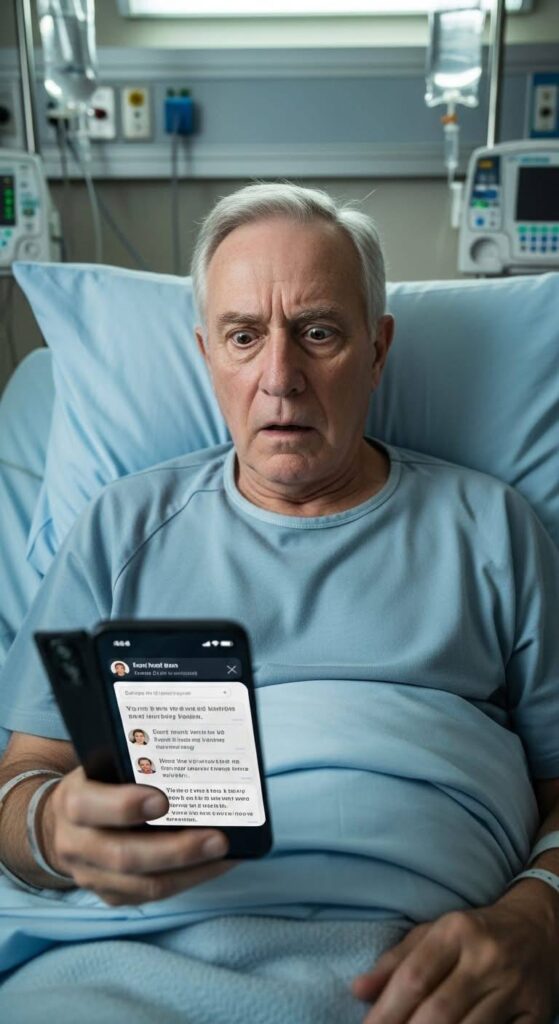
The pain hit like lightning, a brutal, blinding flash that split my chest in half. I gasped, my eyes flying open to a harsh, sterile white light that made my skull pound in rhythm with the frantic beeping of a machine I couldn’t see. Where was I? The room spun in sickening, lazy circles. White walls, more beeping machines, and a web of clear plastic tubes snaking from my arms like invasive vines. I tried to sit up, but my body screamed in protest, a chorus of agony from muscles I didn’t know I had. Something was wrong. Terribly wrong. My chest felt like someone had cracked it open with a crowbar and then messily stapled it back together. Through the thin, humiliatingly open-backed hospital gown, I could feel the thick, tight layers of bandages wrapped around my torso
“Mr. Thompson, you’re awake.” A woman in a white coat appeared at my bedside, her form swimming into focus. She had kind, intelligent eyes behind wire-rimmed glasses. “I’m Dr. Carter, your cardiologist. How are you feeling?”
“Like I got hit by a truck,” I managed, my voice a hoarse, ragged whisper. My throat burned, raw and scraped. “What… what happened to me?”
She checked something on the monitor beside my bed, her expression calm and professional as she studied the numbers and lines that meant nothing to me. “You underwent emergency cardiac surgery two days ago, Mr. Thompson. A triple bypass. Your heart stopped for forty-seven seconds during the procedure.”
Forty-seven seconds. The words echoed in the vast, empty space of my mind like stones dropped into a deep, dark well. Forty-seven seconds. I was dead.
“Technically, yes,” she said, as if reading my thoughts. She pressed her cool fingers against my wrist, counting my pulse. “But we brought you back. You’re going to be fine, Mr. Thompson. The surgery was a complete success. We’re looking at about two weeks in the hospital for recovery, then a gradual return to normal activities.”
Two weeks. I looked around the sterile, impersonal room again. A small window showed a sliver of a gray Dallas skyline under cloudy January skies. There were no flowers on the bedside table. No get-well cards. No brightly colored balloons. No sign that anyone in the outside world knew, or cared, that I was here. A nurse with a warm smile and gentle hands bustled in, checking the IV drip connected to my left arm. But her kindness was professional, a part of the job. It wasn’t family.
After a series of cognitive questions to check my brain function—what year is it? 2025. what month? January—Dr. Carter left, and I was alone with the machines and their endless, rhythmic beeping. I reached a trembling, careful hand toward the bedside table where a nurse had placed my personal belongings. My fingers found my phone.
The screen lit up, showing dozens of notifications. News alerts, email spam, a reminder from the pharmacy to refill a prescription I would no longer need. I scrolled past it all, my thumb swiping with a desperate urgency, looking for something else. A message from my wife, Susan. A missed call from my son, Scott. Anything.
There was nothing.
I opened our family group chat. The last message was from three weeks ago, from Susan, a petty complaint about the grocery store being out of her favorite brand of Greek yogurt. Before that, a message from Scott, asking if I could lend him a few hundred dollars for car repairs. I scrolled up, through months of similar one-sided conversations: their needs, their complaints, their requests. Not a single message about my surgery. Not one missed call asking if their husband and father, the man who had worked himself to the bone for them for forty-five years, was alive or dead.
I set the phone down, my fingers trembling, and stared at the acoustic ceiling tiles above my bed. Forty-seven seconds of being dead, and apparently, no one in my family had even noticed I was gone.
The antiseptic smell of the hospital room triggered a cascade of memories I had been actively avoiding for years. It had started subtly, this slow, creeping betrayal of my own body. In the summer of 2020, I was out in the garden of our Arlington home, staking my tomato plants in the oppressive Texas heat. The chest tightness came on suddenly, a thick, iron band squeezing around my ribs. I had gripped the fence post, my knuckles white, until the sensation passed, telling myself it was just the heat, that I needed to drink more water.
“Buford, you’re being dramatic again,” Susan had called from the cool shade of the back porch, an iced tea glass sweating in her hand. “Come inside before you give yourself a stroke out there.” Her tone was light, teasing, but underlined with an impatience that had become the background music of our marriage. I had laughed it off. At sixty-six, I was still strong as an ox, or so I told myself.
But the episodes kept coming. By 2021, climbing the stairs to our bedroom had become a mountain expedition. I’d pause on the landing, my hand gripping the banister, while my heart hammered against my ribs like a trapped bird trying to escape. Susan would already be in bed, engrossed in one of her evening shows. “You’re getting old, Buford,” she’d say, her eyes never leaving the television screen. “Maybe you should cut back on those weekend projects in the yard.”
I never told her about the metallic taste of fear that filled my mouth during the worst episodes, or how the world would tilt and swim sideways when I stood up too quickly. She had enough to worry about, I reasoned, with her book club, her charity meetings, her busy social calendar.
Our son, Scott, was even less helpful. Thirty-eight years old, a graphic designer with a string of failed freelance projects, living in our converted basement. When I mentioned feeling tired all the time, that I was having trouble catching my breath, he had just shrugged from his position on the living room couch, his eyes glued to a video game. “Maybe see a doctor, Dad,” he’d said. Then he’d added, as an afterthought, “Actually, wait. That’s probably expensive. Try some vitamins first.” He was more worried about his potential inheritance being spent on my medical bills than about my actual health.
The first real attack happened in our kitchen in March of 2023. I was making coffee when the pain hit, a sledgehammer blow to the center of my chest. I grabbed the edge of the counter, coffee grounds scattering across the floor as I slid down to the cold linoleum, unable to breathe. “Susan,” I had gasped, but my voice was a faint whisper that barely carried beyond the kitchen doorway.
She found me ten minutes later. “Oh, Buford, did you fall again?” she’d asked, her voice a mixture of annoyance and concern. She helped me to a chair, but her attention was already shifting. “Look, I’ve got my hair appointment in an hour. Are you okay to drive yourself to the doctor?”
I drove myself to the emergency room instead. The tests showed what I had feared but couldn’t bring myself to admit. The years of chest pain hadn’t just been aging or stress. My arteries were closing like old, rusted pipes. “Without surgery, you have six months, maybe less,” the cardiologist, Dr. Martinez, had told me. “But with a triple bypass, you could have ten good years ahead of you.”
I had driven home in my old Chevy truck, my hands shaking on the steering wheel. Ten good years. The question that echoed in my head was a painful one: did I want to spend them with people who barely seemed to notice when I was dying?
The morning of January 29th arrived, crisp and bright through my hospital window. It was my freedom day. I packed my few belongings into the old sports bag Susan had brought me years ago for a weekend fishing trip that we never took. My chest felt stronger, the crushing pain replaced by a manageable ache from the stitches.
“You’re lucky to be alive, Mr. Thompson,” Dr. Carter had said during her final check. “Make the most of this second chance.”
I checked my phone for the twentieth time that morning. Still nothing. Two weeks of complete, deafening silence while I fought my way back from the edge of death. But maybe, I told myself, they were just planning a welcome home surprise. Maybe they just didn’t know how to act when I was the one who was sick. The eternal provider, the family rock, suddenly fragile.
I typed out a message in our family group chat. My finger hovered over the send button. I had deleted two previous versions, worried they sounded too emotional, too needy. This one was simple, direct. The doctor says I can come home today. Who will pick me up? I pressed send and set the phone on the bed beside my packed bag.
The response came faster than I expected. Scott’s name appeared first. Call a taxi. I’m watching TV.
I stared at the message, reading it three, four, five times, as if the words might rearrange themselves into something less cruel. Forty-seven seconds of being clinically dead, two weeks in intensive care, and my son couldn’t be bothered to pause his television show.
But Susan would be different. Susan would understand. We had been married for forty-five years. She would want to bring me home.
Her message appeared below Scott’s. Stay another month in the hospital. It’s so nice and quiet without you.
The phone slipped from my numb fingers onto the white hospital blanket. The words glowed on the screen, a neon sign announcing the end of everything I had ever believed about my family, about my life. It’s so nice without you.
I sat heavily on the edge of the bed. The morning sunshine streaming through the window felt like a mockery. My chest ached, but it had nothing to do with the surgery. This was a deeper pain, a place no surgeon’s scalpel could ever reach.
Nurse Jennifer appeared in my doorway. She took one look at my face and stepped inside, closing the door behind her. “Mr. Thompson,” she said, her voice soft. “You look pale. Are you having chest pain?”
I just shook my head, unable to speak. She picked up my phone from the bed and glanced at the screen. Her professional expression shifted to one of profound, human sadness. “Oh, Mr. Thompson,” she said quietly. “I’m so sorry.”
Family can be complicated. That was her polite, professional way of putting it. Another way was that I had spent forty-five years of my life giving everything I had to people who saw me as nothing more than a paycheck and a caretaker. People who found my absence more pleasant than my presence. My discharge papers, with their instructions for my new life, began to look like something else entirely. They looked like freedom.
I walked out of that hospital on unsteady legs, each step a reminder that I had almost died and nobody had cared. I took a taxi home, the city of Dallas a blur of indifferent glass and steel outside the window. Memories flooded my mind—not of happy family moments, but of a lifetime of sacrifice. The Harley-Davidson I’d sold in 1982 so we could afford a crib for Scott. The dream trip to Paris I’d cancelled in 1995 to pay for his first year of college. The business loan in 2010, the one I had put our house up as collateral for, the one I had spent three years of double shifts paying off after his graphic design business folded.
The house, when I arrived, should have felt like home. Instead, it felt like a crime scene. Mail was piled up, unopened. Dirty dishes were stacked in the sink. Empty pizza boxes and energy drink cans littered the living room, where Scott’s massive gaming setup had expanded to take over the space. They had been having parties. My absence hadn’t been a time of worried waiting; it had been a celebration of freedom from the old man who paid the bills.
The final insult was my study. They had turned it into a storage closet. Boxes of Susan’s craft supplies were piled on my desk. Scott’s old computer equipment was stacked on my bookcases. A thick layer of dust had settled over the family photos I had so carefully arranged on my shelves.
Forty-seven seconds I had been dead. And they had used that time to turn my private sanctuary into a dumping ground.
I sat down in the one chair they hadn’t covered with their junk. I opened my safe. The combination was Scott’s birthday. How fitting. Inside, my will sat in its blue legal folder. To my beloved wife, Susan Thompson… To my son, Scott Thompson…
Beloved. I laughed, a bitter, hollow sound that echoed in the dusty room. The woman who had told me to stay in the hospital because it was so nice without me. The son who couldn’t be bothered to pause his TV show to pick up his father who had just cheated death.
That evening, I didn’t unpack my hospital bag. I opened my laptop and searched for “Estate Attorneys in Dallas.” The next morning, I was sitting in the polished, mahogany-paneled office of Jonathan Hale, a man with silver hair and intelligent, discerning eyes.
“I want to leave everything to charity,” I said, my voice clear and firm. “Nothing to my family.”
He raised an eyebrow. “That’s quite a substantial change, Mr. Thompson. May I ask what prompted this decision?”
I told him everything. He listened without interruption, his face a mask of professional neutrality. “This isn’t anger, Mr. Hale,” I said when I had finished. “This is clarity.”
An hour later, I was signing the new documents. The language was clean, precise, and final. My entire estate—the house, the savings, the retirement accounts—would be placed in a charitable trust. Upon my death, it would all be donated to the American Heart Foundation. My family would inherit exactly what they had earned. Nothing.
But I wasn’t done. I met with the foundation’s media coordinator, a sharp, savvy woman named Rebecca Mills. She understood the power of a good story.
“A local man, a heart surgery survivor, donating his entire estate after being abandoned by his family,” she’d said, her eyes gleaming. “This is powerful. This will resonate.”
We filmed the interview that afternoon. I sat in my own living room, surrounded by the evidence of my family’s neglect, and I told the truth. I spoke of the surgery, of the forty-seven seconds, of the cold, cruel text messages. I didn’t do it with anger. I did it with a quiet, dignified sadness.
The story aired on the six o’clock news. I watched it from a quiet downtown restaurant. My face, weathered and tired, filled the screen. My voice, calm and steady, narrated the story of a lifetime of sacrifice met with a final, unforgivable act of betrayal. The segment included shots of my house, the house that was no longer my family’s future inheritance, but a gift to a cause that actually valued human life.
At 6:05, my phone, which had been silent for weeks, began to scream. Scott. I ignored it. A minute later, Susan. I ignored that, too. For the next hour, they called, over and over. By the time I finished my steak, there were sixty-seven missed calls.
I drove home, the streets of my city seeming brighter, cleaner. I walked into my house, the house that was now a symbol not of my foolish devotion, but of my newfound freedom. The next morning, they were waiting for me on the doorstep, their faces a mixture of panic, disbelief, and a dawning, abject terror.
“Dad!” Scott started, rushing forward. “What is this madness? We’re your family!”
I held up a hand, stopping him in his tracks. “Family?” I asked, my voice conversational, almost pleasant. “When I was in the hospital, fighting for my life after my heart stopped, did either of you call? Even once?”
“We were busy!” Susan cried, her voice cracking. “You know how hard it is to manage everything without you!”
“So hard,” I said, my voice now as cold and hard as a surgeon’s scalpel, “that you told me to stay in the hospital for another month, because it was so good and quiet without me.”
Scott’s face went white. Susan covered her mouth with her hands. They knew. They knew I had told the world their secret.
“You have twenty-four hours to leave this house,” I said quietly.
“Where will we go?” Susan whispered. “We have no money. Everything is in your name.”
“That is no longer my problem,” I replied. I walked past them, into my clean, quiet house, and closed the door, leaving them alone on the porch with the wreckage of the comfortable, entitled life they had just lost.
I spent the next year not dying, but living. I traveled. I took up photography. I volunteered at the Heart Foundation, sharing my story, helping other families navigate the terrifying world of cardiac recovery. I even started dating again, a wonderful woman I met on a hiking trip in Colorado.
My son, Scott, eventually got a job. He and his mother live in a small, rented apartment. We don’t speak. My new will stands. My new life, the one I was given a second chance at, is my own. And it is a life of peace, of purpose, and of a quiet, profound joy I had forgotten was possible. What they did changed everything. And for that, in a strange, unexpected way, I am eternally grateful.