
The newspaper crinkled between my fingers as I folded it back to the sports section, a Saturday morning ritual that felt more like muscle memory than pleasure. My coffee was cooling in the chipped blue mug, the one my late wife, Martha, always said was my favorite. The silence in our small kitchen stretched out like an old, familiar friend. It had been three years since she passed, and the apartment still held that particular stillness that comes when you’ve lived alone long enough to stop expecting company.
The phone’s shrill, jarring ring cut through the quiet like a blade. My hand jerked, sending a few dark droplets of coffee across the obituaries. I frowned. Who called at 10:30 on a Saturday morning? My daughter, Rachel, always texted first, and my few remaining friends knew better than to interrupt my weekend solitude.
“Hello?”
“Donald.” The voice carried that familiar, practiced politeness that never quite masked the chill beneath. It was my son-in-law, Richard. I straightened in my wooden chair, its old legs creaking against the linoleum. Richard never called. Ever. In the five years since he’d married my daughter, all communication between us had flowed through Rachel, like water finding the path of least resistance.
“Richard. Is everything all right?”
A pause stretched across the line, filled with the sound of his careful, measured breathing. “Rachel… insists I call you about something.” The words carried weight, each one measured and reluctant, as if he were being forced to handle something unpleasant. “My mother’s birthday dinner. Tonight.”
My stomach tightened. Serenity Thompson’s birthday. I’d forgotten, though Rachel had mentioned it weeks ago. The way Richard said insists made it perfectly clear whose idea this last-minute invitation wasn’t.
“I see,” I said, my voice neutral. “She thinks I should come.”
Another pause, longer this time. “The family is gathering at seven. Worthington Hills Country Club.”
Worthington Hills. Of course. The place where the valet parking alone cost more than my weekly grocery budget, and the wine list read like a foreign language designed to separate the worthy from the wanting. I glanced around my kitchen—the mismatched plates drying in the rack, the old refrigerator humming its steady, mechanical song.
“That’s thoughtful of Rachel,” I said.
“Yes. Well,” Richard’s tone suggested thoughtfulness had nothing to do with it, “the dress code is business casual. The club has standards.”
The way he said standards landed like a small, precise punch. It wasn’t cruel enough to challenge directly, but it was pointed enough to remind me exactly where I stood in their pristine, affluent world.
“I’ll be there,” I said, my voice more firm than I felt.
“Fine. Seven o’clock sharp. They don’t hold reservations.” The line went dead before I could respond.
I held the phone to my ear for another moment, listening to the dial tone’s steady hum. Outside, a neighbor’s lawn mower coughed to life, a familiar, mechanical complaint I understood far better than the subtle social codes of my daughter’s new family. Business casual at Worthington Hills. I looked down at my faded Ohio State t-shirt and worn work pants. The clothes hanging in my small bedroom closet hadn’t seen the inside of a country club in years, if ever. But Rachel would be there. And despite Richard’s cold, reluctant delivery, she had asked for me. That had to mean something.
Interstate 70 stretched ahead like a concrete ribbon, cutting through the Ohio farmland under an afternoon sun that painted everything in shades of gold. I’d been driving for an hour, the cruise control set at a steady sixty-eight, the radio playing classic rock at a low volume. The gift bag, containing a simple but elegant silver picture frame, sat securely in the passenger seat, my sixty-eight-dollar peace offering for what I knew would be enemy territory.
The traffic moved steadily, a typical Saturday afternoon flow of families heading to dinner plans and weekend activities. I checked the dashboard clock. Two o’clock. I was right on schedule for a 4:30 arrival, which would give me plenty of time to find the place and compose myself before walking into the lion’s den.
And then I saw it. Up ahead, a silver beacon against the green shoulder of the highway. A Mercedes, its hazard lights blinking a frantic, urgent rhythm. An expensive car, stopped dead. My mechanic’s instincts, honed over forty years of turning wrenches, kicked in before my brain had even finished processing the scene. Someone needed help.
I eased off the cruise control and guided my old Toyota onto the shoulder behind the luxury sedan. A woman stood beside the open hood, her silver hair catching the sunlight, a stylish navy blazer draped over her shoulders. She looked to be somewhere in her sixties, impressively composed despite the circumstances, but also clearly out of her element.
“Car trouble?” I called out, staying far enough back to seem non-threatening.
“The engine just died,” she said, her voice carrying an air of education and breeding, the crisp consonants speaking of a world far removed from my own. “All the warning lights came on at once.”
“I’m Donald,” I said, moving closer, my hands visible. “I used to be a mechanic. Mind if I take a look?”
She hesitated, her eyes weighing the risk of trusting a stranger on a lonely stretch of highway. It was smart caution. “Lauren Whitfield,” she said finally, extending a hand with a business-like efficiency. “I’d appreciate any insight you might have.”
Her handshake was firm, confident. She was a woman accustomed to being in charge. But right now, she was just another driver with a broken-down car.
The engine told its story clearly. A shredded serpentine belt, coolant splattered everywhere, a wobbly water pump pulley. “Good news and bad news,” I announced after my initial diagnosis. “Good news is I can probably get you running again. Bad news is it’s going to take some time. An hour and a half, maybe two.”
Her face fell slightly. “I’m going to be terribly late.”
“Join the club,” I said with a wry smile. “The alternative is a tow truck and waiting until Monday for a repair shop to open.”
She looked down the empty highway, then back at me. “If you’re willing to try,” she said, her decision made, “I would be immensely grateful.”
For the next two hours, I worked. I rolled up my sleeves and dove into the complex, beautiful maze of German engineering. The sun was warm on my back, the traffic hummed past, and my hands, covered in grease and coolant, moved with the sure, steady confidence of a lifetime of practice. Lauren watched from a safe distance, and we talked. She told me about her late husband, a man she had clearly adored. I told her about Martha, about my own loss. We talked about our children, our work, the strange and unexpected turns life takes. It was the easiest, most natural conversation I’d had in years.
She was also headed to a birthday party in the Dublin area. “Business associates, mostly,” she’d said with a sigh. “Sometimes the difference gets blurry.” I knew exactly what she meant.
The repair was a success. The engine purred back to life, steady and strong. Lauren was overcome with gratitude. She tried to pay me, but I refused.
“Sometimes people just need help,” I said, closing my toolbox. “What goes around, comes around.”
“Then at least give me your phone number,” she insisted. “It’s not often you meet a genuinely decent person, Donald. I’d like to stay in touch.”
As she pulled away, her elegant Mercedes now running perfectly, she called out, “Thank you again, for everything!” I watched her go, feeling a strange mixture of satisfaction and a new, more urgent anxiety. The impromptu repair had been a bright spot in my day, a reminder of a world where kindness and competence were valued. But the Thompson’s party loomed ahead, and I was now catastrophically late, and covered in grease.
I turned into the Worthington Hills subdivision an hour later. Every lawn was a perfect, manicured green carpet. Every driveway showcased a luxury vehicle that cost more than my annual income. The Thompson house sat at the end of a cul-de-sac like a monument to successful living, a two-story colonial brick palace with gleaming bay windows. I parked my ten-year-old Toyota behind a line of BMWs and Lexuses. It looked like it had wandered into the wrong neighborhood by mistake.
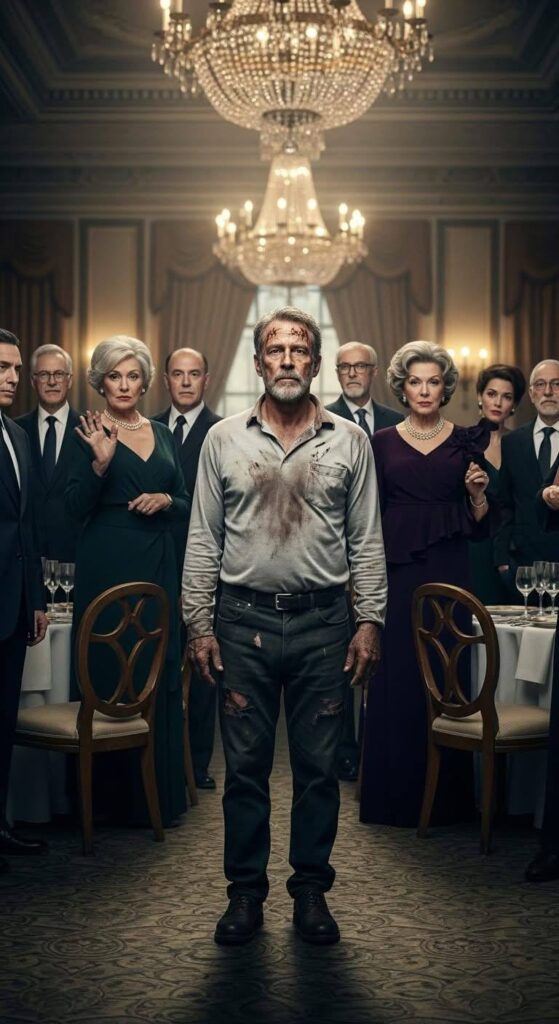
Walking up the curved driveway, I caught my reflection in a parked car’s window. Two hours of roadside engine work had left their mark. There were dark grease stains on my shirt, dirt under my fingernails that no amount of scrubbing with a gas station paper towel could remove, and my hair was disheveled from the highway wind. I was not, by any stretch of the imagination, “business casual.”
Serenity Thompson opened the door. Her expression shifted through several stages in rapid succession: surprise, a quick, cold assessment of my appearance, and then a look of barely concealed horror.
“Donald,” she said, and it wasn’t a greeting. It was a diagnosis of an unwelcome condition.
“Mrs. Thompson, I am so sorry I’m late. Happy birthday.” I offered the wilted gift bag, which she accepted with the tips of her fingers, as if worried about contamination.
“You’re two and a half hours late.”
“I had to help someone with car trouble on the highway,” I explained.
“I see,” she said, and her tone suggested she saw quite a lot, none of it favorable. “Richard, your… guest… has arrived.” The pause before “guest” carried enough ice to freeze the Ohio River.
The scene in the living room was a nightmare of quiet judgment. My daughter, Rachel, rushed to hug me, her face a mixture of relief and embarrassment. Her husband, Richard, and his father, Palmer, looked me over with the same dismay Serenity had shown.
“Dad works with his hands,” Rachel said, a desperate attempt to bridge the gap. “He can fix anything.”
“How… practical,” Serenity had replied, and the pause before the word “practical” spoke volumes.
They tried to send me upstairs to “freshen up,” a polite term for “hide until you look presentable.” But I was tired of hiding, tired of being made to feel ashamed of who I was. And then, Palmer, a man who preferred blunt dismissal to his wife’s icy condescension, made it clear.
“We can’t afford to have such a display at our celebration,” he said, his voice carrying the authority of a man accustomed to being obeyed.
The words hung in the air, an undeniable, public rejection. And that’s when Serenity delivered the final, crushing blow.
“If you can’t be bothered to dress like a human being,” she announced to the room, her voice rising to ensure every one of her perfectly dressed, high-status guests could hear, “then you will not sit at the table with human beings.”
The entire party froze. Twenty pairs of eyes turned to watch this quiet, domestic execution. Rachel’s face went white. “Serenity, that’s my father,” she whispered, her voice cracking.
“Your father,” Richard added with a calculated, cruel smirk, “who apparently thinks a birthday party at a country club is an appropriate place to display his hobby clothes.”
I felt a white-hot heat rise in my chest. The afternoon’s quiet confidence, the simple satisfaction of helping a stranger, was battling against years of their accumulated slights.
“You know what?” I said quietly, but my voice carried in the sudden, absolute silence. “You’re absolutely right.” I looked directly at Serenity, then at Richard, then at Palmer. “Some people simply don’t understand appropriate boundaries. Some people think money makes them better than other human beings. Some people,” I continued, my voice steady despite the rage building inside, “have forgotten that character isn’t for sale.”
Serenity’s face flushed a deep, ugly red. “How dare you?”
“I dare,” I said, “because someone needs to tell you the truth.” I turned to my daughter, my heart aching for her, for the impossible position she was in. “I’m sorry, sweetheart,” I said gently. “But you deserve better than this.” I turned and walked towards the foyer, my dignity my only shield.
And then, the doorbell chimed, its classical, two-toned notes cutting through the toxic atmosphere like music from another world.
Through the glass panels of the front door, I caught a glimpse of silver paint and elegant curves. My breath caught in my throat. It was the Mercedes. The same luxury sedan I had spent two hours repairing on the side of the highway, now sitting in the Thompson driveway like an answered prayer.
The door opened before anyone could move, and Lauren Whitfield stepped inside. She was the picture of grace and composure, her silver hair perfectly styled, her navy blazer immaculate. She carried herself with the quiet, unassailable authority of someone who was accustomed to commanding respect, not demanding it.
Her gaze swept the elegant foyer, and then she saw me. Her entire face lit up with a look of pure, genuine pleasure.
“Donald!” she exclaimed, her voice carrying across the stunned silence of the room. “What a wonderful surprise to see you here!” She moved towards me with the easy grace of someone greeting an old and cherished friend.
The Thompson family stood frozen, their minds clearly racing, trying to solve the impossible equation that had just walked through their door.
“Lauren,” I said, and for the first time in hours, a real smile touched my lips. “Small world.”
“Isn’t it just?” she said, reaching me, her presence a warm, protective shield against their cold judgment. “How did the rest of your drive go? I hope you weren’t too late for your family gathering.”
Behind her, I watched Serenity’s face cycle through confusion, recognition, and a dawning, abject horror. Richard’s wine glass was suspended halfway to his lips. Palmer looked like someone had just told him all his building permits had been revoked.
“My family gathering,” I repeated, the irony thick in my voice. “Actually, this is it.”
Lauren’s eyebrows rose in surprise. “Really? How lovely! What are the odds?” She turned to include the Thompsons in her brilliant smile, and I watched them scramble to reassemble their masks of polite civility.
“Mrs. Whitfield,” Palmer managed, his voice strangled with a forced cheerfulness. “Welcome to our home. We’re so honored you could join us for Serenity’s birthday.”
“The pleasure is entirely mine,” Lauren said, her tone gracious, but I saw her eyes sharpen as she took in the tense, toxic atmosphere. “I do hope I’m not interrupting anything important.”
“Not at all!” Serenity stepped forward, her transformation from contemptuous hostess to fawning supplicant so rapid it would have been comical under different circumstances. “We were just welcoming Donald to the party.”
“How wonderful,” Lauren said, her smile never wavering. “Donald was such a lifesaver this afternoon. My car broke down on the highway, and he spent hours getting me back on the road. Hours. And he refused to take a single penny for his time or the parts he used. Can you believe it? Such kindness from a complete stranger.”
The silence that followed was profound. Every eye in the room moved between Lauren and me, every guest trying to process this incredible revelation. Rachel’s face was a picture of dawning hope, while her husband’s family looked like they were watching their worst nightmare unfold in real time.
“Hours?” Richard’s voice cracked.
“At least two,” Lauren confirmed cheerfully. “I was completely stranded until your father-in-law stopped to help.”
Palmer cleared his throat, his businessman’s instincts now at war with his rising panic. “Yes, well, Donald is… he’s very helpful.” The word came out like he was admitting to a shameful character flaw.
“Is everything all right?” Lauren asked, her head tilted slightly, her social radar picking up on the undercurrents she didn’t yet understand. “There seems to be some tension in the air.”
“We were just discussing… appropriate attire for the celebration,” Richard stammered.
“Attire?” Lauren’s eyebrows rose. “You mean the clothes Donald is wearing?” The temperature in the room dropped several more degrees. “The clothes he wore while repairing my car? The clothes that got dirty because he spent two hours of his Saturday helping a stranger on the side of a highway?” Her voice was still pleasant, but now it had an edge of steel.
“Mrs. Whitfield, you have to understand,” Palmer began, “we maintain certain standards…”
“Standards?” Lauren repeated the word as if she were examining something unpleasant she’d found on her shoe. “What, exactly, did you say to Donald about his appearance?”
The silence stretched, painful and incriminating.
“They said,” I said quietly, my voice carrying in the stillness, “that if I couldn’t dress like a human being, then I couldn’t sit at the table with human beings.”
Several of the guests gasped. Lauren’s expression didn’t change, but something in her posture shifted, a straightening that made her seem suddenly taller, more formidable.
“I see,” she said, her voice now carrying the chill of a winter morning. “And this is how you treat someone who spent his afternoon demonstrating an act of pure, selfless kindness. This is your definition of ‘standards.’”
Palmer and Serenity exchanged a look of pure, unadulterated panic. They had just realized who I was: not just the father of their daughter-in-law, but a friend of their most important potential investor.
“Mrs. Whitfield, please, there’s been a misunderstanding…” Palmer began desperately.
“Oh, I don’t think there’s been any misunderstanding at all,” Lauren said, moving to stand beside me, her presence a solid, unwavering armor against their cruelty. “I understand perfectly. You needed my investment, you invited me to your party, and then you spent the evening demonstrating exactly the kind of people you are.”
Her gaze swept the room, ensuring every guest was a witness. “I have seen more character, more integrity, and more class in this man’s little finger than exists in this entire household combined. And I can tell you this: my firm does not invest in companies run by people who lack basic human decency.”
Palmer’s face had gone from ash to chalk. Serenity looked like she was about to faint. Their entire world, their business expansion, their social standing, was crumbling around them, all because of their own petty, snobbish cruelty.
Lauren turned to me, her face softening, her eyes full of a warmth that felt like the first sun after a long, cold winter. “Donald,” she said, her voice now full of a gentle humor. “Would you like to get some dinner? I know a place nearby that serves a decent steak and doesn’t care what you’re wearing.”
I looked at her, this incredible woman who had appeared like an angel of justice, transforming my humiliation into a stunning vindication. “I’d like that very much,” I said.
We walked out of that house together, leaving the Thompsons to deal with the wreckage of their disastrous, and very expensive, birthday party. My old Toyota, parked among their fleet of luxury cars, had never looked so good. It was a symbol of an honest life, of a man who knew the value of hard work and the importance of helping a stranger on the side of the road. And as I drove away from that house of mirrors and into the rest of my life, with a new, true friend by my side, I knew, with a certainty that filled my soul, that I was the richest man in the world.