
The sun poured through the living room windows of my small Chicago suburb house, painting golden streaks across the worn-out floral couch where I sat, waiting. My daughter, Olivia, had promised a Father’s Day surprise, and despite the slow erosion of hope over the years of quiet disappointments, a traitorous flicker stirred in my chest. The old clock on the mantle, a wedding gift from my parents, ticked relentlessly, each second a small, metallic hammer against the anvil of my life. Twenty years since her mother, my Ellen, had been taken by the cancer. Twenty years of every sacrifice, every extra shift, every postponed dream being etched into the lines on my face and the weariness in my bones. All for her.
The room smelled faintly of lemon polish and old books, a habit I’d kept from my late wife, a small, weekly ritual to keep her memory alive. The family photos on the shelf were the real anchor here, though. Olivia as a gap-toothed seven-year-old, beaming on her first bicycle. Me, looking impossibly young and proud, with my arm around her at her high school graduation. Us together, always us. A team of two against the world.
The doorbell chimed, a cheerful, two-note sound that made my heart lift. I opened the door to find Olivia, her auburn hair swept into a sleek, severe bun, her designer coat far too crisp and clean for our modest neighborhood. She held a small, sad-looking gift bag, the tissue paper crumpled like an afterthought. Her husband, Liam, a man whose smugness was as polished as his expensive loafers, loomed behind her.
“Happy Father’s Day, Daddy,” Olivia said, her voice a confection of sweetness, but edged with something sharp, like a blade wrapped in silk. She thrust the bag into my hands, her smile tight, as if she were posing for a photo she didn’t want to be in.
I forced a grin, my fingers brushing against the rough, cheap tissue paper. “Thanks, sweetheart. You shouldn’t have.”
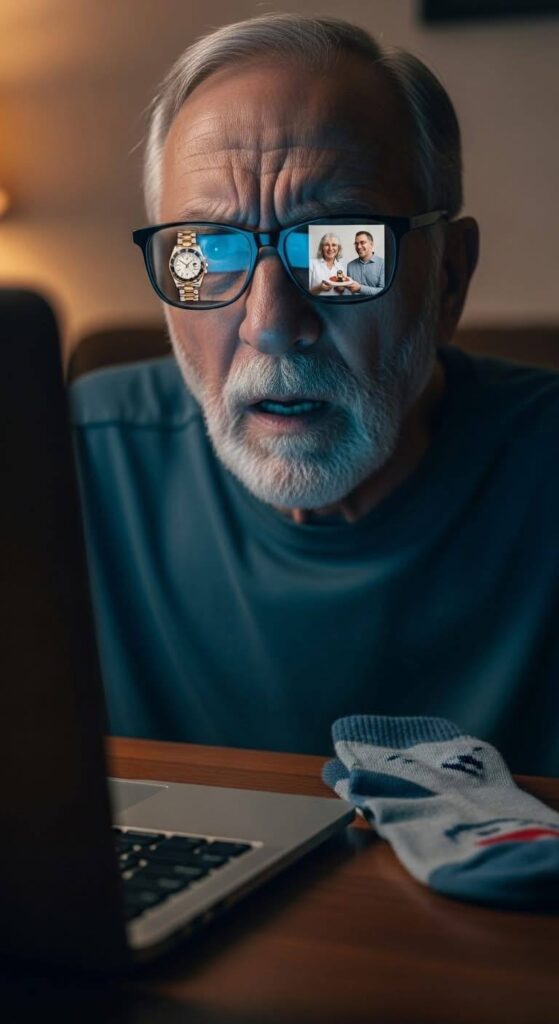
The bag felt light, almost empty. I sat back down on the couch, acutely aware of their eyes on me—Olivia’s, expectant and impatient; Liam’s, faintly amused. The clock ticked louder, or maybe it was just my own pulse hammering in my ears. I reached into the bag and pulled out a pair of navy blue socks, the kind you’d find in a discount bin at a department store, three for fifteen dollars. The price tag was still attached, dangling from the plastic tie like a taunt.
A cold fist clenched in my chest, but I kept my face a neutral mask. “Socks,” I said, holding them up as if they were a rare treasure. “Practical. I’ve always dreamed of these.”
Olivia’s laugh was high and brittle, the sound of something breaking. “Exactly! Something useful, right? It’s not like you need anything fancy.” Her manicured nails, a deep, blood-red, gleamed as she adjusted the silk scarf around her neck. The gesture was casual, but the message was deliberate, a stark reminder of the vast, yawning gulf between our worlds.
Liam chuckled, leaning against the doorframe, a posture of bored, condescending ownership. “Yeah, Paul. You’re a simple guy. No need for extravagance.” His tone dripped with a pity that was more insulting than any outright insult. I felt the room shrink, the air growing thick with their shared smugness.
I nodded, carefully folding the socks with a reverence I did not feel. “I appreciate it. Both of you.” My voice was steady, but my hands trembled slightly, betraying the storm brewing inside me. I glanced at the photo of my late wife on the mantle, her soft, kind eyes watching from the silver frame. Had I failed her? Had I raised a daughter who looked at her own father with such casual contempt? The thought stung, but I pushed it down.
“You staying for coffee?” I asked, already knowing the answer.
“Oh, we have plans,” Olivia said, already pulling out her phone. “Dinner with William, Liam’s dad. You know how he is, always hosting these big family things.” She exchanged a quick, knowing glance with Liam, a flicker of something I couldn’t quite place. Secrecy, maybe. Or triumph. My stomach twisted, but I let it pass.
They were out the door in less than five minutes, leaving the house quieter, emptier than before. The clock’s ticking was a hammer against my skull now. I carried the pair of socks into the kitchen, needing to move, to do something, anything, to keep the rage at bay. The cheap gift bag snagged on the corner of the counter, the tissue paper tearing with a pathetic, whispery sound. I set the socks down and reached for a coffee mug, my hands unsteady.
And that’s when the memory hit me, a sudden, brutal wave. Olivia’s college tuition. Forty thousand dollars a year, for four years. I had sold my dream to pay for hers. For years, I had been saving to buy a small sailboat, a place to retire on the water, a tribute to Ellen, who had loved the sea. I sold the dream without a second thought. I told myself it was worth it, that Olivia was the future, that she would carry our family’s love and our values forward into the world.
The mug slipped from my grip. It shattered on the tile floor, the sound a loud, violent punctuation to my thoughts. I stared at the pieces, jagged and irreparable. My breath was ragged in my chest. Had it all been for nothing?
I swept up the shards, each scrape of the broom against the tile fueling the ache in my chest. Olivia’s voice echoed in my mind. Something useful, right? I wondered when, exactly, she had stopped seeing me as her father and started seeing me as a means to an end, a living, breathing ATM.
The kitchen smelled of coffee now, bitter and grounding. I sat at the table, the fifteen-dollar socks mocking me from the counter. My laptop was open, a habit from years of checking work emails on weekends. Today, I just needed a distraction. I clicked on social media, a mindless scroll through other people’s happy, curated lives.
And that’s when I saw it.
It was a photo, posted less than an hour ago by Olivia. A group of them at a fancy, Michelin-starred restaurant. William, Liam’s father, was at the head of the table, grinning, his arm around a beaming Olivia. And on his wrist, gleaming under the restaurant’s soft, ambient lights, was a Rolex. A brand new, ten-thousand-dollar Rolex.
Her caption read: “To the best father-in-law a girl could ask for! A gift that matches your class. Happy Father’s Day, William!”
My blood ran cold. I clicked on the image, my mouse hovering over William’s wrist, and zoomed in. The watch’s face glinted, unmistakable. And then I remembered. Her call, two months ago. Her voice, trembling with a manufactured panic. “Daddy, I need ten thousand dollars. It’s… it’s a medical thing. A vital expense. I wouldn’t ask if it wasn’t an emergency.”
I had wired the money that same day, no questions asked. My daughter was in trouble. That’s all I needed to know.
My hands were shaking as I stared at the screen. The socks lay forgotten on the counter. The clock on the mantle ticked on. And something inside me, a soft, forgiving part that had made excuses for her for years, finally snapped. Not with a loud, violent crack, but with a quiet, decisive click, like a lock sliding firmly into place.
Olivia called me seventeen times over the next few hours. Her voice on my voicemail shifted from confusion to irritation, and finally, to a frantic, pleading panic. “Daddy, don’t do this. Please, just talk to me.”
But she didn’t know. I was already on a new path, a path that had no room for her lies, and no room for regret.
The kitchen was dim now, the afternoon light choked by gathering clouds. The broken mug shards lay in the trash, but the bitter taste of betrayal lingered, sharper than the coffee that had long since gone cold. The laptop screen glowed, William’s Rolex burning into my retinas. A gift that matched his class. My class, apparently, was a pair of discount socks.
I slammed the laptop shut. I grabbed my jacket. I needed air. I walked to the park, the one where I used to push a giggling, six-year-old Olivia on the swings, her pigtails bouncing. “Higher, Daddy, higher!” A memory surfaced, unbidden, of her promising she would always be my little girl. I sat on that same creaking bench, staring at the empty swings, and the Rolex flashed in my mind, a taunt I couldn’t shake.
“Paul, that you?”
It was my neighbor, Carl, jogging by with his golden retriever. “Thought you’d be celebrating with Olivia,” he said, his face flushed and friendly.
“Celebrating’s done,” I said, my voice flatter than I intended.
He nodded, scratching his dog’s ears. “Saw your girl downtown last month, you know. At that fancy jewelry store on Oak Street. Looked like she was picking out something big.” He chuckled, oblivious to the bomb he had just dropped. “Guess she’s got expensive taste, huh?”
My throat tightened. “Yeah,” I managed. “She does.”
Oak Street. The jewelry store. The Rolex. It all clicked into place. Not a doctor’s office. Not a medical emergency. A glittering store, where she had spent my money, my sacrifice, on a trinket for a man who already had everything.
Back in my quiet, lonely house, my anger had hardened into something colder, more focused. I opened my laptop again. My hands were steady now. I typed Oak Street Jewelers into the search bar. I needed to know for sure. The truth, in all its ugly detail.
The next morning, the rain drummed on my windshield as I pulled into a parking spot near Oak Street. The city was a blur of gray drizzle and indifferent steel. Inside the jewelry store, a world of polished marble and sparkling diamonds, a young clerk looked at my rumpled jacket and scuffed shoes with a polite, professional disdain.
“I need some information,” I said, my voice steady, pulling out the printout of the Rolex photo. “This watch. Was it purchased here?”
Her eyes flickered with recognition. She disappeared behind a velvet curtain and returned with an older, balding man who introduced himself as Mr. Kessler, the manager.
“This is a Rolex Daytona,” he said, his tone cautious. “Yes, we sold one like it in March. May I ask why you’re inquiring?”
I slid my credit card statement across the glass counter, the ten-thousand-dollar charge circled in red. “This is my account. Was it used for the purchase?”
His face softened with a flicker of understanding. He tapped at a tablet, then nodded. “The transaction matches. Paid in full. March 15th. A young woman made the purchase, accompanied by a man. She said it was for a family member.”
“Was it a real Rolex?” I asked, my voice a low growl.
He raised an eyebrow. “Absolutely, sir. We do not deal in counterfeits. That piece was ten thousand, two hundred dollars, with tax.”
I stepped back out into the rain, the truth a heavy, suffocating weight. In my car, I sat for a long time, the printout crumpled in my fist. Her voice echoed in my head: It’s for medical bills, Daddy. I wouldn’t ask if it wasn’t serious.
My phone buzzed. Another missed call from Olivia. She knew. She knew I had seen the photo. She knew I was asking questions. I looked at my reflection in the rearview mirror. The man staring back was not the same man who had accepted a pair of socks with a sad, resigned smile yesterday. This man was different. This man was done being played.
My thumb hovered over her name. Then I scrolled down and found a different number, a number I hadn’t called in years, but had kept for this very reason. It was time to stop reacting and start acting.
The next morning, the sun sliced through the blinds of Elaine Carter’s office, a cluttered, chaotic space on the twentieth floor of a downtown high-rise. Elaine had been my late wife’s divorce lawyer, a sharp, no-nonsense woman with a dry sense of humor and a reputation for being a shark. She had called me, out of the blue, after hearing about my predicament from a mutual friend. “Heard you might need some help,” her text had read.
“So,” she said now, leaning back in her chair, a half-eaten scone on a plate beside her laptop. “Your daughter’s got a taste for Rolexes and a talent for lying.”
I nodded, a tight, humorless smile on my face. “That about sums it up.”
“Socks for Father’s Day,” she snorted. “The kid’s got nerve. But nerve doesn’t pay for watches. Let’s talk options. You want to protect what’s yours, right?”
“I do,” I said, the words feeling heavy, a confession of my own weakness. “But I don’t know where to start. She’s my daughter.”
Elaine’s expression softened, but her voice stayed firm. “You’re not the first loving parent who’s been taken for a ride, Paul. And you won’t be the last. Unless you act.” She slid a contract across the desk. “I can help. We start by freezing her access to your accounts. Then, we dig. We see what else she’s been up to.”
I signed the contract. The scratch of the pen on the paper felt like a quiet vow.
“This changes everything,” I said, my voice low. “She’s really gone now, from my life.”
Elaine looked at me, her eyes full of a surprising compassion. “Not gone, Paul. Just not your burden anymore. You’re taking back your life.”
And that’s exactly what I did. I walked out of her office and went straight to the bank. I filled out the forms to have Olivia removed from my accounts, her secondary credit card deactivated. The manager, a thin man with wire-rimmed glasses, informed me that the secondary user would be notified immediately. I nodded. Let her be notified.
As I was leaving the bank, my phone buzzed. It was a bank alert. A new transaction, for twenty-five hundred dollars, had just been attempted on my card. Olivia’s name was attached to it. It had been declined.
The calls started almost immediately. Seventeen of them in the first hour. I let them all go to voicemail, a string of increasingly frantic, then furious, messages. “Daddy, what the hell did you do? My card’s declined! Fix this now!”
That night, she and Liam showed up at my house. They stood on my porch, their faces a mixture of disbelief and rage.
“Daddy, please,” she’d cried, the tears now flowing freely. “We’re sorry. We messed up. It was a mistake. Let us make it right.”
“A mistake?” I’d said, my voice calm, unyielding. “You spent ten thousand dollars of my money on a watch for your father-in-law, after telling me it was for a medical emergency. You filed a false police complaint against me for ‘financial abuse’ when I cut you off. That’s not a mistake, Olivia. That’s a series of choices.”
“We’ve lost everything,” she’d whispered, her voice cracking. “William is furious. He cut us off. Please, Daddy, we need you.”
“No,” I said, stepping back and closing the door. “You don’t need me. You need my money. And that, you will no longer have.”
The final step was the most painful, and the most liberating. In the quiet, somber office of a notary, with Elaine by my side, I rewrote my will. My original will, drafted after Ellen’s death, had left everything to Olivia. The new one designated my entire estate to a charitable trust, to be administered by Elaine, funding educational scholarships for underprivileged children.
A few days later, I got a call from William. He was a good man, caught in the crossfire of his son’s weakness and his daughter-in-law’s greed. He apologized profusely. He returned the Rolex. “I never would have accepted it if I’d known,” he’d said, his voice heavy with a shame that was not his to bear.
I sold the watch the next day for nearly ten thousand dollars and donated the entire sum to a local children’s shelter. The act of turning her betrayal into something good was a final, quiet act of defiance.
My life is different now. It’s quieter. I’ve reconnected with old friends. I’ve taken up painting again, a passion I had set aside to raise my daughter. I’m even having coffee with Elaine next week.
I don’t know if I will ever fully heal from the wound of my daughter’s betrayal. Some scars, I’m learning, you carry forever. But I am no longer her victim. I am no longer the foolish, sentimental old man who would trade his dreams for a pair of fifteen-dollar socks and a fake smile. I am a man who has reclaimed his life, his dignity, and his future. And that is a treasure that no amount of money can buy.