
I’m writing this on a Tuesday morning, September 30th, 2025. My twins, a boy and a girl, just started kindergarten, and my wife sent me a picture of them standing on the porch, looking impossibly small in their new backpacks. Looking at their bright, happy faces, my mind drifts back to the wild, almost unbelievable series of events that brought them into this world. It’s a story about a blizzard, a mysterious homeless man, and a secret that nearly cost him his life.
My name is Owen Bishop. I own a successful timber company. I grew up the son of a forester in the deep woods of Oregon, and while I trade in board feet and international contracts now, my heart has always belonged to the forest. My business partners call me “The Bear”—partly because I’m a big, bearded guy, and partly because once I make a decision, I’m as immovable as a mountain. My father taught me two things: to respect nature, and to trust your gut. I never knew how much I’d need both lessons.
It all started on a brutal evening in February a few years back. A heavy snow was falling, the kind that swallows sound and turns the world into a pristine, white canvas. I was driving home to my mansion deep in the woods outside the city, feeling the pleasant exhaustion that comes after closing two major deals. I called my wife, Eliza, who was heavily pregnant with our twins.
“How’s my little pearl?” I rumbled into the phone, using the pet name that always made her laugh.
“Your little pearl feels more like a beached whale,” she joked. “Just hurry home. I don’t want anything crazy. Maybe some strawberries gathered under a full moon?”
“I’ll see what I can do,” I laughed. “Flying home now, my love.”
The mood was light, my mind filled with thoughts of our growing family and the perfect life we were building. I was humming along to the radio when a huge, dark shadow darted across the road in front of my headlights and disappeared into a snowdrift on the shoulder.
“Whoa there!” I exclaimed, slamming on the brakes. My heart was pounding. At first, I thought it was a deer, or maybe even an elk, but the shape was wrong. It looked… human.
The highway was deserted. I was alone in the middle of a snowstorm. I looked at the snowdrift where the shadow had vanished. My logical mind told me to keep driving, that it was just a trick of the light and the falling snow. But my gut, the one my father taught me to trust, was screaming at me. I saw footprints in the snow, already filling up fast. Human.
With a sigh, I pulled over, put on my emergency flashers, and got out of the car. The man was half-buried in the snow, unconscious and deathly pale. He was an older man, thin and wiry, with a gray, matted beard and clothes that were little more than patched-up rags. A homeless man, freezing to death on the side of the road. I couldn’t just leave him. I’m a big guy; I picked him up like he weighed nothing, carried him to my car, and laid him in the back seat. He didn’t stir.
Eliza was surprised, to say the least, when I walked in with an unconscious stranger, but she’s got a heart as big as the Oregon sky. We laid him on the sofa in front of the roaring fireplace, covered him with warm blankets, and forced some hot, sweet tea between his lips. He eventually came to, his eyes fluttering open with a look of profound confusion.
“My name is Owen Bishop,” I said gently. “You’re safe now. What’s your name?”
“Arthur,” he whispered, his voice hoarse. “Anatoly Reed.”
That was the beginning. Arthur, it turned out, had no memory of how he’d ended up on the highway. He was an eccentric, quiet man who spoke about birds and the forest with a gentle wisdom. He had no family, no home. I had a large estate that always needed an extra pair of hands. I offered him a job as a groundskeeper and a small, warm room above the garage. He accepted with a quiet, dignified gratitude.
He was a phenomenal worker, tending to the gardens and the grounds with a loving care I’d never seen. But there was a strange tension in the house. Our housekeeper, a young, sharp-featured woman named Kara, seemed to despise him from the moment he arrived. She treated him with a cold, mocking contempt, assigning him humiliating tasks and finding fault in everything he did. I wrote it off as a simple clash of personalities and stayed out of it. It was a mistake that would nearly prove fatal.
A week later, the blizzard of the century hit. We were completely snowed in, the roads impassable, the power flickering. And that was when Eliza went into labor.
Panic, cold and sharp, seized me. The hospital was an hour away in good weather. The paramedics on the phone said they’d try, but they couldn’t promise they could get through. Eliza’s contractions were coming fast and hard. She was screaming in pain, and I was utterly, completely helpless.
The whole house was in a state of chaos. The staff were running around, boiling water, not knowing what else to do. Kara, the housekeeper, was nowhere to be seen. I was trying to coach Eliza through her breathing, my heart pounding with a terror I’d never known, when a calm, quiet voice cut through the noise.
“Mr. Bishop, perhaps I can be of assistance.”
It was Arthur. He was standing in the doorway, his expression serene. “Leave us,” he said to the other staff. “And Kira,” he said, his voice suddenly hard as steel, “bring warm water and as many clean towels as you can find.”
“What are you doing?” I stammered, my mind unable to process what was happening. “What do you know about this?”
“I know a little about the sacrament of birth,” he said, his voice taking on an air of quiet authority that was astonishing. He gently pushed me aside, knelt by Eliza’s side, and took her hand. He spoke to her in a low, soothing murmur, and to my amazement, her panicked screams subsided into pained, focused moans. He was a shaman, a wizard, calming the storm. For the next hour, he was in complete command, his hands sure and steady, his instructions clear and confident. And in the middle of a raging blizzard, in our bedroom, by the light of a few candles, that quiet, homeless man delivered my twin babies into the world.
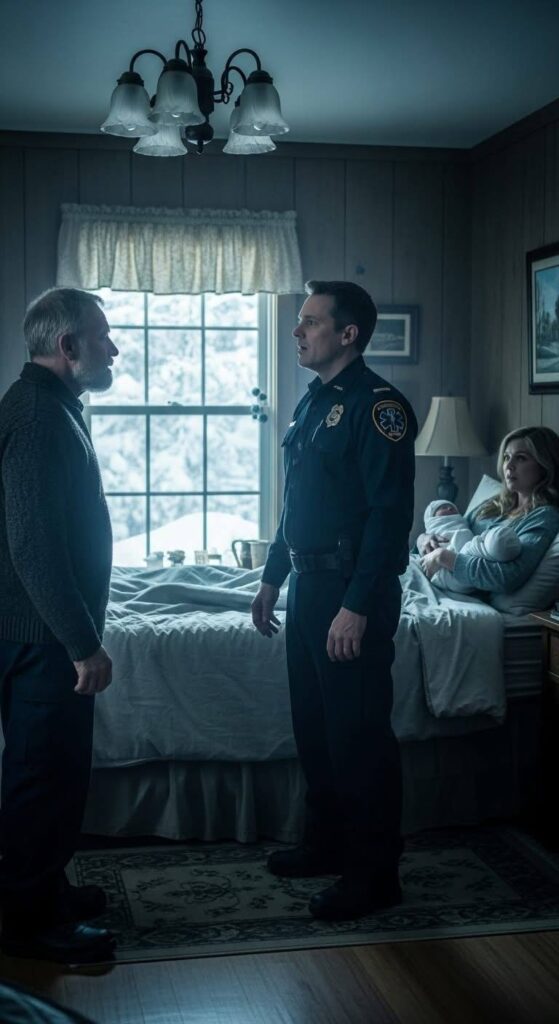
The paramedics arrived the next morning. They were shocked to find two healthy newborns and a tired but stable mother. The lead paramedic, a man about my age named Sergey, looked from the babies to me, and then to Arthur, who was quietly cleaning up.
“Well then,” he said, shaking his head. “Who delivered these two?”
“He did,” I said, pointing to Arthur.
The paramedic’s eyes widened. He walked over to Arthur and peered at his face. “I don’t believe it,” he whispered. He turned back to me, his expression one of pure awe. “Mr. Bishop,” he said, “do you have any idea who you just saved from a snowdrift?”
He told me the story. Ten years ago, Dr. Anatoly Reed was the most brilliant obstetrician in the state, a luminary in his field. He was a genius, a man who could perform miracles. Then, tragedy struck. His wife and son were killed in a car accident, hit by a drunk driver. The loss shattered him. He quit his job, fell into a deep depression, and disappeared. Scammers took his apartment, and he ended up on the streets. Everyone thought he was dead.
I was dumbfounded. The quiet, eccentric homeless man I’d taken in was a legendary doctor, a fallen genius. And he had used his lost gift to save my wife and my children.
Life in our home changed. Arthur—Dr. Reed—was no longer just the groundskeeper. He was a hero, a beloved member of our family. But Kara’s hatred for him only intensified, curdling into something dark and obsessive.
The attack happened a few weeks later. Arthur had taken his usual evening walk to hang feeders for the winter birds. He didn’t come back. I went out looking for him and found him a quarter-mile down the road, lying in the snow, bleeding from a severe head wound. Someone had tried to kill him.
As he recovered in the hospital, I knew I had to face the truth. I confronted Kara. At first, she denied everything. But when I told her I knew about her past, she confessed.
Her secret was a tragic one. When she was eighteen, she had gotten pregnant. Scared and alone, she had gone to Dr. Reed for an abortion. He had been the doctor on call that night. He had talked to her, not with judgment, but with a profound kindness. He hadn’t pressured her, but he had spoken of the sanctity of life, of the potential in every child. His words had moved her, and she had decided to keep the baby. But her boyfriend had left her. She’d had to drop out of school. Her life had become a struggle, and over the years, her gratitude had twisted into a bitter resentment. She blamed Dr. Reed for the hard life she had been forced to live. She had even abandoned her own son, Matthew, in an orphanage a year after he was born. When she saw Dr. Reed, this ghost from her past, in my home, her old hatred had resurfaced, obsessive and violent.
I fired her, of course. But my story with Arthur Reed was far from over. I felt a profound sense of responsibility for this man, a man whose life had been a series of tragedies. He had given me my children. I decided I would give him back his life.
I was a businessman, a man who built things. So I built him a hospital.
It started as an idea, a way to use my wealth for something more than just accumulating more wealth. I found an abandoned hospital building in the city center, a relic of a bygone era. I poured my resources into it, renovating it, equipping it with the most modern technology. It became my passion project. The Dr. Anatoly Reed Perinatal Center. A place of hope, a place for new beginnings.
When Arthur was fully recovered, I took him to see it. He stood before the gleaming new building, his name etched in stone above the entrance, and for the first time since I’d known him, I saw tears stream down his weathered face.
“You don’t have to do this, Owen,” he whispered.
“I know,” I said, clapping him on the shoulder. “But I want to. A man with your gift shouldn’t be feeding birds in the wilderness. He should be saving lives.”
Today, the Reed Center is one of the best in the state. Dr. Reed is back where he belongs, a legend reclaimed from the brink. His hands, once calloused from yard work, are once again performing surgical miracles. Kara, I heard, found her son, Matthew, and they are slowly, painstakingly, rebuilding their relationship.
My life is full. It is filled with the laughter of my children, the love of my wife, and the quiet, profound friendship of the man I pulled from a snowdrift. He saved my family. I’d like to think, in some small way, I helped save his. It turns out my father was right. You should always, always trust your gut.
Interesting For You