
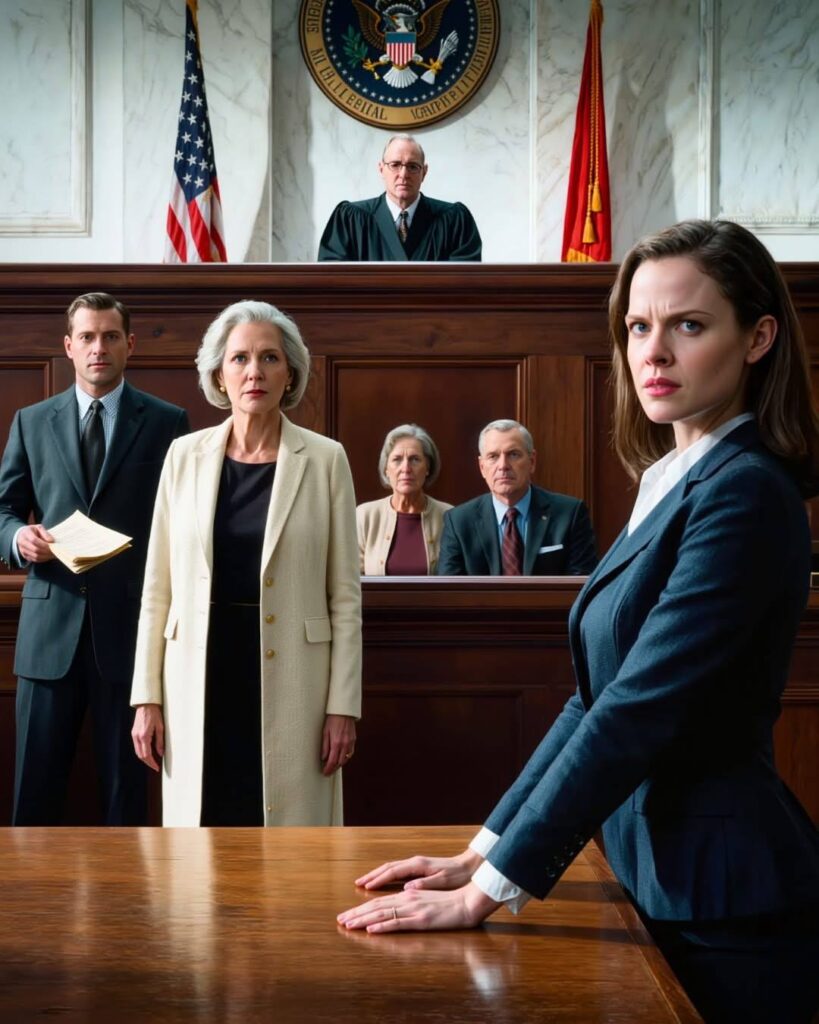
The bailiff read out the case the way you might read a grocery list when you’re already thinking about dinner.
“Estate of Leonard Vale…”
His voice echoed off the high ceiling, bounced over the rows of wooden benches, and landed somewhere in the pit of my stomach. Before he even reached my name, my sister was on her feet.
Not out of grief.
Never grief.
Alyssa rose like someone standing to claim a promotion she’d already told everyone was hers. Her coat—ivory wool, sharply tailored—fell perfectly around her like a frame. Under it, black dress, black heels, black leather bag. It was the kind of quiet luxury that doesn’t shout, Look at me, it whispers, Of course I’m in charge.
Her hair was a smooth dark curtain pinned just so. Her makeup, immaculate. Her eyes… not red, not puffy. No trace of tears. Just calculation. A brisk, practiced brightness that said she’d done this sort of thing before: walk into a room, rearrange reality, walk out with the win.
Her attorney glided up beside her, all gleaming shoes and understated cologne, an expensive watch that flashed when he moved. He carried a slim folder of documents like they were a foregone conclusion. When he reached counsel table, he slid the papers forward with the motion of someone pushing a knife across a table.
“Your Honor,” he said, voice smooth and confident, “we move for immediate transfer of the estate to my client, effective today.”
My parents sat directly behind him, slightly off-center like backup singers in a music video. They nodded at the exact same moment, like they’d rehearsed it in a mirror: solemn, united, righteous.
My father’s jaw was locked in that familiar, unyielding line—his boardroom face. His gaze fixed straight ahead, like this was a meeting and I was the problem he’d come prepared to remove.
My mother’s hands were folded delicately in her lap, fingers laced as if in prayer. She adopted the expression she favored at funerals and charity luncheons: dignified, put-upon, quietly suffering.
None of them looked at me.
The judge didn’t look at them either—not at first. He turned his attention to me, his expression neutral behind square glasses that might have been older than my law-school notebook.
“Ms. Vale,” he said, reading from the file. “Do you object?”
Alyssa’s lips tensed at the corners. She didn’t fully smile; that would have been tacky. But there was something there—a flicker of anticipation, as if she’d already seen this moment in her head: me folding, me pleading, the judge gently explaining why the grown-ups had to take over.
I didn’t beg.
I sat up straighter, placed both hands on the table so that I wouldn’t clench them in my lap, and made sure my voice didn’t tremble.
“Yes,” I said. “I object.”
Her attorney gave a polite, faintly amused smile—something you might offer a child insisting the rules of Monopoly were different at their house.
“On what grounds?” he asked, already certain he’d walk right through whatever I said.
He expected a legal argument. Or a messy emotional outburst he could point to as evidence of my “instability.” Or nothing at all.
I didn’t give him any of those.
“Not yet,” I said. “I want to wait until the last person arrives.”
The judge blinked once. “The last person?” he repeated.
“Yes, Your Honor.” I met his eyes and held them.
Behind me, my sister gave a small, incredulous laugh. There was no humor in it—just sharp disbelief.
“This is ridiculous,” she said, already annoyed. “There is no one else.”
She meant: Everyone that matters is already here.
She meant: We’ve locked the doors on you, Marin. This is a formality.
My father finally turned his head a fraction, just enough that I could see him in my peripheral vision. It was a familiar angle—the one he’d used when I was a teenager, when I’d said something inconvenient in front of his friends. That angled look that meant: You’re embarrassing us. Stop.
https://googleads.g.doubleclick.net/pagead/ads?gdpr=0&client=ca-pub-3619133031508264&output=html&h=280&adk=4062416028&adf=3938564726&pi=t.aa~a.1720809177~i.62~rp.4&w=850&fwrn=4&fwrnh=100&lmt=1770800486&rafmt=1&armr=3&sem=mc&pwprc=9520209535&ad_type=text_image&format=850×280&url=https%3A%2F%2Fmx.ngheanxanh.com%2Fuyenkok%2Fmy-wealthy-sister-demanded-my-inheritance-in-court-and-i-thought-it-was-over-when-the-judge-sighed-then-a-man-in-a-plain-black-suit-walked-in-with-an-envelope-said-one-sentence%2F%3Ffbclid%3DIwY2xjawP5JGZleHRuA2FlbQIxMABicmlkETFJdnIySXBlZ3R6TDF5UkNWc3J0YwZhcHBfaWQQMjIyMDM5MTc4ODIwMDg5MgABHpGNpYG4sHGVrD2T1cRPdeICuH0Nke8bjdT1tJ41bxwkAdDQJxW8wOyM0aYz_aem_n4czzLENg5vl8tNGdUB_FA&fwr=0&pra=3&rh=200&rw=850&rpe=1&resp_fmts=3&aieuf=1&aicrs=1&fa=27&abgtt=6&dt=1770800412890&bpp=2&bdt=4898&idt=2&shv=r20260209&mjsv=m202602050101&ptt=9&saldr=aa&abxe=1&cookie=ID%3D273324e23a4ff43d%3AT%3D1770799529%3ART%3D1770800195%3AS%3DALNI_MbWJ1r2v_iOdhfzdS3BeiM6WhzR1w&gpic=UID%3D00001337c2b96343%3AT%3D1770799529%3ART%3D1770800195%3AS%3DALNI_Ma3Iw743flwlf8NSTMWh4tp_NQcLw&eo_id_str=ID%3Deef675347a6a4ec7%3AT%3D1770799529%3ART%3D1770800195%3AS%3DAA-AfjZpG0iLLfDCxabh-nTzbgn7&prev_fmts=0x0%2C1200x280%2C1200x280%2C1352x556%2C728x90%2C850x280%2C1352x556%2C850x280&nras=8&correlator=5720676710810&frm=20&pv=1&u_tz=420&u_his=3&u_h=1440&u_w=3440&u_ah=1400&u_aw=3440&u_cd=24&u_sd=1&adx=76&ady=5322&biw=1352&bih=556&scr_x=0&scr_y=3111&eid=31096620%2C95378425%2C95382332%2C95382335%2C95382340%2C95382730%2C31096663%2C95382845%2C95379058%2C95382196&oid=2&psts=AOrYGsmxX32VqYL5BaYr4fEes4SFYh9ql-Fa8MnJxfwH3iqqj0EtOmkYPOVQ3Sf8-WWCcqHrLMSJCki3yIWa5mwK-f0qnIR1jttku2sRaFu3NGMzHw%2CAOrYGskjZY_UMn6piBpm_6X5_k4t-zEPYtHgxs3qAQUeiAT_drSZl8dOfMP6fc6bn8dCtpQFNIcuHNVuLOfmDlJPL-TS-qCBzb30WSIdC13A2Ng%2CAOrYGslHCTaySPF4vrshDKxRil0cnOa2_0DhtKG5vXV2Y47vU0RNLcaTHKwQo8CDMfP4cf-knkA-ybVGR_hgyaDRHonG29Ri425SAJiMlA%2CAOrYGsm03IWYaEQwWOq_iq4KFNsMhoh9d2jHMeV40BSoYT9UZG5TV1pfLWTzJH5qS0XjO_w9eJblqMmFlBcHGvm0qy5V4xXW5Ts4DCo3&pvsid=3291976663688879&tmod=1540458628&uas=3&nvt=1&ref=https%3A%2F%2Fl.facebook.com%2F&fc=1408&brdim=1840%2C43%2C1840%2C43%2C3440%2C0%2C1436%2C649%2C1369%2C556&vis=1&rsz=%7C%7Cs%7C&abl=NS&fu=128&bc=31&bz=1.05&pgls=CAEaBTYuOS4x&num_ads=1&ifi=6&uci=a!6&btvi=4&fsb=1&dtd=73414
“You always do this,” he muttered, just loud enough to bleed into the silence. “You make things harder than they need to be.”
The words landed like something thrown, but I didn’t turn.
The judge leaned back in his chair, adjusting his glasses, assessing whether this was a procedural issue or a family circus he wanted no part of.
“Ms. Vale,” he said evenly. “This is probate court, not a stage. If you have an objection, it needs to be legal.”
“It is legal,” I said, keeping my tone calm, almost conversational. “But it isn’t mine to explain.”
That earned me the smallest lift of his eyebrows. My sister’s attorney stepped forward again, seizing the opening.
“Your Honor,” he said in that soothing, reasonable tone that sounds like competence and billable hours, “we’re requesting emergency appointment because Ms. Vale has been uncooperative. There are assets that need protection and my client is the responsible party.”
Responsible.
In my family, that word was never a compliment. It was a weapon.
When my parents called someone “responsible,” they meant, You understand the importance of control. You’ll do what we would do. You won’t ask questions.
https://googleads.g.doubleclick.net/pagead/ads?gdpr=0&client=ca-pub-3619133031508264&output=html&h=280&adk=4062416028&adf=4020180958&pi=t.aa~a.1720809177~i.82~rp.4&w=850&fwrn=4&fwrnh=100&lmt=1770800489&rafmt=1&armr=3&sem=mc&pwprc=9520209535&ad_type=text_image&format=850×280&url=https%3A%2F%2Fmx.ngheanxanh.com%2Fuyenkok%2Fmy-wealthy-sister-demanded-my-inheritance-in-court-and-i-thought-it-was-over-when-the-judge-sighed-then-a-man-in-a-plain-black-suit-walked-in-with-an-envelope-said-one-sentence%2F%3Ffbclid%3DIwY2xjawP5JGZleHRuA2FlbQIxMABicmlkETFJdnIySXBlZ3R6TDF5UkNWc3J0YwZhcHBfaWQQMjIyMDM5MTc4ODIwMDg5MgABHpGNpYG4sHGVrD2T1cRPdeICuH0Nke8bjdT1tJ41bxwkAdDQJxW8wOyM0aYz_aem_n4czzLENg5vl8tNGdUB_FA&fwr=0&pra=3&rh=200&rw=850&rpe=1&resp_fmts=3&aieuf=1&aicrs=1&fa=27&abgtt=6&dt=1770800412914&bpp=1&bdt=4922&idt=1&shv=r20260209&mjsv=m202602050101&ptt=9&saldr=aa&abxe=1&cookie=ID%3D273324e23a4ff43d%3AT%3D1770799529%3ART%3D1770800195%3AS%3DALNI_MbWJ1r2v_iOdhfzdS3BeiM6WhzR1w&gpic=UID%3D00001337c2b96343%3AT%3D1770799529%3ART%3D1770800195%3AS%3DALNI_Ma3Iw743flwlf8NSTMWh4tp_NQcLw&eo_id_str=ID%3Deef675347a6a4ec7%3AT%3D1770799529%3ART%3D1770800195%3AS%3DAA-AfjZpG0iLLfDCxabh-nTzbgn7&prev_fmts=0x0%2C1200x280%2C1200x280%2C1352x556%2C728x90%2C850x280%2C1352x556%2C850x280%2C850x280&nras=9&correlator=5720676710810&frm=20&pv=1&u_tz=420&u_his=3&u_h=1440&u_w=3440&u_ah=1400&u_aw=3440&u_cd=24&u_sd=1&adx=76&ady=5947&biw=1352&bih=556&scr_x=0&scr_y=3793&eid=31096620%2C95378425%2C95382332%2C95382335%2C95382340%2C95382730%2C31096663%2C95382845%2C95379058%2C95382196&oid=2&psts=AOrYGsmxX32VqYL5BaYr4fEes4SFYh9ql-Fa8MnJxfwH3iqqj0EtOmkYPOVQ3Sf8-WWCcqHrLMSJCki3yIWa5mwK-f0qnIR1jttku2sRaFu3NGMzHw%2CAOrYGskjZY_UMn6piBpm_6X5_k4t-zEPYtHgxs3qAQUeiAT_drSZl8dOfMP6fc6bn8dCtpQFNIcuHNVuLOfmDlJPL-TS-qCBzb30WSIdC13A2Ng%2CAOrYGslHCTaySPF4vrshDKxRil0cnOa2_0DhtKG5vXV2Y47vU0RNLcaTHKwQo8CDMfP4cf-knkA-ybVGR_hgyaDRHonG29Ri425SAJiMlA%2CAOrYGsm03IWYaEQwWOq_iq4KFNsMhoh9d2jHMeV40BSoYT9UZG5TV1pfLWTzJH5qS0XjO_w9eJblqMmFlBcHGvm0qy5V4xXW5Ts4DCo3&pvsid=3291976663688879&tmod=1540458628&uas=3&nvt=1&ref=https%3A%2F%2Fl.facebook.com%2F&fc=1408&brdim=1840%2C43%2C1840%2C43%2C3440%2C0%2C1436%2C649%2C1369%2C556&vis=1&rsz=%7C%7Cs%7C&abl=NS&fu=128&bc=31&bz=1.05&pgls=CAEaBTYuOS4x&num_ads=1&ifi=7&uci=a!7&btvi=5&fsb=1&dtd=76232
“Oh, she’s not being difficult, she’s grieving,” my mother added with a soft sigh, as if my mere presence was tragic. “She doesn’t understand how these things work.”
I almost laughed at that. I understood exactly how these things worked. That was why I was sitting here at all.
Alyssa didn’t look at the judge as she spoke. Her attention stayed pinned to me, eyes bright and cold.
“I’m just trying to keep everything from falling apart,” she said. “Grandpa would want this handled properly.”
Handled. Managed. Controlled. In our house, all those words meant the same thing: Sign where we point or we’ll make you regret it.
As the attorney spoke, as my parents nodded on cue, as my sister performed her concerned-executive act, my brain kept drifting back to a different room. Not this oak-paneled courtroom with flags and seals and stiff benches—but the small, cluttered living room where my grandfather had first pressed an envelope into my hands and said, If it ever comes to it, you let the record talk.
I hadn’t understood how literal he was being.
The judge flipped a page in the file, scanning the petition.
“This motion requests full authority over the estate,” he said slowly. “It alleges the respondent”—his eyes flicked briefly to me—“is unfit to participate and may interfere.”
The attorney nodded. “Correct, Your Honor. And we’re asking you to grant that today.”
“Effective immediately?” the judge asked.
“Yes, Your Honor.”
His gaze returned to me. “Ms. Vale, what is your objection?”
This was the moment Alyssa expected me to crumble. To cry, maybe. To say something like, It’s not fair, she always gets everything, and prove her narrative about me being emotional and irrational.
Instead, I sat very still.
“My objection,” I said, “is that they’re asking you to act without the full record.”
Alyssa let out another sharp laugh. “There is no hidden record,” she snapped. “He’s dead. This is what happens.”
https://googleads.g.doubleclick.net/pagead/ads?gdpr=0&client=ca-pub-3619133031508264&output=html&h=280&adk=4062416028&adf=651525914&pi=t.aa~a.1720809177~i.116~rp.4&w=850&fwrn=4&fwrnh=100&lmt=1770800505&rafmt=1&armr=3&sem=mc&pwprc=9520209535&ad_type=text_image&format=850×280&url=https%3A%2F%2Fmx.ngheanxanh.com%2Fuyenkok%2Fmy-wealthy-sister-demanded-my-inheritance-in-court-and-i-thought-it-was-over-when-the-judge-sighed-then-a-man-in-a-plain-black-suit-walked-in-with-an-envelope-said-one-sentence%2F%3Ffbclid%3DIwY2xjawP5JGZleHRuA2FlbQIxMABicmlkETFJdnIySXBlZ3R6TDF5UkNWc3J0YwZhcHBfaWQQMjIyMDM5MTc4ODIwMDg5MgABHpGNpYG4sHGVrD2T1cRPdeICuH0Nke8bjdT1tJ41bxwkAdDQJxW8wOyM0aYz_aem_n4czzLENg5vl8tNGdUB_FA&fwr=0&pra=3&rh=200&rw=850&rpe=1&resp_fmts=3&aieuf=1&aicrs=1&fa=27&abgtt=6&dt=1770800412926&bpp=1&bdt=4933&idt=2&shv=r20260209&mjsv=m202602050101&ptt=9&saldr=aa&abxe=1&cookie=ID%3D273324e23a4ff43d%3AT%3D1770799529%3ART%3D1770800195%3AS%3DALNI_MbWJ1r2v_iOdhfzdS3BeiM6WhzR1w&gpic=UID%3D00001337c2b96343%3AT%3D1770799529%3ART%3D1770800195%3AS%3DALNI_Ma3Iw743flwlf8NSTMWh4tp_NQcLw&eo_id_str=ID%3Deef675347a6a4ec7%3AT%3D1770799529%3ART%3D1770800195%3AS%3DAA-AfjZpG0iLLfDCxabh-nTzbgn7&prev_fmts=0x0%2C1200x280%2C1200x280%2C1352x556%2C728x90%2C850x280%2C1352x556%2C850x280%2C850x280%2C850x280&nras=10&correlator=5720676710810&frm=20&pv=1&u_tz=420&u_his=3&u_h=1440&u_w=3440&u_ah=1400&u_aw=3440&u_cd=24&u_sd=1&adx=76&ady=7354&biw=1352&bih=556&scr_x=0&scr_y=5174&eid=31096620%2C95378425%2C95382332%2C95382335%2C95382340%2C95382730%2C31096663%2C95382845%2C95379058%2C95382196&oid=2&psts=AOrYGsmxX32VqYL5BaYr4fEes4SFYh9ql-Fa8MnJxfwH3iqqj0EtOmkYPOVQ3Sf8-WWCcqHrLMSJCki3yIWa5mwK-f0qnIR1jttku2sRaFu3NGMzHw%2CAOrYGskjZY_UMn6piBpm_6X5_k4t-zEPYtHgxs3qAQUeiAT_drSZl8dOfMP6fc6bn8dCtpQFNIcuHNVuLOfmDlJPL-TS-qCBzb30WSIdC13A2Ng%2CAOrYGslHCTaySPF4vrshDKxRil0cnOa2_0DhtKG5vXV2Y47vU0RNLcaTHKwQo8CDMfP4cf-knkA-ybVGR_hgyaDRHonG29Ri425SAJiMlA%2CAOrYGsm03IWYaEQwWOq_iq4KFNsMhoh9d2jHMeV40BSoYT9UZG5TV1pfLWTzJH5qS0XjO_w9eJblqMmFlBcHGvm0qy5V4xXW5Ts4DCo3%2CAOrYGslH1EBh0M_iNDjbT_iyezCjdFC3J3o97rlpdwgFr56rcYqUNTgP84XZ4f9iS_pVyLSel13YDXlfQcwQX0eg-_LtN1pgT1Zj7-ItuA&pvsid=3291976663688879&tmod=1540458628&uas=3&nvt=1&ref=https%3A%2F%2Fl.facebook.com%2F&fc=1408&brdim=1840%2C43%2C1840%2C43%2C3440%2C0%2C1436%2C649%2C1369%2C556&vis=1&rsz=%7C%7Cs%7C&abl=NS&fu=128&bc=31&bz=1.05&pgls=CAEaBTYuOS4x&num_ads=1&ifi=8&uci=a!8&btvi=6&fsb=1&dtd=92466
Her voice bounced in the quiet room, a little too loud, a little too fast. For the first time, the judge looked mildly irritated.
“Ms. Vale,” he said to her, “you will not speak out of turn.”
My father’s lips tightened. My mother’s eyes narrowed, like she hated watching anyone else scold her daughter. That was supposed to be her domain.
Her attorney tried to smooth the water with practiced politeness.
“Your Honor, if Ms. Vale wants to delay, we object. The estate can’t wait.”
I kept my eyes on the judge.
“It won’t be a delay,” I said. “It’ll be minutes.”
He exhaled once, a small sound, and glanced at the courtroom doors as if considering whether he was about to regret humoring me.
“Who are we waiting for?” he asked.
“The person who actually controls the inheritance,” I said.
The words hung there.
Alyssa’s face tightened, just for a heartbeat. “That’s me,” she said automatically—then caught herself when the judge’s head turned.
He studied me for another moment.
“Ms. Vale, if this is some kind of tactic…”
“It isn’t,” I said quietly. “I’m asking you not to sign anything until the last piece of the record is here. That’s it.”
Silence. Long enough that I heard the rustle of paper from the row behind me, the faint squeak of leather as someone shifted.
Then the doors at the back of the courtroom opened.
They didn’t burst open. No dramatic slam, no cinematic gust of wind. They just swung inward in a controlled, efficient motion that somehow made everyone turn anyway.
A man stepped inside.
He wore a black suit so plain it almost resisted description. No shiny lapels, no colorful tie, no pocket square. White shirt, black tie, dark shoes. That was it. The only thing notable about him was how completely unremarkable he made himself.
He carried a single envelope.
He did not look at my parents. He did not look at Alyssa. He did not scan the room for an audience. He walked straight to the clerk’s desk like a person who’d been in a hundred courtrooms before and never once come there for drama.
He held up the envelope.
“Ms. Vale,” he said.
My name sounded strange in his mouth—formal, detached, like I was a file.
The judge’s hand went instinctively to his glasses. He watched the envelope like it had appeared out of thin air.
The man in the black suit didn’t explain himself. He didn’t preface his next words with apologies or context. He simply placed the envelope on the clerk’s desk and said, in that same calm tone:
“This is for the court. From the trustee.”
The word trustee landed like a small, contained explosion.
The judge took the envelope, glanced at the sender line, and his mouth moved before his brain remembered not to speak out loud.
“That can’t be,” he murmured.
He didn’t treat the envelope like routine mail. He turned it in his hands, studying the return address again, as if checking whether someone was playing a prank on him. Then he tore it open with a single, neat rip.
No theatrics. Just efficiency.
The room went so quiet I could hear the faint hum of the air-conditioning. Somewhere behind me, Alyssa’s attorney shifted his weight. My mother’s bracelet clicked softly as she adjusted it.
The judge pulled out a document, thick paper stamped with an embossed seal. It had the stiff, expensive look of something that spent its life in fireproof cabinets.
He scanned the top line. His jaw tightened.
Then he read the sender out loud.
“Hawthorne National Bank, Trust Department.”
If the name had been First Neighborhood Credit Union, Alyssa probably would have smiled. She’d been in finance for years; she spoke the language of accounts and markets and leveraged this and that. She liked banks—when they belonged to her.
But Hawthorne wasn’t some friendly local branch. It was a national trust department, an institution whose entire existence revolved around managing money for people who didn’t trust their families.
For the first time that morning, my sister’s composure flickered. A tiny hitch. Then the mask slammed back into place.
The judge kept reading, his voice taking on that faint, formal rhythm judges get when they’re reading something into the record.
“This is a notice of trust administration,” he said. “It states the decedent’s assets were placed into a revocable trust and that the trust became irrevocable upon death.”
Alyssa’s attorney was on his feet immediately. “Your Honor, with respect, we’re in probate. If there is a trust, that—”
“Sit down, counsel,” the judge said, not unkindly, but not gently either.
The attorney’s mouth snapped shut. He sat.
The judge turned another page.
“And this,” he continued, “is a certification of trust identifying the trustee.”
He paused. I could practically feel the words on his tongue before he spoke them.
“Successor trustee: Hawthorne National Bank, Trust Department.”
My parents stiffened. It was the first honest reaction I’d seen from them all morning.
Control had just slid out of the room. Not to me, not to Alyssa, not to any blood-related Vale. It had gone to a corporate entity that did not care who cried or shouted or reminded it of “everything we’ve done for this family.”
A bank doesn’t care about guilt trips. A bank cares about documents, risk, and instructions.
Alyssa’s attorney tried to rally. “Even with a trust, Your Honor, the court still has jurisdiction over the estate assets—”
The judge finally looked up, his patience thinning.
“Counsel,” he said, tapping the paper in front of him, “your motion requested ‘all inheritance, effective immediately’ for your client. This certification states that the probate estate is minimal and that the bulk of assets are held in trust. That is a materially different reality than what your motion suggests.”
He nodded to the clerk. “Mark the notice as received.”
Then he looked at Alyssa—not as a daughter buried in grief, but as a petitioner whose paperwork had just collided with a brick wall.
“Ms. Vale,” he said. “Did you know your grandfather established a trust with a corporate trustee?”
Alyssa lifted her chin. “He was influenced,” she said quickly. “He didn’t understand what he was signing.”
She said the word influenced like a diagnosis: of course he couldn’t have wanted this. If something had happened that didn’t benefit her, then by definition, something was wrong.
The judge didn’t argue about her feelings. He lifted another page.
“This notice includes a copy of the trust’s execution affidavit and the list of witnesses,” he said. “There’s also an attorney certification stating that the decedent signed with full capacity.”
Behind me, I heard my father inhale sharply through his nose. My mother’s eyes narrowed again, scanning the room for a new angle.
Then the judge hit the sentence I knew was coming. The one my grandfather had told me about, years earlier, at his kitchen table, while a pot of coffee hissed softly on the stove.
“Additionally,” the judge read, “the trust includes a no-contest clause. It states that any beneficiary who petitions to seize trust assets contrary to the trust terms forfeits their distribution.”
Alyssa’s attorney lost a little color.
My sister didn’t move, but something in her eyes went very, very still. She looked like someone who had just realized the floor she’d been walking on was glass.
The judge lowered the page.
“Counsel,” he said to Alyssa’s attorney. “You filed a motion asking for ‘all inheritance’ to be transferred to your client, effective immediately. You understand that this clause is enforceable? The act of filing that motion may already have triggered forfeiture.”
“Your Honor, we dispute the validity of—”
“You can dispute it,” the judge cut in. “You can’t pretend it doesn’t exist.”
He turned back to me.
“Ms. Vale,” he said. “You asked to wait for the last person to arrive. Was this the person you meant?”
I swallowed once, my pulse loud in my ears, but my voice stayed level.
“Yes, Your Honor,” I said. “The trust department is the trustee. They control the distribution.”
The man in the black suit had remained standing near the clerk’s desk, hands loosely at his sides, like any other functionary. At the judge’s glance, he stepped forward half a pace.
“Your Honor,” he said, calm and precise, “I’m not here to argue. I was instructed to deliver notice and confirm the trustee’s position.”
“State it,” the judge said.
The man did not turn toward my family. He kept his gaze on the bench, the way someone looks at a traffic light: impersonal, matter-of-fact.
“The trustee does not recognize the petitioner’s request,” he said. “The trustee will not distribute assets to anyone based on today’s motion. The trustee will administer the estate according to the trust terms and requests that the court dismiss any attempt to seize trust-controlled assets through probate.”
“You can’t just—” Alyssa started.
“Ms. Vale,” the judge snapped. “You will not speak out of turn again.”
She shut her mouth, but her breathing had changed. Shorter, sharper.
Her attorney scrambled for another foothold.
“At minimum, Your Honor, we move to compel production of the full trust. We have serious questions about whether my client was improperly removed as a trustee or beneficiary. There may have been undue influence by the respondent.”
There it was. The word I’d been waiting for.
Undue influence. The close cousin to the other term I knew they’d brandish if cornered: elder abuse.
The judge’s eyes cooled.
“Undue influence is a serious allegation,” he said. “And you are making it in the same breath as a motion that appears to violate an explicit no-contest clause.”
He looked at the man in the black suit again.
“Has the trustee provided the trust instrument to counsel?” he asked.
“Yes, Your Honor,” the man said. “A complete copy was delivered to both sides yesterday via certified service.”
My mother’s head whipped toward Alyssa’s lawyer. “Yesterday?” she hissed, her stage whisper carrying farther than she intended.
Meaning: they’d known. Or should have known. They had the document with the clause. And they’d filed anyway.
The judge let that sit.
“Did you receive the trust documents yesterday, Ms. Vale?” he asked Alyssa.
She opened her mouth, then closed it again. Her attorney beat her to it.
“Your Honor, we received a packet, but—”
“Counsel,” the judge interrupted. “If you received a packet containing a no-contest clause and still filed a motion demanding all inheritance, effective immediately, I want you to understand how that appears to this court.”
Her attorney went still.
The judge turned to the clerk. “Set a hearing on standing and sanctions,” he said. “And enter the trustee’s letter into the record.”
Then he looked back at my sister.
“And, Ms. Vale,” he added, voice colder now, “if you are a named beneficiary, filing that motion may have just cost you more than you intended.”
For the first time, Alyssa’s mask cracked. Her face twisted—less grief, more something raw and ugly. She turned her gaze on me, and the hatred there was almost a physical thing.
It wasn’t just about money anymore. It was about the humiliation of discovering that the institution she’d expected to crown her had quietly categorized her as a risk.
And when Alyssa couldn’t win by paperwork, she always reached for something else.
“Your Honor,” she said suddenly, her voice pitched louder now, sharpened with urgency. “I need to put something on the record.”
The judge’s eyes narrowed. “What, exactly?”
Alyssa turned fully toward the bench, but her eyes slid to mine when she said the word they’d been saving like a bullet.
“Elder abuse,” she announced.
The air in the courtroom changed. Not because anyone believed her immediately. But because those two words were heavy enough that the entire proceeding now had to bend around them.
“Elder abuse,” she repeated, louder, as if sheer volume might turn accusation into evidence. “The respondent isolated my grandfather, controlled his access to us, and coerced him into signing documents that benefit her.”
Everyone looked at me.
My aunt and cousin, huddled in the back row, shifted uncomfortably. My mother’s face melted into instant, practiced anguish. My father leaned back slightly, eyes narrowing, calculating how to use this new angle.
The judge, however, did not look impressed.
“Counsel,” he said to Alyssa’s attorney, “those are serious allegations. What evidence do you have today?”
“We have witnesses,” Alyssa said quickly, gesturing toward our relatives. “They can testify that she pushed him, that she kept us away, that he didn’t know what he was signing—”
“Witnesses can testify,” the judge said flatly. “I’m asking for something concrete. Medical reports? Prior complaints? Police reports? Adult Protective Services involvement? Anything?”
“He didn’t want to embarrass the family,” Alyssa protested. “He was scared—”
“Then explain why he was the one who called emergency services,” the judge said.
The room went still again.
My sister scrambled. “He was confused,” she said. “He didn’t know what he was doing—”
The judge looked down at the envelope from Hawthorne, then back up.
“According to this file,” he said, “the trust was executed with a capacity affidavit and witness signatures. That suggests deliberation, not confusion.”
My father’s attorney—who had been quiet until now—rose and tried to wedge himself in.
“Your Honor, we also have evidence that the respondent had access to accounts and controlled communications—”
“Objection,” my attorney, Elliot, finally said beside me. I realized my hands had gone numb gripping the table. “Argument without foundation.”
The judge held up a hand.
“Do you have any of that evidence with you today, counsel?” he asked.
There was the briefest hesitation.
“We would request discovery—”
“Discovery is not a fishing license,” the judge said sharply. “You do not accuse someone of elder abuse in open court as a tactic to seize assets held in trust.”
Alyssa flushed. “It’s not a tactic,” she snapped. “It’s what she—”
“Then bring evidence,” the judge said, cutting her off. “Not relatives coached to perform.”
My mother’s voice trembled in that way she’d perfected. “Your Honor, she turned him against us,” she said. “She made him hate his own family.”
“This is not family therapy,” the judge replied. “This is court.”
He turned again to the one person in the room with no emotional stake, only fiduciary duty.
“Sir,” he said to the man in black. “Does the trustee have any documentation of concerns regarding undue influence or abuse?”
“No, Your Honor,” the man answered without hesitation. “The trustee conducted standard intake. The decedent met privately with counsel. He confirmed his intent. The trustee received a letter of instruction and supporting materials.”
The judge’s interest sharpened.
“Supporting materials?” he asked.
“Yes,” the man said. “A log and a written statement. The decedent requested that they be preserved.”
Alyssa’s head snapped up. “What statement?” she demanded.
The judge ignored her.
“Provide it,” he told the man.
The man reached into a second envelope I hadn’t even noticed. It had been tucked flat against a folder, so unobtrusive I’d forgotten my grandfather had mentioned it at all. The trust representative handed it to the clerk, who passed it to the judge.
The judge unfolded a single page. His eyes moved slowly, carefully. He read longer this time, lips tightening at one line, then another.
Then he looked at me.
“Ms. Vale,” he said. “Did you know your grandfather prepared a written statement anticipating these kinds of allegations?”
I swallowed. “He told me he wrote something,” I said quietly. “I didn’t know what it said.”
The judge looked back at the letter.
“If this is being read in court,” he read aloud, “it means my son and his family tried to take my estate by accusing my granddaughter.”
My mother made a strangled sound, half gasp, half sob. My father’s face went rigid.
The judge continued, skipping some lines, choosing passages that spoke directly to today.
“He states that he asked you”—he nodded in my direction—“to move in after his fall,” the judge read. “That he met with his attorney alone to discuss his estate. That he created the trust specifically because he feared pressure tactics and rapid-signature demands from other family members.”
My grandfather’s words, in the judge’s voice, sounded more clinical than angry. That was worse, somehow.
Then the judge reached the line I remembered my grandfather repeating at the kitchen table, the one he’d chuckled over without any real humor.
“On the night I called emergency services,” the judge read, “my son brought a mobile notary to my home to obtain new signatures. I refused to sign. I requested witnesses. If anyone calls what happened that night ‘elder abuse,’ they are describing their own conduct, not my granddaughter’s.”
The room was silent.
I could see it, as if I were back there: Grandpa in his worn armchair, the mobile notary nervously hovering by the coffee table, my father pressing a pen into his hand, my mother tsk-ing about “making things simple” while Alyssa hovered in the doorway scrolling her phone, calculating.
I remembered Grandpa’s hand shaking—but not from confusion. From anger.
I remembered him looking at me and saying, “Call 911.”
He hadn’t looked confused then.
My father’s attorney jumped in, desperation creeping into his polished tone. “Your Honor, we object to hearsay—”
“It’s a statement of intent,” the judge said. “And it’s consistent with the recorded dispatch call and the trust documents. Your objection is overruled.”
He lifted the letter slightly.
“This court is not going to entertain a last-minute elder abuse allegation as a strategy to pry assets away from a corporate trustee,” he said, enunciating each phrase like he wanted it clearly audible on the recording.
“If you want to file a proper petition with actual evidence, you may. But not today. Not like this.”
Beside my sister, her attorney swallowed. “Your Honor, in light of this, we’d… we’d like to withdraw our motion.”
The judge looked at him for a long moment.
“You can’t withdraw consequences,” he said finally. “But you can stop digging.”
His gaze swept over all three of them—my parents, my sister, their attorney—as if he were mentally assigning them to separate boxes: reckless, complicit, foolish.
“Motion denied,” he said. “The trustee will administer the trust. The petition for immediate transfer is dismissed. We will proceed with sanctions at a later hearing.”
My mother went pale. My father’s jaw clenched hard enough that a muscle jumped near his ear. Alyssa’s hands were trembling now; I could see it in the way they gripped the edge of the table.
“So she gets everything,” Alyssa burst out suddenly, pointing at me as if she’d found the still point in the chaos. “Is that it?”
The judge didn’t flinch.
“The trust will be administered according to its terms,” he said. “Not according to who yells the loudest in this room.”
The man in black spoke up again, voice even.
“Given today’s events,” he said, “the trustee will suspend any distributions to parties potentially affected by the no-contest clause until a full review is complete. We will follow the trust language precisely.”
Alyssa whipped around to face him. “Suspend?” she said, incredulous. “You can’t—”
“That is the trustee’s position,” he replied calmly.
The judge leaned forward.
“Ms. Vale,” he said, addressing Alyssa, “you walked into this courtroom acting as if the estate already belonged to you. That is not how this works. Today, nothing has been decided in your favor. And you will answer for the way you attempted to obtain control.”
Her eyes found mine again, burning with humiliation.
“This isn’t over,” she hissed.
I believed her. I also knew something she was still refusing to accept: this wasn’t my game anymore. It was the record’s.
Before I could respond, the bailiff stepped closer to the bench and murmured something low to the judge. The judge’s expression shifted, not to surprise, exactly, but to a kind of tired inevitability.
He nodded once.
“Mr. Vale,” he said, turning toward my father. “Remain seated.”
My father stiffened. “Why?” he demanded.
“Because,” the judge said, “I’ve just been informed there is a deputy in the hallway with paperwork for you. It is not from this court.”
The words seemed to hang in the air for a second before the doors opened again. A uniformed sheriff’s deputy stepped inside, another two visible just behind him.
The deputy carried a packet of documents with a bold header across the top. Even from my seat, I recognized the formatting.
Not civil.
Criminal.
The deputy approached my father’s row but didn’t crowd him.
“Sir,” he said. “You’ve been served.”
My father didn’t stand up for this. He didn’t demand to know who had authorized it. He stared at the papers as if they were radioactive.
“What is this supposed to be?” he asked, voice thin with tightly leashed fury.
“Service of process,” the deputy said. “You can accept it here or in the hallway.”
My father’s attorney leaned in and whispered urgently. My father ignored him and snatched the documents from the deputy, flipping the first page open with shaking hands.
His eyes skimmed the heading. They stopped. The color drained from his face.
“This court has no involvement with that matter,” the judge said. “But, Mr. Vale, I remind you that you are still under oath from earlier testimony.”
“My family is being targeted,” my father said, regaining a shred of his old booming voice. “This is harassment. My daughter—”
“Stop,” the judge said firmly. “Your daughter is not the one who called emergency services to report coercive conduct. Your daughter is not the one who tried to rewrite the decedent’s estate plan in the middle of the night. And your daughter is not the one who filed a false motion in this court.”
My mother whispered, “We were trying to protect the family.”
“You protected it straight into a referral,” the judge replied.
The two deputies by the door didn’t move, but their presence changed the room. It turned the hearing from a family drama into something colder, more permanent.
Alyssa’s attorney cleared his throat. “Your Honor, in light of everything, we would request a brief recess to confer with our clients—”
“You may confer,” the judge said, already picking up his pen, “but the motion is dismissed, the trustee remains in control, and sanctions are on calendar. This hearing is over.”
He paused, then looked back at the man in black.
“One more thing,” he said. “Does the trustee request any protective order?”
“Yes, Your Honor,” the man answered immediately. “Given the attempted interference, the trustee requests an order prohibiting the petitioners from contacting financial institutions, custodians, or third parties in an attempt to access trust assets, and prohibiting harassment of the primary beneficiary.”
The word harassment seemed to hit Alyssa like a slap.
“Harassment?” she echoed, disbelieving. “We’re her family.”
The judge turned a cool stare on her.
“You just accused your sister of elder abuse with no evidence,” he said. “You are in no position to scoff at the word ‘harassment.’ Protective order is granted. Draft it. I’ll sign today.”
My mother’s face crumpled.
“You can’t keep us away from our own daughter,” she whispered.
“You are welcome to stay away from misconduct,” the judge said. “Court is recessed.”
The gavel hit the block with a crack that sounded, to me, like a door locking.
The moment we stepped into the aisle, my mother was there. Not hugging me—she almost never did that—but close enough that her perfume hit me in a cloying wave.
“You did this,” she hissed, face twisted, all pretense of dignity gone. “You ruined your father.”
I didn’t flinch.
“He ruined himself,” I said quietly.
From the other side, Alyssa moved in, eyes wild. Up close, I could see the faint smudges at the corners of her eyeliner, the almost-tremor in her hands.
“You’re going to lose everything,” she whispered. “I will make sure of it.”
I thought of the trust officer’s calm voice, of the embossed seal, of my grandfather’s letter warning the court exactly what my family would try.
“You already tried,” I said. “And the trustee didn’t even have to raise its voice.”
Her mouth twisted. “You think you’re safe because some bank sent a guy in a cheap suit?” she spat.
I leaned in, just enough that she’d hear me over the buzz of people leaving the courtroom.
“I think I’m safer than you,” I said, “because Grandpa planned. And because you can’t bully a written record.”
For a second, I saw the urge to scream flash across her face.
Instead, she did something else.
She pulled out her phone, tapped quickly, and then flipped it face-down on the table as if to hide the screen from anyone watching.
I might have missed it if Elliot hadn’t noticed too. His gaze flicked to her hand, then to mine.
“Don’t engage,” he murmured. “We’re done here. We walk out. That’s it.”
We exited through the side door, away from the knots of attorneys and family members spilling into the hall. The afternoon air outside the courthouse was hot and too bright, sky washed a flat, indifferent blue.
“Here’s your concrete outcome,” Elliot said once we were at the curb. “The trust controls everything. The motion is dead. The no-contest clause is in play. Your parents have no legal avenue to grab the assets. And the court just granted a protective order around you.”
I nodded, but my chest didn’t feel lighter. Just… hollow.
“And Alyssa?” I asked.
“If she’s a named beneficiary,” he said, “today likely triggered forfeiture. That’s what her lawyer is realizing right now.”
We stood there for a moment, the roar of traffic filling the pause.
Then Elliot’s phone buzzed in his hand. He glanced at it, and I watched his expression sharpen.
“What?” I asked.
He held the screen toward me.
Hawthorne National Bank – Trust Department
SECURITY ALERT: Attempted access blocked.
The empty space in my chest filled with cold.
“The hearing just ended,” I said.
Elliot’s jaw set.
“They’re trying to get into the money now,” he said.
In my head, I saw Alyssa flipping her phone face-down in the courtroom, not to keep from yelling, but to hide the fact that she was already in motion.
Elliot was already dialing.
“Hawthorne Trust, this line is recorded, how may I help you?” a woman’s voice answered, professional and steady.
“This is Attorney Elliot Lane,” he said. “Counsel for Marin Vale. I just received a security alert indicating an attempted access. I need details.”
There was a pause, the faint clacking of keys.
“Yes, I see it,” the woman said. Her tone shifted slightly—not alarmed, but focused. “An attempted login to the beneficiary portal. The multifactor authentication failed. Immediately afterward, there was an attempt to change the contact phone number on file.”
My stomach dropped.
“Change it to whose?” I demanded.
The trust officer didn’t respond directly to me.
“Mr. Lane,” she said, “are you authorizing me to disclose the attempted change data to your client?”
“Yes,” he said. “You can speak freely.”
“The attempted phone number change request,” she said, “originated from a device associated with the petitioner, Alyssa Vale.”
I closed my eyes for half a second. I could see her hunched over the screen, thumbs flying, telling herself that this was just “securing what’s rightfully mine.”
“Did she authenticate?” Elliot asked.
“No,” the officer replied. “The system blocked the request. A manual fraud flag has been placed. All distribution status related to that beneficiary is now on hold pending review.”
“Freeze everything,” Elliot said. “No portal changes of any kind without in-person verification. No phone, email, or address changes. Treat any attempted changes as fraud unless initiated through counsel.”
“Already done,” she said. “And a security report has been generated.”
“Send the report to my office,” he said. “And note that there is now a court order prohibiting interference. I’ll be forwarding a copy.”
“Understood,” she replied. “The trustee will comply.”
The call ended.
Elliot looked at me.
“That alert,” he said, “is exactly why corporate trustees exist. They don’t get yelled into submission. They log. They block. They report.”
“So she tried to get in,” I said slowly. “And she failed.”
“Yes,” he said. “And now there’s a timestamped record tying her to attempted interference minutes after the judge warned her.”
We went straight to his office—a quiet space of glass walls, muted art, and thick carpets that hid the sound of fear.
He printed the security report, slid it across the desk to me. It was dry and clinical: timestamps, IP addresses, action descriptions. No adjectives. No narrative. Just facts.
“That,” he said, tapping the page with one finger, “is more powerful than any tearful speech she could give.”
He drafted a one-page instruction for me to sign: all trust communications directed through counsel; no direct contact from my family to Hawthorne to be accepted; any attempted change treated as fraud.
I signed.
He scanned the instruction and the security report and emailed them to the judge’s clerk with a brief note: Attempted access to trust portal blocked within minutes of court recess. For use at the sanctions hearing.
No commentary. No editorializing. Just a digital paper trail lining up behind everything that had just happened in that courtroom.
An hour later, Elliot’s assistant tapped on the open door.
“Hawthorne’s representative is on video if you’re ready,” she said.
The screen lit up with the same man in the black suit. He looked exactly as he had in the courtroom, as if he’d stepped into his office and immediately sat down in front of a camera.
“Ms. Vale,” he said with a small nod. “Mr. Lane.”
“Thank you for joining us,” Elliot said. “We wanted to confirm the trustee’s interpretation of the no-contest clause given today’s filing and subsequent activity.”
“The trustee has reviewed the clause and the relevant events,” the man said. “Based on the petition and the attempted portal interference, we’ve determined that Ms. Alyssa Vale has triggered the no-contest provision. Her beneficial interest is deemed forfeited, subject to court acknowledgment.”
The words felt bigger than the small conference room.
“And my parents?” I asked before I could stop myself.
“Their contingent interests are under review,” he said in the same measured tone. “Given their participation in the petition and their coordinated behavior, the trustee treats them as potentially complicit in interference. We will file a declaration with the court outlining our conclusions and recommendations.”
That, more than any gavel strike, felt like the end of something.
It wasn’t glamorous. There were no dramatic monologues, no last-minute confessions. Just a man in a plain black suit calmly describing how an institution had decided my sister was too dangerous to trust with what she wanted most.
Two weeks later, we were all back in the same courtroom for the sanctions hearing.
Alyssa’s attorney looked like he’d aged ten years. He stood, cleared his throat, and said, “Your Honor, we withdraw all contested claims and apologize to the court for the prior filing.”
The judge didn’t smile. He didn’t say, It’s all right, these things happen.
He imposed monetary sanctions for the bad-faith motion. He ordered Alyssa to pay a portion of my attorney’s fees. He recognized the trustee’s enforcement of the no-contest clause and noted the security report as supporting evidence of ongoing interference.
Then he turned to my parents.
“Your daughter did not take anything from you,” he said, looking from my mother to my father and back again. “Your father’s documents took control away from you. You responded with manipulation and false accusations. This court will not help you undo what he did.”
My mother cried then.
Not the brittle, practiced tears she’d let fall at the funeral while carefully checking her lipstick in her compact. Real tears. Not grief for my grandfather, but grief for a future she’d already started spending in her mind.
My father stared at the floor as if hoping to find some overlooked angle, a loophole the judge hadn’t seen.
There wasn’t one.
Within a month, Hawthorne processed the first scheduled distributions. The house stayed titled in the trust, outside of probate. The accounts were moved into the bank’s custody, each entry mirrored by a ledger note and confirmation receipt. Everything my grandfather owned transformed into numbers and lines and trailing notations in systems my parents couldn’t access without tripping an alarm.
And Alyssa—wealthy, competent, endlessly confident Alyssa—learned that none of those things mattered when you treated legal documents like suggestions. Her wealth hadn’t protected her from a clause she hadn’t bothered to read. Her confidence hadn’t impressed the judge or the trustee.
Courts don’t reward swagger. They reward proof.
On the evening the final confirmation email arrived from Hawthorne, I sat alone at my kitchen table. No courthouse, no lawyers, no uniforms in the doorway. Just the soft hum of the fridge, the tick of the clock, the glow of my laptop screen.
I opened the same worn folder my grandfather had handed me years earlier.
Back then, I’d laughed nervously when he slid it across the table. “You’re planning for World War III,” I’d joked.
He’d smiled in that quiet way of his. “No,” he’d said. “I’m planning for my son.”
In the folder was a copy of the trust summary, the letter he’d written for the court, and a short note addressed to me in his shaky handwriting.
Marin, he’d written. People who can’t control you will try to control the story about you. Don’t fight story with more story. Fight it with something they can’t edit.
He didn’t know what today’s world looked like—group chats, social media posts, carefully curated text messages: modern stories printed in pixel instead of ink. But he understood something that hadn’t changed.
Paper outlasts performance. Records outlast rage.
Three weeks after the sanctions hearing, the court entered Hawthorne’s declaration into the official record. The trust was locked. No changes without in-person verification. Alyssa’s forfeiture was affirmed. My parents’ bid for a “family settlement” was denied, the judge noting that any such settlement could not override the no-contest clause they’d triggered. The sanctions order requiring them to reimburse fees became another number on another ledger.
After that, there were no more emergency motions. No more surprise filings. The inbox quieted.
What remained was… life.
I kept living in my grandfather’s house, now not as a guest but as the primary beneficiary of a trust he’d built stubbornly, quietly, one meeting at a time. I mowed the lawn. I cooked in the kitchen where he’d once burned toast every other morning. I walked past the armchair where he’d sat on the night my father arrived with the mobile notary, and I could almost hear his voice.
“Call 911, kiddo.”
Not because he was scared of me.
Because he was scared of them.
In the end, I didn’t win because I argued better. I didn’t win because I was morally superior or more lovable or more tragic.
I won because my grandfather chose to believe me when I told him what my parents and Alyssa would do if given the chance.
And then he did something radical for our family.
He wrote it down.
THE END.