
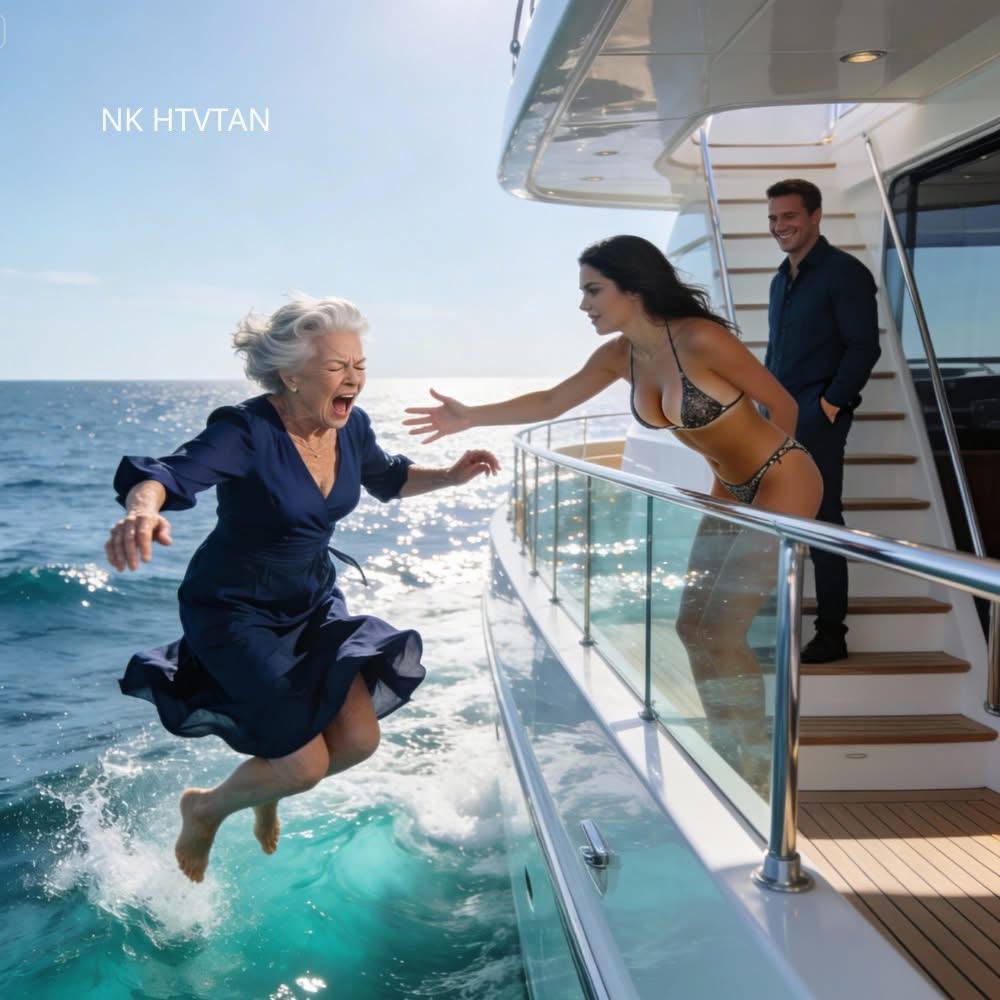
“Say hello to the sharks,” my daughter-in-law whispered as she shoved me off the yacht. My son David simply stood there smiling. Their plan was to steal my fortune of three billion pesos. But when they returned home later that same night, I was sitting in my favorite armchair with a very special gift waiting for them. If you’re watching this, subscribe and tell me in the comments where you’re watching my story from. Let me rewind and tell you how a perfectly ordinary Tuesday morning ended with me falling into the Gulf of Mexico.
I suppose I should have seen it coming, but at sixty-seven I still believed family meant something, that blood was thicker than saltwater, so to speak. The morning had started beautifully. David called me personally—not through his assistant—which should have been my first warning sign, to invite me on what he called a celebratory cruise on his new yacht. “Mom, we want to toast your recovery from surgery,” he said in a warm voice that I mistook for genuine affection. Just the three of us, like a real family. I had been recovering for six weeks from a hip replacement, and honestly, I was desperate for any sign that my son and his wife Vanessa still wanted me in their lives since my husband Roberto Medina died two years earlier, leaving me the fortune of his technology empire. Things between us had felt different since then—colder. So that morning I dressed carefully in my navy-blue dress, the one Roberto always said brought out my eyes, and took a taxi to the marina.
The yacht was magnificent, a gleaming white vessel that probably cost more than most people’s homes. David greeted me on the dock with a hug that felt rehearsed, while Vanessa watched from the deck with a smile as sharp as broken glass. “Isn’t she beautiful?” David asked, gesturing toward the boat. “Almost thirteen meters of pure luxury. We’re thinking of taking her to the Caribbean next month.” What he didn’t mention was that they had bought it with the money I gave them the year before to invest in David’s consulting firm—three million pesos that I was beginning to suspect had never entered any business account at all.
The first hour was pleasant enough. We sailed into calm waters, the Veracruz coastline shrinking behind us. Vanessa served mimosas and talked about her plans to remodel the house—my old house, the one I had put in her name after Roberto died because I thought downsizing to an apartment would be simpler. Then David started asking questions. At first they were casual—about my will, about trust arrangements, about whether I had considered making changes to simplify things for them. “Inheritance can be so complicated, Mom,” David said, refilling my champagne glass with slightly too much enthusiasm. “We just want to make sure everything is taken care of.” That was when I noticed Vanessa recording me with her phone, not openly, but holding it at an angle while pretending to take selfies, capturing me on camera while I drank, while I talked about financial matters, building some kind of evidence.
The pieces snapped together with horrifying clarity: my surgery, their insistence on handling all my paperwork afterward, the power-of-attorney documents they brought to the hospital saying it was temporary, just to help with bills while I recovered, the way my financial advisor had stopped returning my calls. “David,” I said carefully, setting my glass down. “I want to go back to shore now.” That was when his mask dropped completely.
“I’m afraid that’s not going to happen, Mom.” His voice was different now, harder. “You see, we need to talk about your health—about your memory problems.” “Memory problems?” I repeated. I was more lucid than the two of them combined. “You’ve been showing signs of dementia,” Vanessa added, stepping forward. “We have it documented. Doctors agree you’re no longer capable of managing your finances.” “That’s absurd,” I said, but even as I spoke, I realized how carefully they had orchestrated everything. The yacht was miles from shore. There were no other boats in sight—just the three of us, the sea, and their plan to force me to sign everything over.
“Mom, we’re just trying to help you,” David said, but his eyes were cold as winter. “We can do this the easy way or the hard way.” I stood slowly, my hip still aching, but my mind crystal clear. “And if I refuse?” That was when Vanessa truly smiled for the first time all day. “Well,” she said lightly, “a woman with recent surgery probably took too many painkillers, got disoriented on a yacht…” She shrugged. “Tragic accidents happen all the time.” I had raised that man from diapers, taught him to ride a bike, paid for his university, his wedding, his house—and now he stood there nodding while his wife threatened my life.
“You’re insane if you think you’ll get away with this.” “Actually, Mom, we’ve thought it through very carefully.” David pulled out a folder of papers. “Your signature here, transferring all assets immediately for your own protection, and we all go home happy.” I looked at the documents, at my son’s expectant face, at Vanessa’s phone still recording. Then I looked at the sea—vast and dangerous, and somehow less terrifying than the two people who were supposed to love me. “Go to hell,” I said. That was when Vanessa stepped behind me and whispered those words about the sharks. The push wasn’t violent—they were too smart for that—just a sudden shove while I was unbalanced, looking at the water, and I fell in my navy-blue dress straight into the Gulf of Mexico.
As I hit the water, I heard David shout, “Mom! Oh my God! Mom!” But I also heard Vanessa’s lower voice speaking to someone on the phone. “Yes, we’ll need you to file the emergency petition first thing Monday. It’s clear she’s no longer competent.” Then the water closed over my head, and I had bigger problems than their betrayal. I’m a strong swimmer—Roberto and I used to swim laps every morning—but the cold shocked my system and my clothes dragged me down. I kicked off my shoes and surfaced gasping just in time to see the yacht speeding away. They were really leaving me there to die.
That was when I saw the fishing boat. Captain Jacobo Morales was exactly the kind of man who would dive into shark-infested waters to save a drowning grandmother in her sixties—weathered by decades at sea and guided by a moral compass sorely lacking in my own family tree. “Holy heavens, ma’am, what happened?” he asked as he and his teenage grandson Tomás hauled me aboard. I was shaking uncontrollably, teeth chattering so hard I could barely speak. Jacobo wrapped me in a blanket that smelled of salt and engine oil while Tomás started the motor.
My family,” I managed to say between shivers. “Them—the yacht.” “We saw them take off,” Jacobo said grimly. “Didn’t even look back to see what kind of people leave someone floating in the middle of the sea.” “The kind who inherit three billion pesos,” I thought. Out loud I said, “The kind who aren’t really family.” Jacobo radioed the Navy while Tomás piled another blanket on me. “Santa Lupita here. We’ve rescued a woman from the water about nineteen kilometers offshore, near Veracruz. She’s conscious but needs medical attention.” “Wait,” I said, grabbing Jacobo’s arm. “Please don’t let them know you found me. Not yet.”
Jacobo studied me with the sharp eyes of someone who’s lived long enough to recognize when a person is running from more than cold water. “Are you in some kind of trouble?” “Yes. But not the kind you’re thinking.” I took a breath. “I need to reach shore without anyone knowing I survived. Can you help me?” Tomás looked at his grandfather uncertainly. “Grandpa, shouldn’t we—?” “Duty and rules are funny things,” Jacobo said slowly. “Sometimes doing what’s right doesn’t look like following them.” He lowered his voice on the radio. “Navy, Santa Lupita here. Rescued woman alive. Request discretion due to possible family risk. Transporting her to a private dock for medical attention. Will report coordinates upon arrival.”
As we headed toward a small private dock, Jacobo already knew the full story. I told him everything about David and Vanessa, the money, the documents they wanted me to sign. Jacobo listened without interrupting, his expression darkening with every detail. “So they’d rather be rich orphans than poor children with a living mother,” he said when I finished. “Seems so.” “So what are you going to do?” That was the question. To David and Vanessa, I was officially dead. They’d return to shore, call the authorities, report me missing after falling overboard, play the grieving family while executing the legal documents they already had prepared.
But there’s something curious about being officially dead. It gives you options you never had while alive. “I’m going to let them believe they won,” I said, surprised by how calm my voice sounded. “And then I’m going to destroy them.” Jacobo smiled for the first time since pulling me from the water. “Now that’s a plan worth helping with.”
Tomás dropped us at a tiny hidden dock in a cove I’d never seen. Jacobo knew a woman who ran a small inn—no questions, cash only. Mrs. Chen, a strong-looking woman in her seventies, saw me as I was and immediately put soup on to heat. She didn’t even blink when Jacobo explained I needed a place to stay off the books for a while. “My daughter,” she said as she served chicken broth, “I’ve run this place thirty years. I’ve seen people running from all kinds of things. As long as you don’t bring violence to my door, you’re welcome.”
That night, while David and Vanessa were likely filing police reports about their tragically drowned mother, I sat in Mrs. Chen’s kitchen wearing borrowed clothes and planning their downfall. Jacobo agreed to be my eyes and ears. His boat legitimately ran fishing excursions, which meant he spent plenty of time near the marina where David kept the yacht. He could watch their movements, overhear conversations, maybe even investigate on his own. “There’s something I don’t understand,” I said over my third cup of coffee. “How did they plan to make this legal? Even if I had died accidentally, there would be procedures, investigations.” “That’s what’s been bothering me too,” Jacobo admitted. “They must have had more than forged documents—someone on the inside.”
That night I made a list of everyone who had access to my financial information since Roberto died: my lawyer, my accountant, my financial advisor, bank managers, trust administrators. Someone had been feeding David and Vanessa information, helping them plan this, and I intended to find out who. But first I needed to know exactly what story they were telling about my disappearance.
Mrs. Chen had an old computer with internet access, and I spent hours reading news articles about the tragic boating accident that supposedly claimed the life of Yolanda Medina, widow of renowned tech entrepreneur Roberto Medina. The articles painted a picture of a grieving family dealing with the mental decline of an elderly woman. David was quoted extensively, speaking about my confusion and memory problems in recent months. Vanessa, according to reports, had cried in front of journalists, talking about how worried they were for my safety. They even included a photo of me at David’s birthday party the year before, holding a drink and looking slightly disoriented. I remembered that moment—I’d been confused because no one told me it was a surprise party. I’d arrived expecting a quiet family dinner and found twenty strangers in my former home. In the photo, I just looked lost and old, exactly the image they wanted to project.
My obituary was already online. “Yolanda Medina, beloved mother and grandmother, passed away in a tragic boating accident while enjoying an outing with her devoted family. In lieu of flowers, the family requests donations to Alzheimer Mexico.” Even in death, they were constructing the narrative of my supposed mental decay. “Bastards,” I muttered, closing the laptop. Mrs. Chen looked up from her knitting. “Planning something special for them?” “Oh yes,” I replied. “Something very special.”
The funeral was surprisingly well attended for someone supposedly losing her mind. I watched from the other side of the cemetery through binoculars Jacobo had taken from his fishing gear, hidden behind a maintenance shed that gave me a perfect view of the ceremony. David spared no expense: an empty luxury coffin, elaborate floral arrangements, a professionally printed program with my photo on the cover. He and Vanessa stood by the grave, dressed in perfectly matched black, accepting condolences from friends, business associates, and people I barely recognized.
What shocked me most was how genuinely sad some attendees looked. My neighbor Elena was openly crying. The women from my book club were there. Even Dr. Pérez, who’d performed my hip surgery, stood there solemnly. These people truly cared about me—and David and Vanessa were accepting their sympathy knowing full well I was alive. “See anything interesting?” Jacobo whispered beside me. “Besides my son giving an Oscar-worthy performance?” I said. “Look who’s not here.” Jacobo adjusted the binoculars. “Like who?” “My financial advisor Ricardo Barrenechea, my lawyer Patricia Salas, my accountant Miguel Torres.” I lowered the binoculars as the pieces clicked into place. The people who would normally attend the funeral of a client with three billion pesos were nowhere to be seen. Maybe they were busy handling inheritance paperwork. Or maybe they couldn’t look people in the eye knowing they were part of this plan.
After the service, I watched David and Vanessa move through the crowd like politicians, shaking hands, receiving hugs, playing their roles perfectly. I also noticed how quickly they steered away anyone who started asking detailed questions about my last days. That afternoon Jacobo drove me back to Mrs. Chen’s place, taking a long route to avoid any chance encounters. I had officially been dead for four days, and I was beginning to understand the unique advantages of my situation.
“I need to get into my old house,” I said as we parked. “That sounds dangerous. They’re probably living there now.” “No,” I said. “According to property records I checked this morning, they stayed in their own house. Mine has been empty since I moved to the apartment last year.” I pulled out a page of notes. “Here’s what’s interesting—someone’s been paying the utilities. Electricity, water, gas. Someone’s maintaining the place.” “Why would they do that if no one lives there?” Jacobo asked. “Exactly. I think it’s time to find out.”
Two days later, more stable and thinking clearly, we drove overnight back to Mexico City using back routes Jacobo knew. By dawn we were entering the city. No one knew I was alive. That night Jacobo dropped me three blocks from my old house in a quiet traditional neighborhood. I still had my key—David never thought to ask for it back. I circled the house and entered through the back door like a thief breaking into her own life.
The house felt wrong—not empty, but altered. I moved through familiar rooms with the flashlight Jacobo gave me, avoiding the street-facing windows. The living room furniture was covered with sheets, but I saw new additions: expensive leather sofas, a state-of-the-art entertainment center that definitely hadn’t been there before. In the kitchen, the refrigerator was stocked not with occasional-visit basics, but with fresh, expensive food—imported cheeses, organic produce—signs someone lived there regularly.
But it was in Roberto’s old study where I found what I was really looking for. The desk was covered with documents, legal papers, financial statements, and most damning of all, a detailed timeline labeled “Project Yolanda”—my name turned into a code for my elimination. I photographed everything with the disposable camera Jacobo gave me, hands shaking with rage as I read their plans. They’d been working on this for over a year, carefully documenting what they called signs of my mental deterioration: staged medical visits, social situations designed to make me look confused, deliberately swapping my medications to induce errors. The birthday party photo had been intentional—they made sure I didn’t know it was a surprise, then captured my disorientation.
The most chilling document was a letter signed only with the initials MT. “The timeline must be accelerated. Yolanda has been asking too many questions about the power-of-attorney documents. If she seeks independent legal counsel, everything collapses. Recommend moving to phase three within the next two weeks.” Phase three, according to the timeline, was my death.
I was photographing the last document when I heard a car door slam outside. Headlights swept across the front windows. Voices approached the door. David and Vanessa were coming home from their mourning performance. I grabbed my things and headed for the back door, but I overheard them as they entered. “Do you think Mrs. Pineda bought it?” “She was crying too hard to think clearly. Besides, what’s she going to investigate? Mom fell off a boat. It happens.” “And the will—how long before the succession opens Monday?” “MT says six weeks until full access to the accounts.”
I slipped out into the garden, heart pounding, but then I heard something that froze me: a baby crying. There was a baby in my house. David and Vanessa had never mentioned a child. That changed everything. Crouched behind rose bushes I’d planted twenty years earlier, listening to a newborn cry inside what was once my home, I realized this wasn’t just about my money. It was much bigger.
Jacobo picked me up fifteen minutes later. I was still shaking when I got into his truck. “You look like you’ve seen a ghost.” “Worse,” I said. “I’ve seen my replacement.” I told him about the baby, the documents, the mysterious MT. “A baby,” Jacobo repeated slowly. “They never mentioned having a child. Ever.” I pulled out the disposable camera. “I need these photos developed—but not anywhere they have contacts.” Jacobo knew a man on the Veracruz coast who ran a quick photo lab and asked no questions.
As we waited, drinking gas-station coffee in Jacobo’s truck, we pieced it together. “They’ve been planning this over a year,” Jacobo said, reviewing my notes. “Systematically making you appear incompetent, documenting everything, placing someone inside your financial team—and now a baby.” “Which means either they’ve been lying about having a child,” I said, “or…” Another possibility struck me. “Or the baby isn’t theirs.”
“What do you mean?” Jacobo asked.
“Think about it. If they’ve been planning to steal my fortune, they’d want to make sure they had a legitimate heir—someone who could inherit everything if something happened to them. But they’d need a child with the ‘right’ bloodline and legal standing.”
Jacobo looked at me with concern. “Do you think they stole a baby?”
“I think they did something,” I said. “And I think MT—whoever she is—is the key to understanding it all.”
When the photos were ready, they were devastating. Clear proof of a conspiracy more than a year in the making—timelines, falsified medical reports, financial projections showing how they planned to spend my money. But the most disturbing image was the last one. An official-looking birth certificate, nearly hidden beneath other papers. Baby Medina, born three weeks earlier. Mother: Vanessa Medina. Father: David Medina.
I had been with Vanessa just four days earlier on the yacht. She absolutely had not given birth three weeks before.
“This birth certificate is fake,” I said.
“So whose baby is it?” Jacobo asked quietly.
That night I couldn’t sleep. I lay awake in the guest room at Mrs. Chen’s, staring at the ceiling. My son and daughter-in-law had spent more than a year systematically destroying my reputation, planning my murder, falsifying documents to steal my fortune—and now they had a baby whose existence they were hiding from the world.
The next morning I made a decision that surprised even me.
“I’m going back,” I told Jacobo over breakfast.
“That’s dangerous.”
“Not to the house. I’m going to follow them.”
“They’ll see you.”
“They won’t,” I replied. “To them, I’m fish food.”
I spread out a local map on Mrs. Chen’s kitchen table. “They have to take the baby somewhere during the day. A pediatrician, a nanny, something. Babies don’t disappear eight hours a day while their parents play grieving family.”
Jacobo studied the map. “And what do you expect to find?”
“The truth about that baby. And hopefully the identity of MT.”
Mrs. Chen, who had been silently washing dishes, finally spoke. “There’s a private investigator in the city who owes me a favor. Discreet. Very good at following people without being seen.”
“I can’t involve anyone else,” I protested.
“Sweetheart,” she said gently, “you passed that point when they tried to kill you.”
She was right.
The investigator, Daniel Cruz, turned out to be exceptionally competent. Within two days he uncovered more than I had in weeks.
“Your son has been very busy since you ‘died’,” he said, laying photographs across Mrs. Chen’s table. Meetings with lawyers. Bank visits. Trips to a private medical clinic outside the city.
“Clinic Santa Lucía,” Daniel said. “A fertility clinic. Very exclusive. Very discreet. Specializes in surrogacy arrangements for wealthy clients.”
The truth hit me like a blow.
“They bought a baby,” I whispered.
“That’s what it looks like,” Daniel confirmed. “And not just any baby. They requested a newborn that could plausibly pass as theirs.”
Then Daniel showed me another photo. A woman in her forties with reddish-brown hair shaking hands with David outside a law firm.
“That’s MT,” Daniel said. “Miranda Torres. Estate-planning attorney.”
I froze. “Torres? Miguel Torres is my accountant.”
“They’re married,” Daniel said grimly. “And Miranda specializes in what she calls ‘compassionate transition planning.’ In reality, she identifies wealthy elderly clients with strained family relationships and helps accelerate inheritances using claims of incapacity, dementia—or accidents.”
“How many?” I asked.
“At least twelve suspicious deaths in five years. Probably more.”
And then the final horror.
The baby’s biological mother was a seventeen-year-old girl named Sara Colín. A runaway from Oaxaca. No family. No support. Miranda Torres found her in a shelter and offered her money to carry a baby.
“Where is she now?” I asked.
Daniel’s voice hardened. “According to medical records, she died during childbirth. But a nurse remembers her—healthy pregnancy, no complications. She collapsed minutes after Torres personally administered a ‘routine medication.’”
“They killed her,” I said.
“That’s my belief.”
And suddenly everything was clear.
David and Vanessa weren’t just trying to kill me. They were part of an organized system that eliminated inconvenient people—elderly women, poor girls, anyone who stood between greed and money.
The next day I returned to my old house.
Carolina, the nurse caring for the baby, answered the door. When I told her my name, she went pale.
“You’re… you’re dead.”
“So they say,” I replied calmly.
Inside, I showed her everything. The documents. The photos. The truth about Sara.
Carolina cried as she looked at the baby.
“Then he’s an orphan.”
“Yes,” I said. “And if they succeed, he’ll grow up never knowing his real mother died to give him life.”
She agreed to help.
And that night, when David and Vanessa returned home, they found me sitting in my favorite armchair—alive, waiting, and holding the truth.
Their screams echoed through the house.
The police arrived shortly after. Then federal agents. Then the prosecutor.
Miranda Torres confessed on tape to thirty-seven murders.
David and Vanessa were arrested for conspiracy, attempted murder, fraud, and complicity in homicide.
Miranda Torres was sentenced to life without parole.
The network was dismantled.
And the baby—Roberto Sara Medina—became my son.
I adopted him legally, with the blessing of Sara’s extended family, who only wanted one thing: that her child be loved and that the truth never be erased.
Today I am seventy-two years old.
Roberto Sara knows exactly who he is. He knows his biological mother was brave. He knows blood does not define family. Actions do.
And I know this:
Family is not who pushes you off a boat.
Family is who pulls you out of the water.
And this time, I chose correctly.