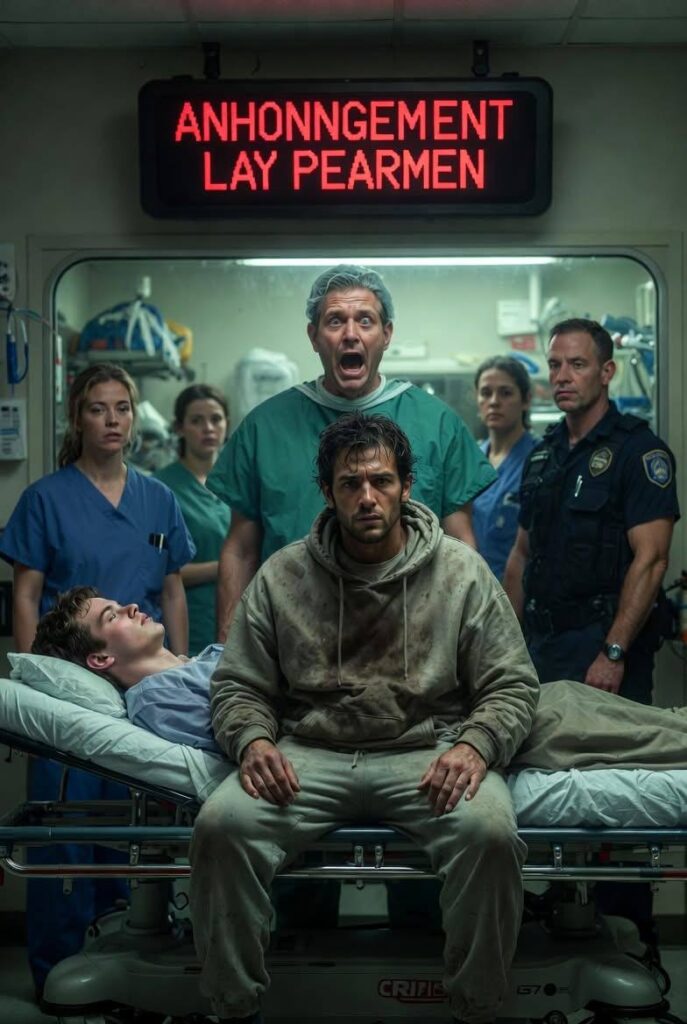
1. The Chaos of the Emergency Room
The automatic doors of St. Jude’s Medical Center hissed open, admitting a rush of heavy, humid evening air and the frantic, vibrating energy of a father in the grip of panic.
I, Arthur Vance, barreled into the lobby, my breath coming in short, sharp gasps that burned my lungs. In my arms, I carried Leo, my ten-year-old son. His face was buried in the crook of my neck, his small body trembling with a shock that rattled my own bones. His left leg hung at a sickening, unnatural angle, the tibia clearly fractured and tenting against the skin from a brutal, illegal slide tackle during the final minutes of his youth soccer game.
“It hurts, Dad… it burns… make it stop,” Leo whimpered, his voice muffled by the rough fabric of my old, grease-stained gray hoodie.
“I know, buddy, I know. We’re here. Daddy’s got you. Just breathe with me,” I whispered, tightening my grip, terrified that if I loosened my hold even an inch, he would shatter completely.
To the casual observer—the receptionist chewing gum, the security guard scrolling on his phone—I looked like a nobody. I was wearing oversized sweatpants I’d owned since my dorm days at MIT, cheap rubber flip-flops, and a hoodie smeared with rich, dark potting soil because I had been happily planting blue hydrangeas in the backyard when the coach called. I didn’t look like the founder of Vance Technologies, a man whose proprietary encryption software secured half the hospital networks in the Western Hemisphere. I didn’t look like the “Silent Donor” who had anonymously funded the very pediatric wing we were currently standing in.
I looked like a desperate, disheveled, working-class father. And in that moment, that’s exactly who I was.
I rushed to the triage desk, ignoring the line of people waiting with coughs and sprained ankles.
“My son has a compound fracture,” I announced, my voice cracking. “He needs surgery. Now.”
The triage nurse, a woman with kind eyes and tired shoulders, looked up. She saw the angle of the leg, the pallor of Leo’s skin, and moved with practiced efficiency.
“Code Yellow, trauma bay two!” she shouted into her headset. “Name?”
“Leo Vance.”
“Date of birth?”
“August 12th, 2014.”
Within minutes, we were processed. The machinery of the hospital swallowed us whole. The on-call resident, a young man who looked like he hadn’t slept in three days, took one look at Leo’s leg and grimaced, a flicker of sympathy breaking his professional mask.
“That’s a bad break. Tib-fib fracture. It needs to be set immediately to prevent nerve damage,” the resident said, checking Leo’s pulse. “We need Dr. Bennett. He’s the Head of Orthopedics and he’s on duty tonight. We’re prepping Operating Room 2.”
Relief, cool and washing, flooded my system. Dr. Lawrence Bennett. I knew the name. He was reputed to be a virtuoso with a scalpel, the best in the state, albeit known for an ego that could barely fit through the double doors. But I didn’t care about his personality; I didn’t need him to be nice. I needed his hands to fix my boy.
Leo was placed on a gurney, a white sheet draped over his mangled leg. An IV line was inserted with a sharp pinch, and as the pain medication began to drip into his veins, his eyes started to droop, the agony dulling into a hazy fog.
“Don’t leave me, Dad,” he murmured, his fingers gripping my thumb with weak desperation.
“I’m right here, Leo. I’m not going anywhere. I’ll be waiting right outside the door when you wake up.”
Just as the orderlies were unlocking the wheels of the gurney to rush him toward the surgical wing, the double doors at the main entrance swung open with a violent, attention-seeking bang.
Cliffhanger:
The air in the ER shifted instantly. It wasn’t just a new patient arriving; it was an invasion. I turned to look, my hand still holding Leo’s, and saw a whirlwind of noise and entitlement sweeping toward us. A man in an ill-fitting, expensive suit was shouting, demanding attention, oblivious to the suffering around him. I recognized him immediately, and a knot of dread formed in my stomach. This wasn’t going to be simple.
2. The Absurd Delay
The entourage was a spectacle of absurdity. Councilman Higgins, a local politician whose face was plastered on billboards promising “A Cleaner City” while he was currently under investigation for embezzlement, marched in. He was followed by a weeping woman clutching a designer handbag and a teenage boy who looked more bored than injured, scrolling through TikTok with his free hand.
“I need a doctor! Now!” Higgins bellowed, waving his hand as if shooing away peasant flies. “My son has been injured! Do you know who I am? I demand the Chief of Surgery!”
I looked at the boy. He was holding his elbow. There was a scrape. A superficial, red abrasion about two inches long that barely oozed blood. He had clearly taken a tumble, perhaps off an electric scooter, but he was standing, walking, and texting.
Dr. Bennett emerged from the hallway, looking every bit the celebrity doctor. He was a tall man with silver hair coiffed to perfection and a smile that looked like it cost more than my first house. He scanned the room, his eyes landing on me and Leo first.
He saw the dirt on my hoodie. He saw the cheap flip-flops. He saw the tears on my face. His eyes slid over us with a dismissive, glassy disinterest, categorizing us as “indigent” or “unimportant.”
Then, his gaze landed on Higgins.
“Councilman!” Bennett’s voice transformed instantly, dripping with a syrupy, obsequious charm. He rushed over, physically sidestepping Leo’s gurney which was blocking the hallway. “Good heavens, what happened? Is everyone alright?”
“My son, Chad!” Higgins pointed dramatically to the scrape. “He fell. It looks deep. It could be infected. It could scar. We need the best care. Immediate attention. We have a gala next week; he can’t have a scar.”
Bennett inspected the elbow with the gravity one might reserve for a gunshot wound to the heart. “Oh, this looks nasty. Very tricky. We can’t risk scarring on a young man with such a bright future. We need to debride this and suture it with plastic surgery precision.”
He turned to the head nurse, snapping his fingers. “Prep OR 2. I’ll handle this personally. I want the finest sutures we have.”
The nurse froze. She looked at Bennett, then at Leo, who was groaning softly on the gurney. “But… Doctor Bennett,” she stammered, pointing at my son. “The boy in 302… the compound fracture. He’s prepped. The anesthesiologist is waiting. The OR is booked for him.”
Bennett waved a dismissive hand, not even looking at her. “Cancel it. Push him back three hours. Or have a resident set it.”
I stood up. The blood in my veins turned to absolute ice. The exhaustion vanished, replaced by a cold, predatory focus that I usually reserved for hostile boardroom takeovers. I walked over to them, stepping directly into Bennett’s path.
“Excuse me,” I said, my voice low but vibrating with suppressed rage.
Bennett looked down at me, a sneer curling his lip. “We are busy here, sir.”
“My son has been fasting for six hours,” I stated, locking eyes with him. “His tibia is snapped in two. The bone is pressing against the skin. He is in agony. You are not bumping him for a scratch that a school nurse could fix with a Band-Aid.”
Bennett laughed, a sharp, barking sound. He stepped closer, invading my personal space, smelling of expensive cologne and arrogance.
“Listen to me, gardener,” Bennett hissed. “Medical triage is my decision. Your son just has a broken leg. It’s stable. He won’t die. He can wait. He can wait all night if I say so.”
He gestured grandly to the Councilman. “This is the son of a VIP. A Very Important Person. Councilman Higgins approves our zoning permits. He secures our funding. We must prioritize those who contribute to the well-being of this city.”
“You’re prioritizing a political favor over a medical emergency,” I stated flatly. “You are violating your oath.”
“I am securing the future of this hospital,” Bennett countered. “Welcome to the real world. Now step aside, or I’ll have security remove you and your son to the street. You can go to the county clinic if you don’t like the service here.”
Cliffhanger:
The room went silent. The nurse looked down, ashamed, clutching Leo’s chart. The Councilman looked smug, adjusting his tie. Bennett smirked, taking my silence for submission. He placed a hand on the Councilman’s back and began to usher him toward the double doors—toward my son’s operating room. I watched them go. I didn’t scream. I didn’t throw a punch. I simply sat back down on the hard plastic chair, my hand diving into the pocket of my dirty sweatpants. Bennett thought the conversation was over. He had no idea I was about to start the only conversation that mattered.
3. The Secret Text
The security guard, a beefy man named Miller, was eyeing me warily, hand hovering near his belt, waiting for me to cause a scene. I didn’t give him the satisfaction. I sat frozen, a statue of calm amidst the chaos, while inside, a nuclear reactor was melting down.
Leo let out a soft moan from the gurney. “Dad? Why did we stop?”
“Just a technical issue, Leo,” I lied, stroking his hair. “Just a few more minutes.”
I pulled out my phone. It wasn’t the cracked Android typical of a struggling landscaper. It was a matte black prototype, custom-encrypted, with no logo on the back. It was a device that didn’t technically exist yet.
I didn’t call the hospital complaints line. I didn’t Google a lawyer. I opened my secure contacts list.
I scrolled past CEOs of Fortune 500 companies. I scrolled past a U.S. Senator I had consulted for on cyber-security. I stopped at a name saved simply as “Ed – Golf.”
Edward Thorne. The current State Secretary of Health.
Ed and I had played eighteen holes at the Augusta National last Sunday. I had beaten him by two strokes, and over a post-game lunch, I had casually agreed to donate ten million dollars to his initiative for rural telemedicine. He owed me. Not a favor, but respect.
I opened a new message. My fingers hovered over the keyboard. I looked up at the double doors where Bennett had disappeared. He was scrubbing in to put a stitch in a healthy boy’s arm while my son lay with a shattered bone.
I typed three words. Simple. Brutal. Final.
“Revoke his license.”
I snapped a photo of Dr. Bennett’s ID badge, which was displayed on a “Meet Your Team” poster on the wall, and attached the hospital code and my location.
I hit send.
I watched the screen. Ten seconds. Twenty seconds.
Three dots appeared.
Then a reply: “Arthur? Is this serious?”
I typed back: “He bumped Leo’s emergency surgery for a Councilman’s son with a scratch. Called Leo a nobody. I’m in the lobby. Fix this. Now.”
Thirty seconds of silence. The longest thirty seconds of my life.
Then: “Done. The Board Chairman is in the building for a fundraiser upstairs. I just screamed in his ear. He’s running down the stairs now. Give me 2 minutes.”
I put the phone away. The metal casing felt cool against my palm. I took a deep breath and leaned over the gurney rail.
“Leo,” I whispered, kissing his forehead. “Do you trust me?”
“Yeah, Dad,” he breathed, his eyes fluttering.
“Good. Because the cavalry is coming.”
Cliffhanger:
At the scrub sink just beyond the swinging doors, visible through the small glass window, I could see Bennett laughing. He was scrubbing his hands, chatting amiably with the Councilman about property taxes. They looked like two kings surveying their kingdom. Then, the hospital’s PA system crackled to life. It wasn’t the soft, melodic chime used to page a doctor. It was the harsh, jarring, three-tone blast of a Code Red administrative alert. BEEP… BEEP… BEEP… The sound echoed through the hallways, stopping every nurse, doctor, and patient in their tracks. Bennett looked up at the speaker, foam dripping from his hands, a flicker of confusion crossing his face.
4. The Announcement on the Speaker
The silence that followed the alarm was heavy, pregnant with anticipation. The hum of the vending machines seemed to grow louder.
Then, a voice boomed over the intercom. It wasn’t the polite, automated voice of the receptionist. It was a male voice, breathless, shaking with a mixture of fear and urgent authority. I recognized it immediately—it was Director Sterling, the man who had personally shaken my hand when I signed the check for the new MRI wing three years ago.
“Attention all staff. Attention all staff. This is an emergency directive from the Board of Directors.”
Through the window, I saw Bennett pause. He held his soapy hands up, waiting for the announcement to finish so he could get back to his “VIP.”
“Dr. Lawrence Bennett, Chief of Surgery, is hereby suspended from all medical duties, effective immediately.”
The words hung in the air like a guillotine blade.
Inside the scrub room, Bennett’s jaw dropped. He looked at the speaker, then at the nurse beside him, his eyes wide with disbelief.
The voice continued, louder this time, almost shouting.
“Security is directed to escort Dr. Bennett off the premises. He is not—I repeat, NOT—permitted to touch any patient, enter any sterile field, or access any hospital records. Dr. Stevens, please report to Operating Room 2 immediately to take over the surgery for the patient in room 302, Leo Vance.”
I saw the color drain from Bennett’s face. It happened in an instant, a physiological crash from arrogance to terror. He looked like a ghost.
Next to him, Councilman Higgins dropped his phone. It clattered onto the tiled floor, the screen likely shattering, but he didn’t even look down.
Director Sterling wasn’t finished.
“And to the family of Leo Vance… The Board extends its deepest, most humble apologies. We are aware of the gross violation of ethics that just occurred. All medical fees for your son, for this visit and any future needs at St. Jude’s, are waived for life. We are… so incredibly sorry.”
The intercom clicked off.
The silence that returned to the waiting room was deafening. Slowly, heads began to turn. Every nurse at the triage station, the security guard who had been eyeing me, the other patients holding ice packs to their injuries—they all turned to look at the man in the dirty hoodie sitting next to the boy with the broken leg.
Miller, the security guard, took a step back, his face pale. He realized he had almost manhandled the most powerful person in the building.
I didn’t look at them. I kept my eyes on the window of the scrub room.
Bennett was freezing. He hadn’t moved. He was staring at his hands, the soap drying on his skin, trying to comprehend how his world had disintegrated in the span of five minutes.
Cliffhanger:
The double doors to the surgical wing burst open again. But this time, it wasn’t a doctor coming out to give news. It was Director Sterling himself, flanked by two large, grim-faced security officers. Sterling was sweating profusely, his tie askew, his face flushed. He ran past the stunned Councilman. He ran past the frozen staff. He didn’t stop until he was standing directly in front of me. He looked at my muddy shoes, then up to my face, and bowed—actually bowed—at the waist.
5. The Real VIP
“Mr. Vance,” the Director panted, struggling to catch his breath. “Mr. Chairman. I… I had no idea you were here. I am… I am mortified. Beyond words.”
I stood up slowly, unfolding my height. I didn’t look at Sterling. My gaze was fixed on the scrub room door, where Dr. Bennett was now being forcefully escorted out by security. He was still wearing his surgical scrubs, his hands still wet.
As they dragged him into the hallway, Bennett saw me.
He saw the Director bowing to me. He saw the nurses looking at me with awe. And finally, the realization crashed down on him like a falling skyscraper. He realized too late that the “gardener” he had sneered at was the man who paid for the da Vinci robotic arm he was so proud of using.
“Mr… Vance?” Bennett stammered, his voice a pathetic squeak. The arrogance had evaporated, leaving behind a small, frightened man. “I… I didn’t know… I thought…”
“You thought I was nobody,” I said. My voice was calm, but it carried across the silent room like a thunderclap.
I walked over to him. The security guards stopped, holding Bennett in place. He looked at me with pleading eyes.
“You said you prioritize VIPs,” I said, stepping close enough to see the sweat beading on his upper lip. “You said we have to prioritize those who contribute to this city.”
“Sir, please,” Bennett begged, glancing at the Director for help, but finding none. “It was a misunderstanding. I was just trying to manage resources…”
“You were right about one thing, Doctor,” I interrupted. “A hospital should prioritize VIPs. But you are confused about the definition.”
I pointed to my son. Dr. Stevens had already arrived—a young, sharp-looking female surgeon—and was gently moving Leo’s gurney toward the OR with a team of four nurses who were treating him like he was made of porcelain.
“In medicine, a VIP is not the man with the title,” I said coldly, my eyes boring into Bennett’s. “A VIP is not the man with the zoning permits or the expensive suit. A VIP is the person in the most pain. That boy with the broken bone is the most important person in this building. Not the politician. And certainly not you.”
Bennett slumped in the guards’ grip. “My career…”
“Is over,” I finished. “You lost your license the moment you looked at a suffering child and saw an inconvenience. You traded your oath for a political favor. Now, you have neither.”
I turned my gaze to Councilman Higgins. He was standing by the wall, trying to make himself invisible. He had realized the tide had turned and he was standing in the presence of a shark much bigger than himself.
“And Councilman,” I said.
Higgins jumped. “Mr. Vance! I… I had no idea…”
“Get your son a Band-Aid,” I said dismissively. “And get out of my sight before I make a phone call to the Ethics Committee about your zoning deals.”
Higgins grabbed his son—who was still texting—and scuttled out the back exit like a cockroach when the lights turn on, abandoning his demand for a plastic surgeon.
I turned back to Director Sterling. “Take care of my son. If he feels even one second of unnecessary pain, I will turn this building into a parking lot.”
“Yes, sir. Immediately, sir. I will scrub in to assist Dr. Stevens myself.”
As I watched the doors of the operating room close behind Leo, finally, finally getting the care he deserved, the adrenaline began to fade, leaving me exhausted. I sat back down on the plastic chair. I looked at my hands, still stained with garden soil.
They thought power was a suit. They thought influence was a title on a badge. They forgot that the most powerful men are often the ones who don’t need to announce their arrival. They don’t need to shout. They just change the reality of the room when they decide it’s time.
Dr. Bennett learned a lesson that day, a lesson that cost him everything he had built: The most dangerous person in the room isn’t the one screaming for a manager. It’s the quiet father watching you hurt his child.