The air inside the Oak Ridge Sports Complex wasn’t just stale; it was intimidating. It smelled of floor wax, vulcanized rubber, and the expensive, musk-heavy cologne of wealthy fathers who spent their weekends closing deals on golf courses. It was a sensory assault that instantly made me feel small, like a stain on a pristine tablecloth. I pulled my faded beige cardigan tighter around my ribcage, my fingers tracing the frayed wool of the cuffs, and looked down at my son, Leo.
Leo was twelve, a wiry bundle of kinetic energy with hair that defied gravity and eyes that burned with a quiet, intense fire. He was clutching his basketball to his chest—a worn, orange sphere that was smooth from relentless use, its pebbled grip long since sacrificed to the asphalt courts of our neighborhood. But it wasn’t the ball that drew the eye.
It was his shoes.
They were, objectively, a disaster. A pair of generic, third-hand sneakers we had salvaged from the bottom of a thrift store bin six months ago. The canvas was stained, the laces were mismatched, and the soles were divorcing the uppers in a slow, tragic separation. They were held together by layers of silver duct tape that Leo had applied with the grim precision of a battlefield surgeon. To him, they were battle armor, the only thing standing between his feet and the hardwood. To everyone else in this gleaming, glass-walled gymnasium, they were a punchline.
“Mom, you think I have a chance?” Leo whispered, his voice trembling slightly. He wasn’t looking at me; he was staring at the other boys warming up.
“You have more than a chance, baby,” I lied, smoothing his hair. “You have heart. You have talent. The floor doesn’t know what shoes you’re wearing. It only knows how you move.”
But I knew the world didn’t work like that. Not here. We were at the tryouts for the Oak Ridge Elites, the city’s most prestigious youth basketball program. It was a pipeline to scholarships, to scouts, to a future that didn’t involve double shifts at a diner. The parking lot outside was a showroom of Range Rovers and Teslas. The other kids were lacing up brand-new Nikes, LeBrons, and Currys—shoes that cost more than my monthly rent.
Coach Miller, the program director, stood at center court with a clipboard held like a scepter. He was a man who wore a tracksuit that looked tailored, a whistle gleaming silver around his neck like jewelry. He didn’t look like a molder of young minds; he looked like a gatekeeper for a country club that had a strict ‘no riff-raff’ policy.
I climbed the bleachers, my heart hammering a nervous, erratic rhythm against my ribs. I was a single mother fighting a losing war against gravity and bills. I couldn’t give Leo the gear, the private lessons, or the organic nutrition plans these other kids had. All I could give him was this morning. This one shot.
Coach Miller blew his whistle. The sound was sharp, piercing the murmur of the gym. “Alright, listen up! Laps. Now. If you’re not sweating, you’re leaving.”
Leo took a deep breath, hitched up his oversized shorts, and ran onto the court. The sound of his taped shoes—thwack, thwack, thwack—was different from the squeak of high-end rubber. It was heavier. Sadder.
I watched him run, praying that the tape would hold. Just for an hour. Just let the tape hold.
But as he rounded the first corner, a tall boy with a buzzcut and a smirk—Chase, I would later learn his name was—stuck his foot out slightly. It wasn’t enough to be a blatant trip, but enough to clip Leo’s heel.
Leo stumbled. He caught himself, but the friction tore a strip of tape loose. It dragged behind him like a silver tail.
Chase laughed. “Nice kicks, trash.”
Leo didn’t stop. He didn’t look back. But I saw his jaw clench, and I knew the war had begun.
The tryouts began in earnest. The drill was simple on paper: dribbling through cones, layups, and defensive shuffling.
Leo moved like water. Despite the heavy, clunky shoes clattering against the polished hardwood, his handling was exquisite. The ball seemed attached to his hand by an invisible, elastic string. He wove through the orange cones with a fluidity that made the other kids—stiff with their expensive training and rigid drills—look mechanical. He had rhythm. He had what the old heads at the park called “sauce.”
But talent breeds jealousy, especially among those who believe they can purchase superiority.
A group of boys, led by Chase—whose father’s name was prominently displayed on the digital scoreboard above us—began to box Leo out. It started subtle—an elbow to the ribs here, a hip check there. Leo didn’t complain. He just played harder, his eyes narrowed, his focus absolute.
Then came the scrimmages.
It was 3-on-3. Leo was guarding Chase. Chase was taller, stronger, and fed on premium protein shakes, but Leo was quicker. Chase tried to drive left, but Leo cut him off, his feet sliding perfectly into position. Frustrated, Chase threw a wild pass, clearly intentional, forcing Leo to scramble toward the sideline.
As Leo pivoted on his left foot to save the ball from going out of bounds, Chase stepped hard on the toe of Leo’s taped-up shoe.
RIIIP.
The sound was distinct, ugly, and heartbreaking. It cut through the gym louder than the bounce of the ball.
The duct tape gave way completely. The sole of Leo’s left shoe flapped open like the mouth of a dying fish. Leo tried to step, but the loose rubber caught on the floor. He crashed onto the court, skinning his knee, the ball rolling away into the corner.
Laughter erupted. It wasn’t just a few giggles; it was a cruel, echoing roar from the boys on the court. Even some of the parents in the stands chuckled, covering their mouths with manicured hands.
Coach Miller blew his whistle. He walked over, his stride leisurely. He didn’t offer a hand to help Leo up. He stood over him, casting a long shadow.
“Stop! Cut the music!” Miller barked. The gym fell silent.
Leo scrambled to his knees, his face burning a deep, radioactive crimson. He was frantically trying to stick the sole back onto his shoe, pressing the useless, dust-covered tape against the canvas. “I… I can fix it,” he mumbled.
“What is that?” Miller asked, pointing a manicured finger at Leo’s feet as if they were contaminated.
“It… it broke, Coach. Just give me a second,” Leo stammered, his voice thick with unshed tears.
“Fix it?” Miller scoffed. His voice amplified in the cavernous space, bouncing off the rafters. He looked up at the parents in the stands, performing for his donors, making sure they knew he was protecting their investment. “This is the Elites, son. We maintain a standard here. This is a basketball court, not a municipal junkyard.”
I stood up. My hands were shaking so hard I had to grip the metal railing of the bleachers. I was ready to scream, to run down there and shield my son, but the sheer shock of the humiliation held me frozen.
“Go home,” Miller said, dismissing my son with a lazy wave of his hand. “Tell your mother to buy you real shoes before you dream of being a player. You’re a liability out here. You’re scratching my floor.”
“Heads up, trash!” Chase shouted.
He picked up the loose basketball and threw it hard. It wasn’t a pass. It was a projectile.
It struck my son squarely in the chest. Thud.
Leo didn’t move. He just stood there, the broken shoe hanging from his foot, the sole slapping the ground. He took the abuse, too proud to cry in front of them, but I could see his spirit cracking. He looked small. He looked defeated.
And then, from the darkest corner of the gym, a shadow moved.
The cruelty of the moment hung heavy in the air, thick and suffocating like smoke. I was halfway down the bleacher steps, ready to tear Coach Miller apart with my bare hands, consequences be damned, when the movement stopped everyone.
He had been there since the beginning, a solitary figure sitting in the highest, darkest row of the bleachers, away from the chatter of the other parents. He was massive, a mountain of a man, easily six-foot-six. He was draped in an oversized gray hoodie with the hood pulled low, obscuring his face in shadow. He had been silent, a statue witnessing the sins of the arena.
Until now.
He stood up. The sheer size of him commanded attention. He unfolded himself, his shoulders broad enough to block out the lights. He walked down the bleacher steps with a slow, rhythmic gait—a panther-like prowl that spoke of immense power and absolute conservation of energy.
Squeak. Squeak. Squeak.
The sound of his pristine sneakers on the wood was the only sound in the gym.
He walked right past me. I felt the heat radiating off him. He walked right past a stunned Coach Miller, who opened his mouth to speak but found no words. He walked onto the court, crossing the boundary line that Miller guarded so fiercely.
“Hey!” Miller shouted, finally regaining his composure, his face flushing pink. “Who do you think you are? This is a private session! You can’t be on the floor! Security!”
The stranger ignored him completely. He didn’t even turn his head. He walked straight to Leo.
He towered over my son, casting a shadow that felt protective rather than oppressive. Leo looked up, fear mixing with confusion in his wet eyes. He flinched, expecting another lecture, another insult.
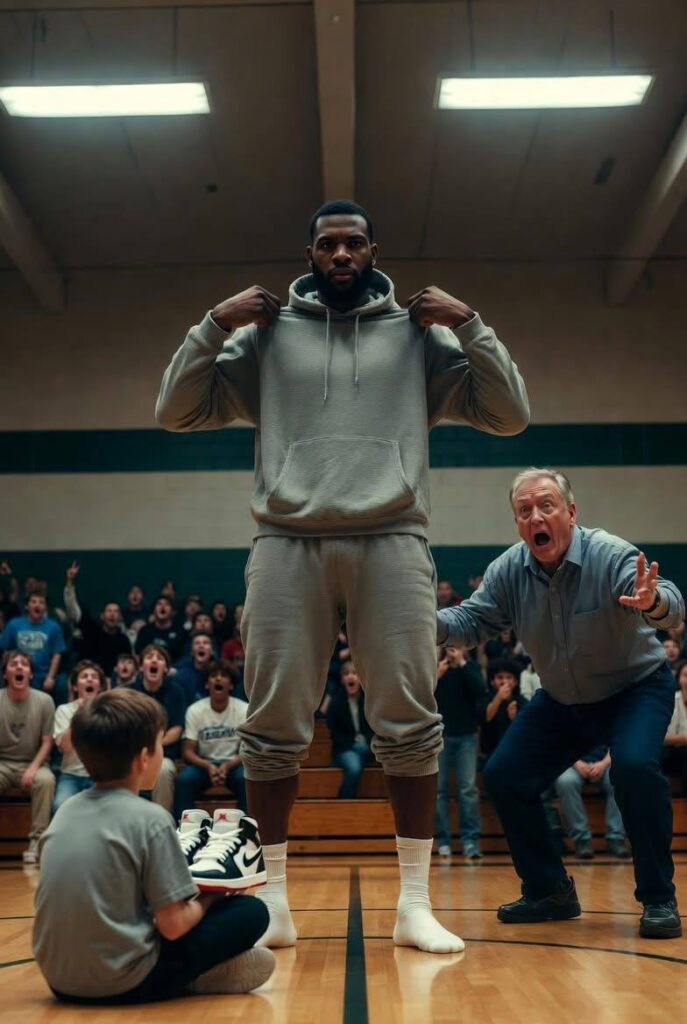
The man didn’t say a word. He simply sat down on the hardwood floor, right in front of Leo. He began to untie his shoes.
They were magnificent. Air Jordan 1 Retro High OGs, a custom colorway in black and gold that I knew, even with my limited knowledge of sneaker culture, cost thousands of dollars on the resale market. They were pristine, uncreased, holy relics of the sport.
He slipped them off his massive feet.
“What size are you, kid?” the man asked. His voice was a deep, rumbling bass that vibrated in your chest.
“Eight… eight and a half,” Leo whispered, wiping his nose with the back of his hand.
“I’m a fourteen,” the man said, a hint of amusement in his tone. “But if we lace ’em tight, and you double up your socks, they’ll work for now.”
He held out the shoes. “Put them on.”
“I… I can’t,” Leo said, looking at the expensive leather as if it were made of glass. “I’ll mess them up. My mom… we can’t pay for these.”
The man looked up at Leo. His eyes, visible now under the hood, were intense but kind. “Put. Them. On.”
It wasn’t a command; it was an invitation to greatness. It was a lifeline thrown into a stormy sea.
Leo sat down. With shaking hands, he took off his duct-taped disasters. He pulled on his extra pair of gym socks. He slid his feet into the Jordans. They were boats on him, huge and clunky, but he laced them tight, pulling the strings until the leather hugged his ankles.
The man stood up in his socks. He reached up and grabbed the edge of his hood.
“Now,” he said, turning to face Coach Miller. “Let’s talk about standards.”
He pulled back his hood.
A collective gasp sucked the oxygen out of the room. It started as a murmur, then a ripple, then a crashing wave of disbelief.
The face was unmistakable. The sharp, angular jawline. The intense, intelligent eyes. The faint scar above the left eyebrow. This was a face that had been on Wheaties boxes, Nike billboards, and holding up championship trophies for a decade.
“That’s… that’s Marcus King,” a father in the front row whispered, dropping his phone.
“The Titan,” someone else breathed, the name spoken like a prayer.
It was him. Marcus “The Titan” King. A three-time NBA MVP, a global icon, the man who had retired two years ago as arguably the greatest point guard in the history of the league. He was a myth made flesh, standing in our local gym in his socks.
Coach Miller’s face went from angry red to a pasty, sickly white. He looked like he was about to faint. “Mr… Mr. King. I… I didn’t know you were… we are honored…”
Marcus turned his gaze on Miller. It was a look of withering, absolute disappointment. It was the look a lion gives a hyena.
“You said shoes make the player, Coach?” Marcus asked, his voice calm but cutting like a serrated knife.
Miller stammered, wringing his hands. “I… I was just setting discipline… maintaining the integrity of the program…”
“You were bullying a child,” Marcus said. He didn’t shout. He didn’t have to. “You were shaming him for poverty. And you’re wrong. Shoes don’t make the player. Heart does. Vision does. The grind does.”
He walked over to Leo and placed a large, heavy hand on my son’s shoulder. The oversized Jordans looked comical on Leo’s feet, like clown shoes, but Leo stood taller than he ever had in his life. His spine straightened. His chin lifted.
“I’ve been watching for an hour,” Marcus announced, addressing the silent room, his voice reaching every corner. “This kid? He has better handles, better vision, and better technique than every single person in this gym. Combined. Including your ‘stars’.” He cast a glance at Chase, who shrank back behind his father.
Marcus picked up the ball Chase had thrown at Leo. He spun it on his index finger, the orange blur hypnotic.
“But words are cheap, right Coach?” Marcus smiled, a genuine, dazzling smile that didn’t reach his eyes. “So let’s prove it.”
He tossed the ball to Leo. Leo caught it, surprised by the weight.
“Lace ’em up tight, kid,” Marcus said. “Let’s play 1-on-1. You and me. First to five. Let’s show them what real basketball looks like.”
Leo looked at me. I nodded, tears streaming down my face. Go, I mouthed.
Leo turned back to the Titan. He dribbled the ball. Thump. Thump. The sound was solid. Confident.
“I’m ready,” Leo said.
The next twenty minutes were a blur of magic.
It wasn’t a fair fight, of course. Marcus King was a giant among men, a professional athlete who had battled the best in the world. But he didn’t play to crush Leo; he played to elevate him.
He pushed Leo. He guarded him closely, forcing Leo to use his speed, to dribble with his off-hand, to drive into the paint against a mountain of defense. And Leo… my Leo flew.
The oversized shoes thumped against the floor, looking ridiculous, but Leo compensated. He moved with a newfound ferocity. He crossed over, the rubber of the Jordans gripping the floor like claws. He spun. He faded away.
At one point, Marcus backed off, standing at the free-throw line, daring Leo to shoot from deep.
“Show me your range!” Marcus roared.
Leo, fueled by adrenaline and the presence of a god, stepped back behind the three-point arc. He looked at the hoop. He looked at his feet in the hero’s shoes. He jumped.
The release was perfect. The follow-through was a swan’s neck.
Swish.
Nothing but net. The sound was sweet, pure, and final.
Marcus stopped. He nodded slowly, a look of genuine respect on his face. “That’s it,” he yelled, clapping his hands. “That’s the release! That’s the fire!”
When they finished, both were sweating. Leo was panting, his chest heaving, his face glowing with a joy so pure it hurt to look at. Marcus walked over and high-fived him, a crack that echoed through the gym like a gunshot.
“Good game, young blood,” Marcus said.
Coach Miller tried to approach them, a sycophantic, oily smile plastered on his face. He held out his clipboard as if it were a peace offering. “Mr. King, that was incredible! Truly inspiring! Perhaps you’d like to be a guest coach for the season? Leo is definitely making the team, of course… we can find a scholarship…”
Marcus didn’t even look at him. He acted as if Miller were a ghost. He looked past him, straight at me.
He walked over to the bleachers where I was standing, trembling.
“Ma’am,” he said respectfully, wiping sweat from his brow. “Your son is special. You’ve raised a warrior.”
He took a card from the pocket of his hoodie and handed it to me. It was simple, black matte, with a gold logo embossed in the center.
“This is my personal number,” Marcus said. “I’m opening a new Academy next month. The King’s Court. It’s about talent, not tuition. Full scholarship. Gear, travel, coaching, nutrition. Everything covered. I want Leo to be my first recruit. I want to build the team around him.”
He gestured vaguely at Miller and the stunned rich parents in their designer clothes. “Get him out of this… this toxicity. This isn’t basketball. This is a country club.”
He turned back to Leo. “Keep the shoes, kid. You earned them. Wear them until they fall apart, then call me for a new pair.”
He picked up his hoodie, threw it over his shoulder, and walked out of the gym in his socks. He didn’t look back. He didn’t sign autographs. He just left, leaving a vacuum of awe in his wake.
I looked at Coach Miller, who stood alone on his shiny, expensive court, looking smaller and cheaper than the duct tape that still lay on the floor.
I walked down the stairs. I took Leo’s hand.
“Let’s go home, champion,” I said.
As we walked to our rusting sedan in the parking lot filled with luxury SUVs, Leo looked down at the massive shoes on his feet. He had to lift his knees high to walk without tripping.
“Mom,” he whispered, clutching the basketball like a treasure. “Did that really happen?”
“It happened,” I said, squeezing his hand.
The shoes were too big. They were clunky. They were ridiculous. But as I watched my son walk, I saw something change. His stride was longer. His head was higher. I knew he would grow into them.
That day, he didn’t just get a pair of sneakers. He got his dignity back. And the man who thought a court was a showroom learned a valuable lesson: stars aren’t made of money. They’re made of fire, grit, and hunger. And sometimes, the brightest ones come wrapped in silver duct tape.
Six months later, I sat in the stands of a different gym.
This one was in the city. It was gritty, loud, and alive. The logo on the center court was a golden crown.
Leo was on the floor. He was wearing a jersey that fit, and shoes that were his size—brand new King’s Court exclusives. He caught a pass, faked left, and drove to the basket with a speed that blurred the eye.
On the sidelines, Marcus King stood with his arms crossed, a rare smile on his face. He nodded at Leo.
Leo scored. He pointed to the sky, then pointed to me.
I looked down at my own feet. I was wearing a new pair of sneakers, too. Marcus had insisted. “Team moms need good support,” he’d said.
I touched the frayed cuff of my cardigan, a habit I couldn’t break. But I wasn’t cold anymore. The fire Leo played with warmed the whole arena.
We had left the junkyard behind. We were flying now.