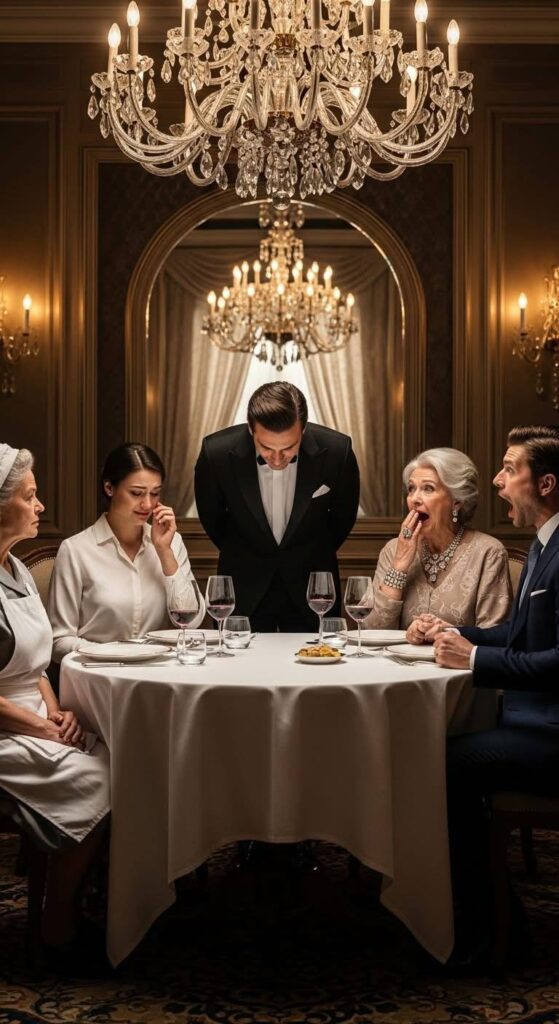
The crystal chandeliers of The Golden Spoon, the flagship establishment of the city’s most prestigious dining conglomerate, cast a warm, deceptive luminescence over the evening. To the uninitiated, the air smelled of vintage Merlot, shaved truffles, and seared scallops. To me, however, it smelled of sweat, equity, and thirty years of relentless labor.
I, Martha, sat quietly at the periphery of the round VIP table, smoothing the fabric of my simple, unbranded cotton dress. My hands, weathered and calloused from years of tending to my prize-winning rose garden—my one true solace outside the boardroom—rested atop the pristine white tablecloth. To the untrained eye, or perhaps the willfully ignorant one, I appeared to be a woman who had lived a hard, modest life, perhaps a housekeeper or a laborer who had scrubbed floors to make ends meet.
Across from me sat the living, breathing embodiment of “new money” devoid of old grace: Linda Parker, my daughter’s future mother-in-law. She was draped in enough gold jewelry to anchor a small yacht, and her fingers, adorned with gaudy gemstones, clicked impatiently against the stem of her wine glass like the talons of a restless hawk.
“The service here is slipping,” Linda announced, her voice carrying across the hushed dining room with zero regard for decorum. “Brad, you really need to speak to the staff. It’s been five minutes since I asked for more ice. It’s simply unacceptable.”
Brad, my future son-in-law, puffed out his chest, adjusting the lapels of a suit that was slightly too shiny to be tasteful. He was currently serving as the manager of Branch 5 of this very chain—a mid-level position he wore like a general’s uniform. He had never met the owner. I had stepped back from daily operations five years ago, preferring the shadows of strategy to the glare of management. To him, I was just Emily’s “quaint” mother.
“Don’t worry, Mom,” Brad said with a smug, conspiratorial wink directed at my daughter, Emily. “I’m a manager in this system. The staff here respects the hierarchy. I’ll make sure we get the treatment we deserve. They know who holds the keys.”
Emily, my sweet, soft-spoken daughter, smiled nervously. She was a dedicated high school teacher, a vocation she pursued with passion, but one that Brad and his mother seemed to view as a temporary, adorable hobby to be discarded once “real life” began.
“Mom, please,” Emily whispered to me, squeezing my rough hand under the table. She knew I possessed a formidable temper when it came to rudeness, though she remained blissfully unaware of the full extent of my dominion over this building.
“I’m fine, honey,” I replied, my voice a low hum. I watched as Linda wiped a microscopic, non-existent speck of dust from her fork with a look of utter, theatrical disgust. Earlier, when we walked in, I had instinctively bent down to pick up a dropped napkin to assist a flustered busboy. Linda had witnessed that small act of service and immediately categorized me in her mental filing cabinet: The Help.
Whatever patience I had was fraying, but I held my tongue. I needed to see just how deep this rot went before I decided whether to excise it.
Linda turned her gaze toward the waiter who was approaching with the appetizers. “Boy,” she snapped, not even looking him in the eye. “Make sure the wine keeps flowing. We have things to discuss.”
As the waiter retreated, looking flustered, Linda’s eyes locked onto mine. There was a predatory glint there, a sharpness that signaled the pleasantries were over.
“Now,” she began, leaning forward, “let’s talk about the wedding budget. Or rather, the lack of one from your side.”
The appetizers arrived—delicate carpaccio with capers and a drizzle of lemon oil—but the culinary excellence did nothing to thin the suffocating tension at the table. Linda decided it was time to bypass the small talk and dissect the “real” matters of the merger she believed was taking place.
“So, Martha,” Linda said, looking at me over the rim of her glass, her eyes scanning my plain attire with thinly veiled amusement. “Emily tells me you do… freelance work? Gardening, is it?”
“I manage my own investments,” I corrected gently, taking a sip of water. “And I tend to my garden. It keeps me grounded.”
Linda smirked, exchanging a knowing look with her son. “Investments. Right. Every retiree with a savings account calls themselves an investor these days. Well, let’s be realistic, shall we? We need to talk about the future infrastructure of this family.”
She turned her gaze to Emily, her eyes sharpening. It was the look of a butcher assessing a cut of meat.
“Emily, dear, Brad tells me you’re planning to continue teaching after the wedding?”
“Yes, Mrs. Linda,” Emily said, her voice brightening with genuine enthusiasm. “I love my students. We’re doing a project on classic literature right now that is really opening their minds.”
Linda set her glass down with a sharp clink. The faux smile vanished, replaced by a mask of cold authority. “Let me be straight with you, dear. That’s not going to work. A Parker wife does not work. It looks… desperate. You need to focus on supporting Brad, keeping a pristine home, and raising my grandchildren.”
“But…” Emily started, her face flushing a deep crimson. “I worked hard for my degree. I have a career.”
“No buts,” Linda cut her off, her voice rising an octave. She pointed a manicured finger directly at me, the diamond on her ring catching the light aggressively. “Look, we all know where you come from. Your mother’s salary is peanuts. And with a background like hers—acting like a… well, let’s call it a ‘janitor’—you two clearly don’t understand how the upper class operates. You can’t support yourself on that pittance you call a teacher’s salary.”
My blood ran cold. It wasn’t fear. It was a simmering, volcanic fury. She had insulted me, which I could handle; I had been underestimated by men in thousand-dollar suits my entire life. But she was belittling my daughter, stripping away her agency and reducing her to an accessory.
I looked at Brad, waiting. This was his test. I was waiting for him to defend his fiancée. Waiting for him to say that Emily’s career mattered, that he respected her intellect and her passion.
Instead, Brad nodded, taking a languid sip of his wine, looking bored. “Mom’s right, babe. I’m managing a high-end restaurant now. My income can support the whole family. You don’t need to tire yourself out with those bratty kids. I make the money, so I make the decisions. It’s just how the world works.”
The betrayal in Emily’s eyes was heartbreaking. She looked small, defeated, trapped between her love for this man and the terrifying realization of a lifetime of servitude. She looked at me, her eyes shimmering with unshed tears, silently begging for an escape route.
“Is that so?” I asked, my voice cutting through the ambient noise like a razor wire. “The one who holds the wallet holds the whip?”
Linda laughed, a harsh, barking sound. “Crude, Martha, but accurate. Brad is the provider. Therefore, he is the head. You wouldn’t understand, living on… whatever it is you scrape together.”
I felt the familiar weight of the silver chopsticks in my hand. They were part of a premium setting I had personally designed for this flagship location ten years ago. Solid sterling silver, balanced perfectly.
I looked at the engraving on the handle, obscured by my thumb. The Parker family was about to learn a very painful lesson in economics.
“Brad,” I said, my voice dropping to a dangerous whisper. “Do you truly believe that your position gives you ownership over my daughter’s life?”
Brad scoffed, rolling his eyes. “Look, Martha, don’t make this awkward. I’m doing her a favor. She gets to live the good life. She should be grateful.”
“Grateful,” I repeated, tasting the word. It tasted like ash.
I tightened my grip on the silver chopsticks. The time for observation was over.
Emily looked like she was about to shatter. She started to push her chair back, the legs scraping against the marble floor, ready to flee the humiliation.
I reached out and placed my hand firmly over hers. My skin was rough against her smooth hand, but my grip was iron. “Stay,” I said quietly. “You have done nothing wrong. You do not run.”
The table went silent. The command in my voice was not that of a gardener. It was the voice that had negotiated leases, fired embezzlers, and built an empire from a single food cart.
Linda looked at me, annoyed, her lip curling. “Excuse me? Do you have something to add, Martha? Or are you just going to delay dessert?”
I picked up the silver chopsticks. I held them up for a moment, letting the chandelier light dance off the polished metal. Then, I set them down on the fine china plate.
Clink.
The sound was sharp, decisive, cutting through the murmurs of the restaurant. It was a gavel striking a block.
I looked straight into Linda’s eyes. My posture shifted. The slouch of the tired worker vanished, replaced by the erect, formidable spine of a Chairwoman.
“You are right, Linda,” I said, a small, cold smile playing on my lips. “A janitor’s wage is indeed very low. It is hard to build a dignified life on that. I have immense respect for those who do.”
Linda let out a triumphant huff, swirling her wine. “See? Even she admits it. It’s simple math.”
“However,” I continued, my gaze shifting to Brad, locking onto him with a predator’s intensity. “The salary of the Owner and Chairwoman of the twenty-restaurant chain where your son is merely a mid-level manager… well, that is quite decent.”
The air left the table.
Brad froze. His wine glass stopped halfway to his mouth. He blinked, a glitch in his reality processing. Confusion warred with a dawning, terrible realization in his eyes. “What… what did you say?”
“I said,” I enunciated clearly, “that while a janitor’s wage is modest, the dividends from owning The Golden Spoon franchise are substantial.”
“You…” Linda sputtered, laughing nervously. “You’re drunk. That’s the cheap wine talking. You? The owner? Look at you! You look like you just came from digging a ditch!”
“I came from my rose garden,” I said calmly. “But yes, I built this place. I chose these chandeliers. I approved the menu you are eating. And I approved the hiring protocols that, unfortunately, seem to have failed in Branch 5.”
At that exact moment, the double mahogany doors of the kitchen swung open.
Mr. Sterling, the General Manager of the entire franchise—and Brad’s direct superior’s superior—walked into the dining room. He was a man of immense composure, usually unflappable. He was scanning the tables, looking for something, checking the quality of the evening service.
His eyes swept the room and landed on me.
His face transformed. The professional neutrality vanished, replaced by a look of pure, unadulterated panic. He practically ran across the room, ignoring the waving hand of a senator at table four. He stopped at our table and bowed—a deep, respectful bow, almost ninety degrees, that he saved for only one person.
“Madam Chairwoman!” Mr. Sterling gasped, wiping a bead of sweat from his brow. “I… I didn’t know you were coming! Why didn’t you call? We would have prepared the Private Suite! Is the service acceptable? Is the wine temperature correct?”
Linda dropped her fork. It clattered loudly onto her plate, echoing in the sudden silence of our table.
The silence was absolute. It was the kind of heavy, suffocating silence that follows a bomb blast, where the world holds its breath to see what is left standing.
Linda’s mouth hung open, a piece of unchewed carpaccio visible on her tongue. She looked from the General Manager to me, her brain seemingly short-circuiting. The data points—”janitor,” “gardener,” “Madam Chairwoman”—refused to reconcile.
But Brad… Brad was worse.
All the color had drained from his face, leaving him a sickly shade of gray, like wet ash. He stood up, his legs shaking so violently they knocked against the table, spilling the wine he had been so proud of.
“Chair… Chairwoman?” he stammered, his voice cracking like a teenage boy’s. “You… you are Martha? The Martha? The founder?”
I didn’t look at him. I kept my eyes fixed on Mr. Sterling.
“Mr. Sterling,” I said pleasantly, my voice steady and warm. “I was just having a fascinating conversation with your employee here, Mr. Brad.”
“Y-yes, Madam?” Sterling asked, sensing the radioactive levels of danger in the air. He glanced at Brad, then back to me, terror in his eyes.
“Mr. Brad here just informed us that he has the right to make all the decisions in his household because he ‘makes the money.’ He seems to believe that his position as a manager allows him to dictate the lives of others, specifically my daughter.” I paused, taking a slow sip of my water, letting the words hang there. “I find this management philosophy… incompatible with our company culture. We value respect, do we not, Mr. Sterling?”
“Absolutely, Madam,” Sterling said, straightening up and glaring at Brad with the fury of a man whose career was being threatened by an idiot underling. “Completely unacceptable. Zero tolerance.”
I finally turned to look at my future son-in-law. He looked like he was about to vomit on his shiny shoes.
“So,” I said, my voice hardening into steel. “As the person who actually makes the money here—the person who signs the checks that pay your salary—I have made a decision. I am exercising my right to terminate the manager of Branch 5. Effective immediately.”
Brad collapsed back into his chair, his legs giving out. “No… please… Madam Chairwoman… I have a mortgage… the car payments…”
“Perhaps your mother can support you,” I suggested coldly. “She seems to have very strong opinions on who should work and who shouldn’t.”
I turned to my daughter. Emily was staring at me, shock slowly being replaced by a spark of realization. She looked at the powerful woman sitting next to her—her mother—and then at the whimpering man across the table. The illusion of his authority had shattered.
“Emily,” I said softy, my demeanor softening only for her. “You’ve always been excellent at organizing. You managed your classroom with more efficiency than I’ve seen in most boardrooms. And you have more patience than anyone I know. I need someone I can trust to run Branch 5. Someone who knows how to treat people with respect. Do you want the job? You can hire an assistant manager to handle the nights so you can keep teaching, if you wish. Or you can take the reins completely.”
Emily looked at Brad. She looked at the man who had just told her to quit her dreams to serve him. She saw him now—sweaty, terrified, stripped of his arrogance, pleading with his eyes.
Slowly, deliberately, she slid the diamond engagement ring off her finger. It wasn’t a particularly big diamond, despite Linda’s boasting.
She placed it on the table next to my silver chopsticks.
“I think I’ll take the offer, Mom,” she said, her voice strong and clear. She looked at Brad, her eyes dry and fierce. “And this… I’m returning it to the ‘money maker’. You’re going to need it to pay rent.”
“Wait! Martha! Emily!” Linda shrieked, finally finding her voice as the reality of her social and financial suicide hit her. “This is a misunderstanding! We were just joking! It was a test! We’re family!”
“We are not family,” I said, standing up. The movement rippled through the room, commanding attention. “And God willing, we never will be.”
Brad scrambled to his knees, ignoring the gasps of the other diners. He reached for the hem of my dress, his desperation palpable. “Please, Madam Chairwoman! I worked so hard for this! I was going to be Regional Director! Please!”
I stepped back, pulling my dress away as if he were contagious. I nodded to Mr. Sterling.
“Remove him,” I ordered. “And ensure he is blacklisted from all our properties. Including the franchises. If I see him in a Golden Spoon uniform again, the General Manager of that branch will be joining him in the unemployment line.”
“Security!” Sterling barked.
Two large men in dark suits materialized from the shadows near the entrance. They moved with professional efficiency. As they hauled a sobbing Brad and a sputtering, red-faced Linda toward the exit, the entire restaurant watched in stunned silence. The “upper class” facade they had tried so hard to maintain was shattered, leaving only the ugly, naked reality of their greed exposed for all to see.
Linda shouted something about “suing” as she was dragged out the door, but her voice was swallowed by the heavy thud of the closing mahogany panels.
The silence returned, but this time, it was lighter. Cleaner.
I turned to Emily. She was trembling slightly, not from fear, but from the adrenaline of liberation.
“Are you alright, my love?” I asked, brushing a strand of hair from her face.
“I… I think so,” she breathed, a small smile tugging at the corners of her mouth. “Did you really mean it? About the job?”
“I never bluff in business, Emily. You know that.”
“I can’t believe I almost married him,” she whispered, looking at the empty chair where Brad had sat.
“We all make mistakes in investment, darling,” I said, offering her my arm. “The key is to cut your losses before you go bankrupt.”
I looked around the room. The other diners were pretending to go back to their meals, but I could feel their eyes on us. The waiters were looking at me with a mixture of awe and terror.
“Mr. Sterling,” I called out.
“Yes, Madam?” He was at my side instantly.
“Comp the meals for everyone in the dining room tonight. Apologize for the disturbance. Tell them it’s on the house.”
“Of course, Madam. Immediately.”
“Come on, darling,” I said to Emily. “Let’s go.”
“Stay for dinner?” she asked.
I shook my head. “The air in here has become suddenly… polluted. I know a little Italian place across the street. Plastic tablecloths, terrible lighting, but the marinara sauce is honest. And the owner treats his wife like a queen.”
We walked out, heads held high, leaving the crystal chandeliers and the gold-plated pretenses behind us.
Three months later, I sat on the porch of my farmhouse, the scent of blooming jasmine heavy in the evening air.
My phone buzzed on the wicker table. It was a text from Emily. It was a photo of the weekly report for Branch 5. Sales were up 15%. Employee turnover was down to zero. Underneath the photo, she had typed: Turns out, treating people like humans is a good business strategy. Who knew?
I smiled, taking a sip of my tea.
Brad was currently working as a shift supervisor at a car wash on the other side of town. Word travels fast in the hospitality industry; once you are marked as “toxic” by the matriarch of The Golden Spoon, doors tend to close. Linda had apparently moved to a smaller condo, her jewelry pawned to cover Brad’s debts.
I looked down at my hands. They were stained with soil from planting new rose bushes that morning. Linda had mocked these hands. She had called them the hands of a janitor.
She was right about one thing: these are working hands. They dig, they prune, they bleed. But she failed to understand the most basic law of nature.
You have to get your hands dirty if you want to grow an empire. And you certainly have to get them dirty if you want to weed out the pests.
I picked up my trowel and went back to the
garden. There was still work to be done, and the roses were just beginning to bloom.