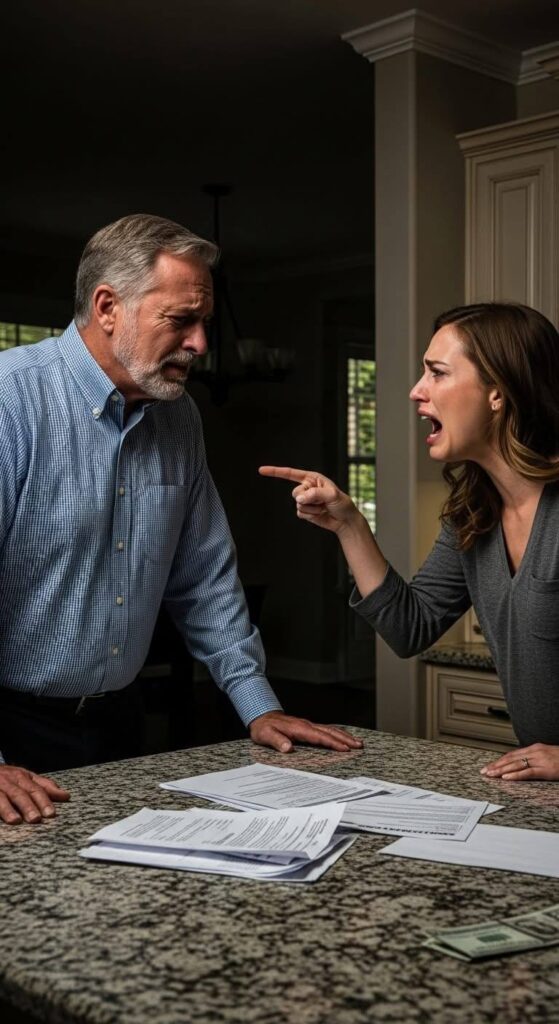
I stood on the threshold of my daughter’s house, a place I had helped her buy, a place where I was no longer welcome. The Florida humidity hung heavy in the air, but the chill came from within. “Go away, or I’ll call the police,” she shouted, her voice trembling with a rage I didn’t recognize, her eyes glistening with a coldness that shattered my heart. I had come here to save her from the ruins of her life. Instead, she had just handed me the rubble.
So, I smiled. A thin, grim, humorless smile. I turned around, walked back to my car, and dialed my realtor’s number. If my daughter and her parasitic husband wanted to lose their house so badly, then I would be more than happy to help them. They had no idea what I was about to do.
It had all started two days earlier, in the breakroom of my son-in-law’s office. The room smelled of stale coffee and microwave popcorn. Austin’s face was a blotchy, crimson mask as he slammed the credit report down on the formica table. Coffee sloshed from his mug, soaking a stack of bank statements I’d just pulled from my jacket pocket—printouts that told a story of reckless desperation he never intended me to read.
“Where the hell did you get these?” His voice cracked, the sound of a cornered teenager, not a thirty-something man in an expensive watch.
I kept my tone level, the same calm, measured voice I’d used for forty years to speak to panicked contractors when a foundation started settling wrong. “The bank called my house by mistake. Something about a late payment notice on a home equity line. For this address.” I tapped the statement with one calloused finger. “Fifty-three thousand dollars, Austin. Fifty-three thousand in gambling debts, all secured against my daughter’s house.”
He stepped closer, close enough that I could smell his cloying cologne mixed with the sour tang of nervous sweat. The fluorescent lights above us buzzed like angry wasps. “This doesn’t concern you, old man.”
“Doesn’t concern me?” I spread the papers across the scratched table surface, a mosaic of financial ruin. “My daughter is about to lose her home because you can’t stay away from online poker sites, and it doesn’t concern me?”
Austin’s expensive watch caught the harsh light as he swept the documents aside with a furious gesture. Papers fluttered to the grimy linoleum floor like dying leaves. “Stay out of my business, Clarence. I handle my own affairs.”
“Your affairs?” I bent down, my old knees protesting, and collected each sheet with the same methodical care I’d once used to organize blueprints. “These credit lines are tied to Lindsay’s house. The house she thinks is safe. The house she doesn’t know you’ve been using as your personal ATM.”
“She knows,” he said, but his voice wavered, a flicker of uncertainty in his eyes.
“Does she?” I straightened up, holding his gaze. “Does she know about the second mortgage? The home equity line? The loan you took out against her 401k?”
He turned away then, staring at the humming vending machine in the corner, his shoulders tensed under his perfectly pressed shirt. “I’m handling it,” he muttered.
“By borrowing more?” I pulled out my phone and showed him the screenshot I’d taken of his latest credit application. “This one’s for another thirty thousand. Also against the house.”
He spun around and snatched at my phone. I pulled it back, but not before I saw the look on his face. It wasn’t just anger anymore. It was fear. Real, gut-wrenching fear.
“You don’t understand,” he said, the fight draining out of his voice. “I had a system. It was working.”
“Your system is about to make my daughter homeless.”
“Your daughter?” He laughed, a hollow, bitter sound in the small, stuffy room. “She’s my wife, Clarence. Has been for three years. It’s about time you figured that out.”
I slipped my phone back into my jacket pocket. “I put thirty years of equity into that house,” I said quietly, the words heavy with the weight of a lifetime of sacrifice. “Thirty years of overtime shifts at the concrete plant. Thirty years of choosing mortgage payments over new clothes, over vacations, over everything else. And you’re gambling it away on a screen.”
“I didn’t ask for your help then, and I don’t need it now,” he said, grabbing his coffee mug, his knuckles white against the ceramic. “Stay out of my business.”
“Or what?” I asked, my voice still quiet.
He set the mug down hard enough to crack it. Coffee seeped across the table, a brown tide moving towards my recovered papers. “Just. Stay. Out.”
I folded the damp documents and slipped them back into my jacket. “I’m trying to help you, son.”
“I don’t want your help.”
I nodded, turned, and walked toward the door. Behind me, he called out something about me minding my own business, about knowing my place. But I was already gone, my mind already calculating the next step. Lindsay. Lindsay would listen to reason. She had to.
The engine of my old pickup truck ticked as it cooled in Lindsay’s driveway. Through her large front window, I could see the blue, flickering glow of the massive television Austin had bought last month, the one that probably cost more than most people’s monthly rent. I sat for a moment, organizing my thoughts the way I’d once organized complex construction schedules. Step one: show her the documents. Step two: calmly explain the imminent danger. Step three: help her find a solution before it was too late. It was a solid plan. It was a fool’s plan.
Lindsay opened the door before I could knock, her phone pressed to her ear. “Mom, I have to call you back. Dad’s here.” She hung up and plastered on that careful, bright smile she’d been using ever since she married him. “Dad! This is unexpected.”
“We need to talk, honey.”
Her smile flickered. She stepped aside, gesturing toward the living room where Austin’s massive gaming setup—another recent, expensive purchase—dominated one corner. Empty energy drink cans were scattered across the coffee table. The house smelled of expensive scented candles and something else… stress, maybe. The kind of quiet, desperate tension that settles into the walls when people are fighting about money.
“Coffee?” she asked, already moving toward the kitchen.
“This is serious, Lindsay.”
She paused at the kitchen entrance, her hand on the doorframe. “Okay,” she said, her voice a little too bright. “But I’m making coffee anyway. My hands need something to do when you use that tone of voice.”
I followed her into the kitchen. Her wedding pictures covered the refrigerator, Austin prominent in every shot, his arm draped around her shoulders possessively, like he owned her. I noted a stack of unopened bills tucked behind the toaster, the way she carefully avoided looking at them as she busied herself with the coffee maker.
“I found out about the gambling debts,” I said, and the coffee scoop clattered from her hand onto the counter.
“What… what gambling debts?”
I pulled out the documents and spread them across the polished granite of her kitchen island. Bank statements, credit reports, loan applications, all bearing Austin’s elegant, looping signature, all tied to this address. “Fifty-three thousand dollars, Lindsay. Maybe more. He’s been using your house as collateral.”
Her face went white, then a blotchy pink, then a furious red. “That’s impossible.”
“It’s right here,” I said, pointing to the home equity line statement. “Second mortgage for thirty thousand. This credit line for fifteen. And this one…”
“No!” She swept the papers aside with a violent gesture, scattering them across the pristine tile floor. “Austin would never do that! He would never risk our house!”
“Lindsay, just look at the documents.”
“These are fake!” she spun away from me, gripping the edge of the counter until her knuckles were white. “You made these up!”
“Made them up?” I knelt, my old knees protesting, and began to gather the papers again. “Why on earth would I do that?”
“Because you don’t like Austin!” she whirled back around, her voice rising, taking on that shrill, cornered quality I hadn’t heard since she was a teenager. “You’ve never liked him! You just want to break us up!”
“I want to save your house, honey.”
“Our house is fine!” she screamed, her eyes bright with tears. “We make our payments! We’ve never been late!”
“Because you don’t know about these payments,” I said, holding up the statements I’d printed from the online poker sites. “Two thousand three hundred last month. One thousand five hundred the month before. Where do you think that money is coming from?”
“Stop it!” Lindsay pressed her hands over her ears, shaking her head. “Stop it!”
“He’s borrowed against everything you own, Lindsay. Your car, your retirement account, your home.”
“Stop it!” She lunged for her phone on the counter. “Austin loves me! He would never hurt me! You’re lying!”
I stood slowly. The kitchen, with its expensive appliances and perfect finishes, felt fragile, like a stage set that might collapse at any moment. “I’m not lying, sweetheart.”
“Don’t call me that!” Her fingers trembled as she scrolled through her contacts, her face a mask of desperate denial. “Don’t you dare call me that! Get out!” The words came out strangled, desperate. “Get out of my house right now!”
“Your house?” I looked around at Austin’s expensive television, his gaming console, the unopened bills hidden behind the toaster. “This house I helped you buy? The one I co-signed the mortgage for?”
“Get out!” she shrieked, raising her phone like a weapon. “Get out, or I’ll call the police and tell them you’re harassing us!”
And that’s when it happened. The quiet click. Something cold settled in my chest. It wasn’t hurt anymore. I’d moved past hurt somewhere between the coffee maker and her covering her ears. This was something else. Something clearer, sharper. I smiled. A small, cold smile.
Lindsay blinked, confused by the expression. She had expected anger, maybe pleading. She was not prepared for this. I collected my papers with the same methodical care I’d shown in Austin’s breakroom. Each document was folded precisely and slipped back into my jacket pocket.
“You’ll call the police?” I asked quietly.
“Yes, I will!” But uncertainty flickered across her face.
“On your father, who is trying to save your house from foreclosure?”
“You’re not trying to save anything!” she cried. “You’re trying to ruin my marriage!”
I walked toward the door and paused in the kitchen entrance. Behind me, Lindsay clutched her phone like a lifeline. “I hope Austin is worth it, Lindsay,” I said.
“He is!”
“I hope the house is, too.”
I let myself out, walked slowly to my old truck. As I started the engine, I saw her in the front window, phone still pressed to her ear, probably calling Austin, warning him about her crazy old dad and his fake documents. She looked so small in that big window, surrounded by all of Austin’s expensive, debt-fueled purchases. My little girl, who used to help me balance the checkbook every Sunday, who used to trust me with everything. I drove home slowly, a new plan already forming in my mind. This next conversation wouldn’t be with a desperate gambler or a daughter in denial. This one would be with someone who understood the value of documentation, someone who appreciated the cold, hard, legal weight of a co-signer’s signature.
My house felt unnaturally quiet after the drama of Lindsay’s kitchen. I set my keys in the small wooden bowl by the door, the one Lindsay had made in seventh-grade woodshop, its lopsided charm now a painful reminder of a simpler time. The coffee I made was strong and black, the way I’d learned to drink it during those early, lean years when we were paying off our own mortgage, when cream was a luxury we couldn’t afford.
I settled into my father’s old recliner and let the memories surface. 1994. Lindsay was seven, all gap-toothed smiles and endless questions. I’d taken a second job at the concrete plant then, mixing foundations until my back screamed and my hands were raw and cracked from the lime. Twelve-hour shifts at the engineering firm, then another six hours pouring concrete. Eighteen hours a day, so we could make that mortgage payment three days early every single month.
“Why do you pay extra, Daddy?” she had asked once, her small finger tracing the numbers on the payment stub.
“Because the bank charges interest,” I’d explained. “If we pay extra, we save money later. We’ll own the house faster.”
“So it’ll really be ours,” she’d said, nodding with a solemn, seven-year-old’s wisdom.
The memory tasted bitter now, mixed with coffee and thirty years of irony. I had scrimped and saved, thinking I was teaching her the value of ownership, of building something solid. But she had forgotten that lesson, seduced by Austin’s world of easy credit and borrowed pleasures.
My mind drifted back to the day they had applied for the mortgage, four years ago. Austin’s employment history was spotty, his credit score mediocre. Lindsay’s salary as a dental hygienist was steady but modest. Together, they didn’t qualify for the loan on the house she had fallen in love with.
“We’ll need a co-signer,” the loan officer, a woman named Margaret Chen, had explained. “Someone with excellent credit and verifiable income to guarantee the full loan amount.”
I had hesitated. My engineer’s instinct for risk assessment was screaming at me. But Lindsay had looked at me with those same pleading eyes that had melted my resolve since she was a little girl. “Please, Dad. We’ll never miss a payment. I promise.”
“You understand, Mr. Brooks,” Margaret Chen had continued, “that as a co-applicant, you will have legal standing in any major decisions regarding the property. Refinancing, home equity loans, even the sale of the home would require your consent.”
Austin had nodded quickly, eager to get to the house-shopping part. Lindsay had squeezed my hand. And I had signed my name, thinking I was helping my daughter achieve the American dream. Now, those legal technicalities were about to become my salvation.
I went to my home office and pulled the thick manila folder labeled House – Lindsay. My filing system was my pride, a lifetime of organized precision. And there it was, the original mortgage application. Co-Applicant: Clarence Brooks. Relationship to Primary Applicant: Father. Financial Responsibility: Joint and several liability for the full loan amount. The phrase carried a legal weight that Austin, in all his financial cleverness, had apparently forgotten. And a section in the fine print I had skimmed past four years ago now stood out like a beacon: In the event of financial distress or dispute, all co-applicants retain equal legal standing to initiate protective measures, including… a forced sale.
The next morning, I was in the office of Richard Chen, the loan officer’s brother and a real estate attorney who specialized in family property disputes.
“A legal partition action,” he confirmed after reviewing my documents. “As a co-applicant, you’re not just a co-signer who guaranteed the debt. You’re a legal co-owner. They can’t make unilateral financial decisions, like taking out a home equity line for fifty-three thousand dollars, without your consent. Filing a partition suit is the nuclear option. It forces a sale through a court order and divides the proceeds. Once you file, there’s no going back. This will permanently damage your relationship with your daughter.”
I thought about Lindsay’s threat to call the police, about Austin’s visit to my home, about thirty years of my own mortgage payments being gambled away. “I think that relationship is already damaged beyond repair,” I said.
We filed the petition first thing Monday morning. The sound of the clerk’s official stamp on the documents was final, decisive. This was no longer a family dispute. It was a legal proceeding, governed by rules they couldn’t manipulate or ignore.
The calls started on Thursday, after the sheriff’s deputy served them with the papers. First Lindsay, her voice shaking with a confusion I knew was genuine. Then Austin, his voice a cocktail of disbelief and impotent rage. I let them all go to voicemail. By Sunday, Lindsay’s message was calmer, more calculated. “Dad, Austin talked to a lawyer. He says this partition thing is just a scare tactic, that you don’t really want to sell our house. You just want attention. So, we’re not going to play along. We’re ignoring this whole legal circus until you come to your senses.”
It was the most beautiful gift she could have given me. They were calling my bluff. They didn’t know I wasn’t bluffing.
The next few weeks were a quiet, methodical execution of a legal strategy. They ignored the court filings. They missed the deadline to respond. A default judgment was entered in my favor. The court ordered an appraisal. A “For Sale” sign went up in their yard. Their panic, when it finally came, was a symphony of desperate voicemails and frantic texts. They begged, they threatened, they apologized. It was too late. The legal machinery I had set in motion was now unstoppable.
The closing took place on a bright, sunny afternoon in March. I sat in a sterile conference room and signed the final papers. The house was sold. After the original mortgage was paid, and after Austin’s gambling debts were settled from the proceeds, I received a check for seventy-eight thousand dollars—my share of the equity, a tangible return on a thirty-year investment in a dream that had died.
That evening, I found a final voicemail from Lindsay. “Dad, we moved out yesterday,” she’d said, her voice small and defeated. “Austin found a job in Jacksonville. We’re starting over. I wanted to say… I understand now. About the money, about Austin’s gambling, about why you did what you did. I’m sorry it took losing our house for me to see it. I hope someday you can forgive us. I love you.”
I listened to the message twice, then deleted it. Understanding the consequences was a different thing from earning reconciliation.
A few weeks later, I bought a small condo in a quiet golf course community. I spend my mornings in the garden, my afternoons on the course. My life is my own again. The house, the one I had worked my whole life for, the one I had given away out of love, is gone. But in its place, I have found something I had lost along the way: my own peace, my own freedom, and the quiet satisfaction of knowing that some foundations, the ones built on a lifetime of integrity and hard work, can never truly be broken.00000000000