I’m writing this on a Tuesday, September 30th, 2025. My daughter, Evelyn, just started the sixth grade. Watching her pack her own lunch this morning—deftly assembling a turkey sandwich, her tongue stuck out in concentration—it’s hard to believe that for four years, she was a ghost. A ghost who haunted every waking moment and every tormented dream. A wound in the center of my life that refused to close. My name is Dr. Anna Reid, and this is the story of how a routine call to a rundown apartment building brought my daughter back from the dead.
Four years ago, my world didn’t just end; it evaporated. It was a sun-drenched afternoon in a perfectly ordinary park. One minute, my three-year-old daughter, a whirlwind of blonde curls and joyful shrieks, was laughing as she chased a monarch butterfly near the swings. The next, she was gone. I had turned away for no more than thirty seconds. My husband, Zach, had sent a text—something mundane about dinner plans. I had typed back a quick reply. When I looked up, the spot where she’d been standing, a small figure in a bright yellow dress, was empty.
The days that followed were a blur of sirens, search parties, and a soul-crushing, suffocating terror I wouldn’t wish on my worst enemy. We lived a nightmare that every parent dreads. But there were no witnesses, no credible leads, no ransom note. My daughter had simply vanished into thin air. An open case file in a detective’s drawer. A smiling face on a missing child poster that eventually faded and tore in the rain.
The official investigation wound down, becoming a cold case. But for me, the search never ended. My life became a hollowed-out shell, defined by the gaping, Evelyn-shaped hole in its center. My marriage to Zach, once so full of laughter and easy affection, became strained under the weight of our shared, unspoken grief. He was a traveling consultant, and his business trips grew longer, more frequent. It was his way of escaping the suffocating sadness of our home, a home that had become a museum of her absence. Her tiny pink sneakers remained by the front door. Her favorite teddy bear, a raggedy thing named Zippy with one button eye, sat on her perfectly made, un-slept-in bed. The faint, happy crayon marks on the dining room wall—a rebellious mural of a purple sun and a green dog—were a daily, painful reminder of the life that had been stolen from us.
I threw myself into my work as an ER doctor and paramedic with a ferocity that bordered on self-destruction. The constant chaos of the ambulance, the high-stakes drama of saving other people’s children, became my only solace. It was a grim, exhausting penance. My life became a series of long, grueling shifts, a litany of human suffering that served as a distraction from my own.
The day it happened started like any other. My partner, Marco, and I were checking the supplies in our ambulance, the crisp morning air doing little to wake me from my perpetual fatigue. “Ready for another day of saving the world, Doc?” he asked, his usual morning cheerfulness grating on my raw nerves.
“As always,” I replied, my smile a well-practiced mask that never reached my eyes.
The calls came in, a steady rhythm of the city’s pain. An elderly woman with chest pains, her frightened eyes searching mine for reassurance. A young mother with a migraine so severe she couldn’t stand the light. Then came the call that was a cruel echo of my own life’s tragedy. A pregnant woman. Her water had broken on the side of the highway. We knew instantly we wouldn’t make it to the hospital in time. We were going to have to deliver the baby right there, in the back of the ambulance, on a cold stretch of asphalt.
I worked with a focused, clinical precision, my training taking over, pushing my own roiling emotions down into the dark pit where I kept them. But as the baby was born, a perfect, beautiful little girl, my heart stopped. She was silent. I worked on her, my hands moving with a desperate urgency, but it was no use. She was gone. The mother’s piercing, animalistic scream of grief was a sound I knew all too well. It was the sound my own soul had been making for four years. As I tried to comfort the devastated woman, her husband arrived, his face a mask of rage and unbearable pain. He saw his lifeless daughter, saw me, and lunged, grabbing my arm. “You killed my baby!” he screamed, his grief so raw it was a physical force.
Marco and our driver pulled him away, but his words, his wild, unjust accusations, ricocheted around my skull for the rest of the day. Every day, I was a tourist in other people’s worst moments, and every day, it felt like I was reliving my own.
Later that afternoon, a call came in for an elderly patient, a Mr. Malone, a regular with chronic heart problems. He was a sweet but lonely old man who, I suspected, often called 911 just for some human contact. He was fine, just needed his medication adjusted. As we were loading him into the ambulance for observation, he gripped my hand, his eyes, usually clouded with age, suddenly sharp and clear.
“The lost bird will find its nest, Doctor,” he whispered, his voice full of a strange, prophetic urgency. “You’ve been looking in all the wrong places.”
I dismissed it as the ramblings of a confused old man, but his words sent an unsettling shiver down my spine, a strange ripple in the stagnant waters of my grief.
The day was a blur of more routine calls. As our shift was finally winding down, one last call came in. A woman with acute abdominal pains. The address was an old, rundown apartment building in a part of town I knew well.
“Let’s make this quick,” Marco said as we pulled up. “I’m dreaming of a hot meal and my couch.”
We climbed the creaking stairs to the third floor. I had a powerful sense of déjà vu. I was sure I had been in this building before, maybe even this very apartment. When the door opened and I saw the woman’s face, pale and etched with pain, I knew why. She was a patient I had treated months ago in the ER for a minor injury.
“Hello,” I said, stepping into the cramped, cluttered apartment. “You’re having stomach pains?”
“It hurts so much, Doctor,” she whispered, clutching her side.
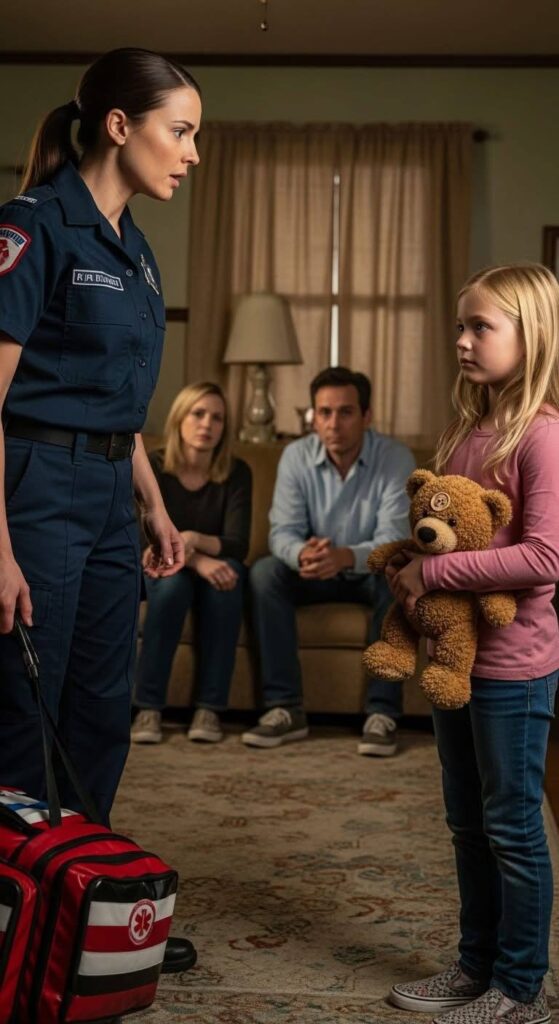
As I began my examination, I heard the sound of small footsteps from the other room. A little girl, about seven years old, peeked around the doorframe. She had bright, curious eyes and a cascade of blonde curls that fell over her shoulders. My heart stopped. It was the exact same shade of spun gold as Evelyn’s.
I tried to focus on my patient, but my eyes kept darting to the little girl. She was watching me with a shy, serious expression that felt achingly familiar.
“Is your husband home?” I asked the woman, my voice sounding strained to my own ears. “I’ll need to ask him a few questions.”
“He’s in the bedroom,” she said. “He can pack my hospital bag.”
The woman’s husband came out. He was a nervous, twitchy man who wouldn’t meet my gaze. He scurried into the bedroom to pack his wife’s things. As he left, the little girl stepped fully into the room. She was holding a well-loved, slightly ragged teddy bear.
And that’s when my world stopped turning. My heart, my lungs, every function of my body ceased. It wasn’t just any teddy bear. It was a bear with one black button eye and a small, slightly crooked hand-stitched patch on its left ear, a patch I had sewn myself after a particularly rough playtime session. It was Evelyn’s bear. Her Zippy.
I felt the air leave my body in a rush. My vision narrowed to a single, impossible point: the little girl with my daughter’s blonde hair, my daughter’s serious eyes, holding my daughter’s favorite toy.
“Evelyn?” I whispered, the name a ghost on my lips, a sound of prayer and disbelief.
The little girl’s eyes widened. Her own face, which had been a mask of shyness, was suddenly filled with a dawning, impossible recognition. A memory, buried under four long years of a different life, was fighting its way to the surface.
“Mommy?” she whispered back.
It was a lightning strike. A jolt of a thousand volts that brought my dead heart back to life with a single, painful, glorious beat. It was her. My daughter. My Evelyn. Four years older, her face a little thinner, but it was her. It was really her.
I took a step towards her, my arms outstretched, but at that moment, the husband came back into the room. He saw the look on my face. He saw the recognition in his “daughter’s” eyes. He saw the teddy bear. And his face contorted in a mask of pure panic. He lunged, not at me, but at the girl.
“She’s our child!” he screamed, his eyes wild. He grabbed a kitchen knife from a magnetic strip on the wall. “I won’t let you take her!”
My years of training, of dealing with violence and chaos, took over. As he moved, my hand was already hitting the emergency distress button on my tablet, a silent alarm that would bring every police car in the vicinity to our location. I moved between him and Evelyn, shielding her with my body, my mind a vortex of terror and a fierce, primal protectiveness.
“Put the knife down,” I said, my voice as calm and steady as if I were instructing a patient. “It’s over.”
He was a man driven mad by grief. As the police burst through the door, his wife, my patient, sobbed out the whole tragic story. Their own daughter had died of a rare illness five years ago. A year later, her husband, shattered and unable to cope with the loss, had gone to the park where they used to take their little girl. And he had seen Evelyn. A child who looked so much like their own. In a moment of madness, he had simply… taken her. He had brought Evelyn home, and they had raised her as their own, a desperate, stolen replacement for the daughter they had lost.
The reunion was a storm of tears and a joy so profound it was almost painful. I held my daughter, my living, breathing Evelyn, in my arms, breathing in the scent of her hair, tracing the familiar shape of her face. She was quiet, traumatized, a stranger in so many ways, but she was mine. She was home.
I called Zach from the back of the ambulance, Evelyn clutching my hand as if she would never let go. He was on a business trip in California. “Zach,” I said, my voice breaking. “She’s alive. I found her. Evelyn is alive.” He was on the next flight home.
The years since that day have been a long, slow journey of healing. It wasn’t a fairy-tale ending where everything was magically okay. Evelyn had to get to know us again. She had memories of another family, a life that was both a lie and her only reality. We had to go through therapy, all of us, to rebuild our family from the rubble of our collective trauma.
Zach took a local job that didn’t require travel. He never left our side again. We poured all our love, all our patience, all our resources into helping our daughter reclaim the life that had been stolen from her. We had to be gentle, to let her come back to us on her own terms.
Last night, we were all sitting at the dinner table. Evelyn, now a bright, thriving eleven-year-old, was telling us a long, complicated story about her day at school. She laughed, a sound of pure, unadulterated joy that is now the constant music of our home. And in that moment, I looked at her, at my beautiful, resilient daughter, and then at my husband, his face full of a love and contentment I thought we had lost forever. The lost bird had found her nest. My family was finally, miraculously, whole again.