My name is Vincent. For fifteen years, my life has been a quiet exercise in managing loneliness. I own a restaurant, a nice place with dark wood and soft jazz, the kind of establishment where people celebrate anniversaries and close business deals. It’s a successful business, but for me, it’s mostly a distraction. A way to fill the gaping void left in my life fifteen years ago when my wife, Julia, took our infant daughter, Cassie, and moved to Europe, vanishing from my world forever.
I had resigned myself to this hollow existence. And then one night, my art director, a man with more enthusiasm than sense, burst into my office, dragging a young girl behind him.
“You have to hear her, Vince! She’s a nugget of pure gold!” he exclaimed.
I looked at the girl. She was maybe thirteen, modestly dressed, with a neat braid and a fresh, innocent face that had no business being in a place that served hundred-dollar bottles of wine.
“Art,” I said, my voice tired. “This is a restaurant, not a school talent show. You know we don’t hire children.”
“Just listen,” he pleaded, pushing her gently towards the small stage in the main dining room.
To get him out of my office, I agreed. The girl, whose name I learned was Oksana, took the microphone. And when she began to sing, the entire room froze. The clinking of glasses, the murmur of conversations, the hustle of the waiters—it all just stopped. Her voice was a thing of pure, unearthly beauty. It was clear, powerful, and filled with a depth of emotion that a thirteen-year-old shouldn’t have been able to possess.
When she finished, there was a beat of stunned silence, followed by an eruption of applause. I was speechless. This wasn’t just talent; it was magic.
Later, in my office, she told me her story. She was an orphan. She had no parents, only an elderly grandmother who was seriously ill and needed an expensive operation. The amount she wrote down on a piece of paper made me whistle.
“I know what a restaurant is,” she said, her gaze direct and unflinching. “I know people here drink more than tea. But I need this job, Mr. Ross. I’ll do anything.”
My mind was screaming at me to say no. Child labor laws, the seedy element of the late-night crowd, the sheer irresponsibility of it all. But then I looked at her, at this brave, desperate girl who sang like an angel, and she reminded me so much of my own lost daughter.
“Alright,” I heard myself say. “Twice a week. You’ll be fed in the kitchen, and my driver will take you straight home to the orphanage after your set. And if anyone, I mean anyone, bothers you, you come straight to me.”
That was how Oksana, my singing bird, came into my life. Her performances became the stuff of local legend. The restaurant was packed on the nights she sang. But I was fiercely protective. I made sure she was always safe, always respected. A few weeks in, a woman named Liz, a cook from the orphanage, came to see me. She was a warm, no-nonsense woman with kind eyes, and she wanted to make sure I was a decent man. She vetted me thoroughly, and in the process, we found a connection. After years of being alone, I started dating this wonderful, down-to-earth woman. For the first time in a long time, my life felt like it was filling up again.
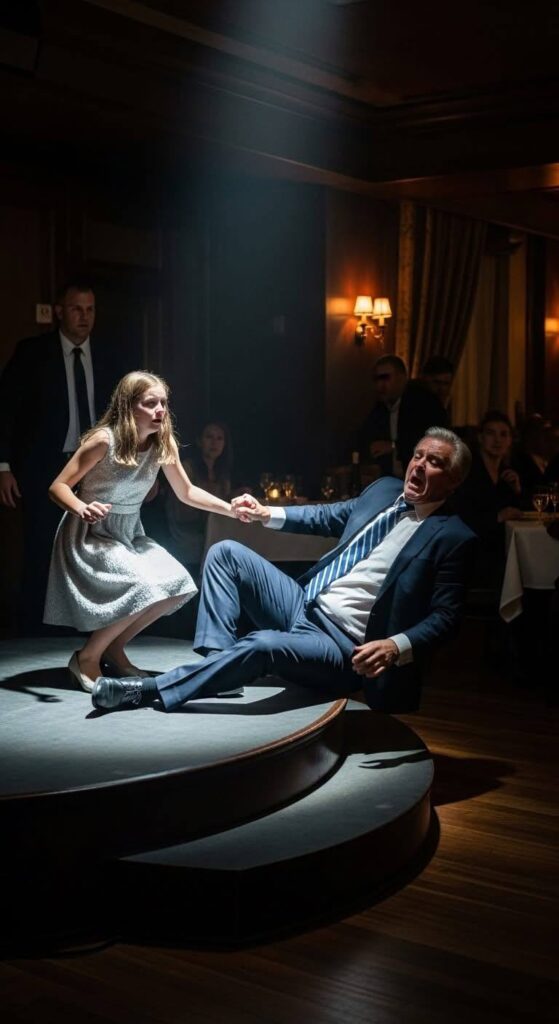
Then came the night that changed everything. Oksana was on stage, singing a soulful ballad, when a man in an expensive suit, who had been drinking heavily at the bar, suddenly stood up and screamed.
“Julia!” he yelled, his voice a raw cry of anguish. “It can’t be you!”
He rushed the stage. The music stopped. Oksana backed away, her face a mask of fear. “Julia, it’s me!” he cried, grabbing at the hem of her silver dress. Before my security could reach him, the man’s eyes rolled back in his head, and he collapsed to the floor. It was a massive heart attack.
The next day, I went to the hospital to check on him. His name was Ethan, a wealthy geologist. I found him lying in a private room, looking pale and frail.
“I’m the manager of the restaurant,” I said. “I wanted to see how you were.”
“The girl…” he rasped. “The singer. Is she alright?”
“She was scared, but she’s fine,” I said. “You called her Julia. Do you know her?”
He shook his head, a look of profound sadness on his face. And then he told me a story that made the hairs on my arm stand up. Fifteen years ago, he had been madly in love with a girl named Julia. She was his whole world. But she was fiercely ambitious, dreaming of a life in Europe. One day, she just… disappeared. He never saw her again.
“That singer,” he whispered, tears in his eyes. “She looked exactly like her. Untouched by time. For a second, I thought I’d gone crazy, or that I’d seen a ghost.”
The name. The timeline. The uncanny resemblance. A cold, impossible thought began to form in my mind.
That evening, I went to the orphanage. I sat down with Oksana and her grandmother, Anna. I told them about the man in the hospital. Then I took a deep breath. “Oksana,” I said gently. “What was your mother’s full name?”
“Julia,” she replied. “Julia Stepanova.”
My heart stopped. “And your father?”
She shrugged. “I don’t know. My mom left me with my grandma when I was a baby. She went to England. Grandma said she didn’t want me.”
“That’s not true!” the old woman cried, her composure finally breaking. She confessed the whole story. Julia, her daughter, had been ambitious and selfish. She had a chance to move to London for a job and a new life. She didn’t want to be tied down by a baby. She had abandoned her daughter with Anna and left, forcing her mother to promise she would never tell me the truth. To protect the little girl from the painful knowledge that her own mother had discarded her, Anna had changed her last name, inventing a story about a different father.
I stared at the young girl in front of me. The same dark hair, the same determined chin, the same deep, soulful eyes as the baby I had held in my arms fifteen years ago. My Ksenia. My Cassie.
“Oksana,” I said, my voice thick with emotion. “Your name isn’t Oksana. It’s Ksenia. Cassie. And I… I am your father.”
The reunion was a storm of tears, of questions, of fifteen years of lost time. I learned that my proud, stubborn Julia had indeed moved to Europe. Her life, however, was not the glamorous dream she had imagined. She lived alone in a small English village, a bitter, lonely woman, consumed by the regrets of the choices she had made.
My life, on the other hand, was suddenly full. I immediately paid for Anna’s surgery. Ethan, the man from the restaurant, upon hearing the full, incredible story, insisted on contributing as well, grateful for the closure I had inadvertently given him. He and I became unlikely friends, two men bound by the ghost of the same woman.
I asked Liz, my wonderful, patient Liz, to marry me. She had stood by me through this entire emotional whirlwind, a rock of steady love and support. A year later, we were married, with Cassie as our beautiful, radiant maid of honor.
That was ten years ago. Today, my daughter is no longer a shy orphan singing in a smoky restaurant. She is Ksenia Ross, an internationally renowned vocalist, selling out concert halls across the world. Tonight, she’s performing here, in her hometown, and our whole family is in the front row. My wife, Liz; our two rambunctious twins; Cassie’s grandmother, Anna, now healthy and spry; and me.
As she walks onto the stage, the spotlight hitting her, she looks out into the crowd, finds my eyes, and smiles. The sound of her voice fills the massive hall, a sound of pure, breathtaking beauty. It’s the same magic I heard all those years ago, but now it’s shared with the world.
My life was a quiet, empty room for fifteen years. I thought the door was locked forever. I never imagined that the key would be a little girl with an angel’s voice, a girl who was my own daughter, coming home to me when I needed her most. She didn’t just save her grandmother; she saved me, too.