My name is Loretta Thornton, and the first time my ex-husband called me “trailer trash” in front of his new wife, I was three months away from making Lieutenant Colonel in the United States Army. I was 40 years old, standing in the parking lot of a Chili’s in Fort Worth, Texas, watching him introduce his fiancée, Amber, to our daughter, Sophie.
Sophie was 16 and looked at me with a mixture of pity and embarrassment as Derek explained that I came from nothing and never really made anything of myself. “Your mom tried,” he said, ruffling Sophie’s hair. “She just didn’t have the background for success, you know. But hey, she’s doing okay for someone who grew up in a trailer park.“
Amber, blonde and 28, gave me a sympathetic smile, the kind you give to a poor relation at a wedding. I smiled back, said nothing, and took Sophie to my car. “Mom,” Sophie said as I drove away, “why don’t you ever defend yourself?“
“Because,” I said, “some things don’t need defending.“
She didn’t understand. She’d grown up in Derek’s world: the nice house, the private school, the country club. She didn’t know where I’d come from, not really. And Derek made sure she never forgot that he’d “rescued” me from it.
I did grow up in a trailer park in Abilene, Texas. My mother cleaned houses; my father left when I was four. I wore secondhand clothes and ate free lunch at school. I learned early that people looked at you differently when your address included “Lot 47.” But I was smart, sharp enough to know that education was my only way out. I got straight A’s, worked weekends at a grocery store, and got a full ride to Texas Tech, the first in my family to go to college.
I met Derek my sophomore year. He was pre-med from a family of doctors in Dallas—old money, country club. He thought I was “refreshingly authentic.” I thought he was my ticket to a different life. We got married when I was 22. I dropped out to support him through medical school, working as a receptionist. We had Sophie when I was 24. By the time Derek finished his residency, I was 29 with an unfinished degree and a husband who’d started looking at me the way his mother did, like I was something he’d outgrown.
The divorce was quick and brutal. He got primary custody because he had “stability.” I got every other weekend and child support that barely covered Sophie’s private school tuition. His lawyer made sure to mention my limited education and lack of career prospects multiple times. I signed the papers, took my settlement, and then I did something that surprised everyone, including myself: I joined the Army.
I was 30 years old, too old for most people’s idea of military service. But the Army didn’t care where I came from. They cared if I could do the job. Turns out, I could. I went through Officer Candidate School and commissioned as a Second Lieutenant in logistics. I was good at it—better than good. I understood systems, people, and what it meant to make something out of nothing. I made First Lieutenant after two years, Captain at 35, and Major at 38.
Through it all, Derek had no idea. He thought I was enlisted, some kind of supply clerk. I’d tried to explain the difference between an officer and enlisted, between a Major and a Private. He’d glazed over. “It’s all very military,” he’d said. “Good for you, though. Steady paycheck.“
Sophie knew I was in the Army, but she spent most of her time in Derek’s world. Around age 14, she started looking at me differently, with a kind of embarrassed tolerance. Derek encouraged it with little comments: “Your mom’s doing her thing,” or “Your mom’s world is different.“
He remarried when Sophie was 15. Amber was everything I wasn’t: young, educated at the right schools, and comfortable in his world. I told myself I didn’t care. I had my career, my self-respect. But it hurt every time Sophie rolled her eyes when I picked her up in my Honda Civic instead of Derek’s BMW.
Then, last November, everything changed. I got the call: I’d been selected for Lieutenant Colonel. O-5 rank, senior field-grade officer, command level. I sat in my office at Fort Hood, stared at the email, and cried. The girl from Lot 47 had made Lieutenant Colonel in the United States Army.
The promotion ceremony was scheduled for January. I called Sophie to tell her. “That’s cool, Mom,” she said, distracted. “Hey, can I call you back? We’re about to have dinner.” She didn’t call back.
The ceremony was on a Friday. I invited Sophie, told her it was important. She said she’d try to make it but had to go dress shopping with Amber for some gala. “Can’t you reschedule?” I asked. “Mom, it’s just a work thing, right? You’ve had promotions before.” “This one’s different,” I said. “I’ll try,” she said. She didn’t come.
My mother came, though, driving six hours from Abilene. She sat in the front row and cried through the whole ceremony. My battalion commander pinned the silver oak leaf insignia on my uniform. “Speech!” someone called out. I looked at the room—my fellow officers, the soldiers I’d served with.
“I grew up in a trailer park,” I said. The room was silent. “My mother cleaned houses. I wore secondhand clothes. I got made fun of for where I lived. I joined the Army because I needed a paycheck and a way to finish my degree. I didn’t know what I was doing. Ten years later, I’m standing here as a Lieutenant Colonel. And I want everyone in this room to know: where you start doesn’t determine where you finish. The only person who gets to decide your worth is you.“
The applause was thunderous. Afterward, my commander pulled me aside. “Thornton, we’re deploying to Kuwait in March. I want you as my Executive Officer. Interested?“
Executive Officer. Second-in-command of a battalion of over 800 soldiers. “Yes, sir,” I said.
In February, Sophie’s school had a career day. Parents were invited to speak. Derek couldn’t make it. Amber had a conflict. Finally, reluctantly, she asked me. “What would I even say?” she asked. “That my mom’s in the Army?“

“You could say that,” I said. “Or you could say your mom’s a Lieutenant Colonel who’s about to deploy as the Executive Officer of a battalion.“
Silence. “What does that mean?” she asked.
“It means I’m second-in-command of over 800 soldiers. It means I oversee logistics for an entire battalion. It means I’m responsible for millions of dollars of equipment and the lives of the people under my command.“
More silence. “Oh,” she said finally. “I didn’t know you were… I thought you just worked in an office.“
“I do,” I said, “when I’m not in the field, or deployed, or training, or commanding. Will you come?“
“Yes,” she said, her voice different now, smaller.
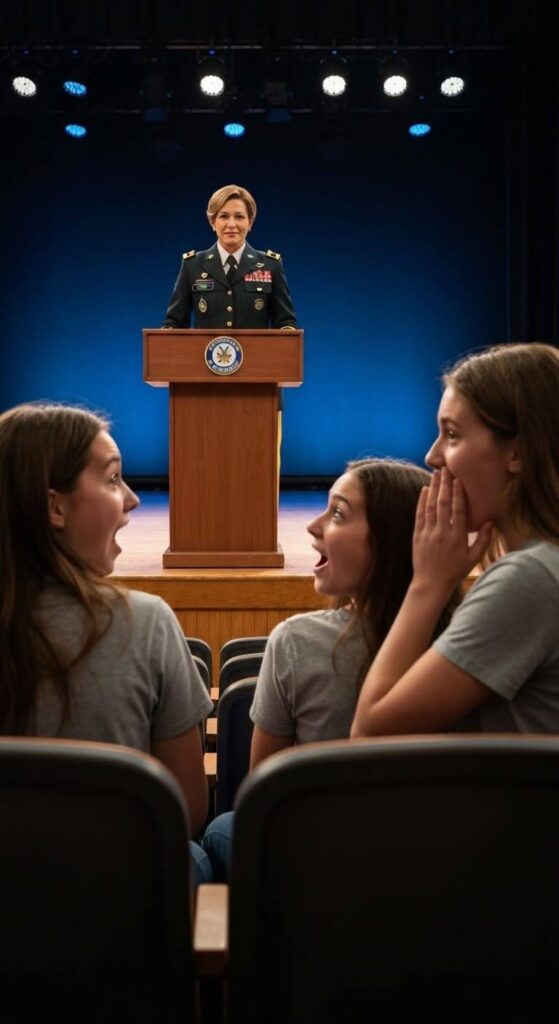
I showed up in my dress uniform, Army Service Blues: dark blue jacket, silver oak leaf insignia on my shoulders, ribbons on my chest—deployment medals, service medals, commendation medals earned over 10 years. Sophie stared at me. “Mom,” she whispered, “you look… professional.“
“Important,” she corrected herself.
I gave my presentation. I talked about Army logistics, leadership, responsibility, and the weight of command. At the end, Sophie’s teacher came up to me. “Lieutenant Colonel Thornton, thank you so much. Sophie must be so proud.” Sophie, standing next to me, nodded slowly. “I am,” she said. And I think she meant it.
That weekend was Derek’s, but Sophie asked to stay with me instead. “I want to hear more,” she said. We sat in my small, modest apartment that she’d always seemed embarrassed by, and I told her everything. “Why didn’t you tell me all this before?” she asked.
“I tried,” I said gently. “But you weren’t interested. And your dad… he didn’t think it mattered.“
“He doesn’t know, does he?” she asked. “About your rank, about what you actually do?“
“No,” I said.
“Can I tell him?“
“If you want to.“
She must have, because the next week I got a call from Derek. “Sophie says you’re a Lieutenant Colonel,” he said, no greeting.
“Yes,” I said.
“Since when?“
“Since January. And you’re deploying in two weeks? To Kuwait?“
“For nine months.“
Silence. Then, “Why didn’t you tell me?“
“Derek,” I said, “I’ve been in the Army for 10 years. I’ve tried to tell you about my career. You’ve never been interested.“
“I didn’t realize you were… I thought you were enlisted. Like a supply clerk or something.“
“I’m an officer,” I said. “I have been since I was 30. I’ve deployed twice. I’ve commanded soldiers. I’ve briefed generals. And I’ve earned every rank I’ve gotten.“
More silence. “I didn’t know,” he said finally.
“I know,” I said.
“Sophie wants to have a dinner,” he said. “Before you deploy. All of us. To acknowledge this properly.“
“Okay,” I said.
We met at a nice restaurant. I wore my uniform; Sophie had asked me to. Derek stood when he saw me, stared. “Jesus, Loretta,” he said.
We ordered, made small talk, and then Derek said, “I owe you an apology.” I looked at him. “I’ve spent 10 years underestimating you,” he said, “dismissing what you do, making you feel small. I told myself it was because you came from nothing, because you didn’t finish college. But the truth is, I was the one who wasn’t enough. You built a career from scratch. You earned respect. You became someone. And I was so busy looking down on you that I missed watching you become extraordinary.“
Amber was quiet. Sophie was watching me carefully. “I forgive you,” I said.
Derek looked up, surprised. “Just like that?“
“Just like that,” I said. “Because I don’t need your approval anymore, Derek. I don’t need you to see my worth. I already know it.” He nodded slowly.
As we left, he stopped me in the parking lot. “When you get back,” he said, “from Kuwait… can we try this again? The co-parenting thing, but actually respectful this time?“
“Yes,” I said. “I’d like that.“
I deployed three weeks later. Sophie cried at the airport. Derek was there too. “Be safe,” he said. “Please.“
“I will,” I said.
“And Loretta,” he hesitated. “Thank you. For everything you do. For our country, for Sophie… for proving me wrong.“
I smiled. “You’re welcome.“
I’m in Kuwait now, four months into the deployment, Executive Officer of a battalion. Sophie emails me every day. She’s started researching military service, talking about ROTC programs. Derek sends care packages, apologizing in small ways. And my mother, who cleaned houses, who raised me in a trailer park, who never stopped believing I could be more… she keeps every article she finds about the battalion.
I’m 40 years old. I’m a Lieutenant Colonel in the United States Army. I grew up in a trailer park. And the people who said I’d never amount to anything were wrong. Not because I proved them wrong, but because I stopped letting them define me. I define myself. And that, I’ve learned, is the only victory that matters.
Interesting For You