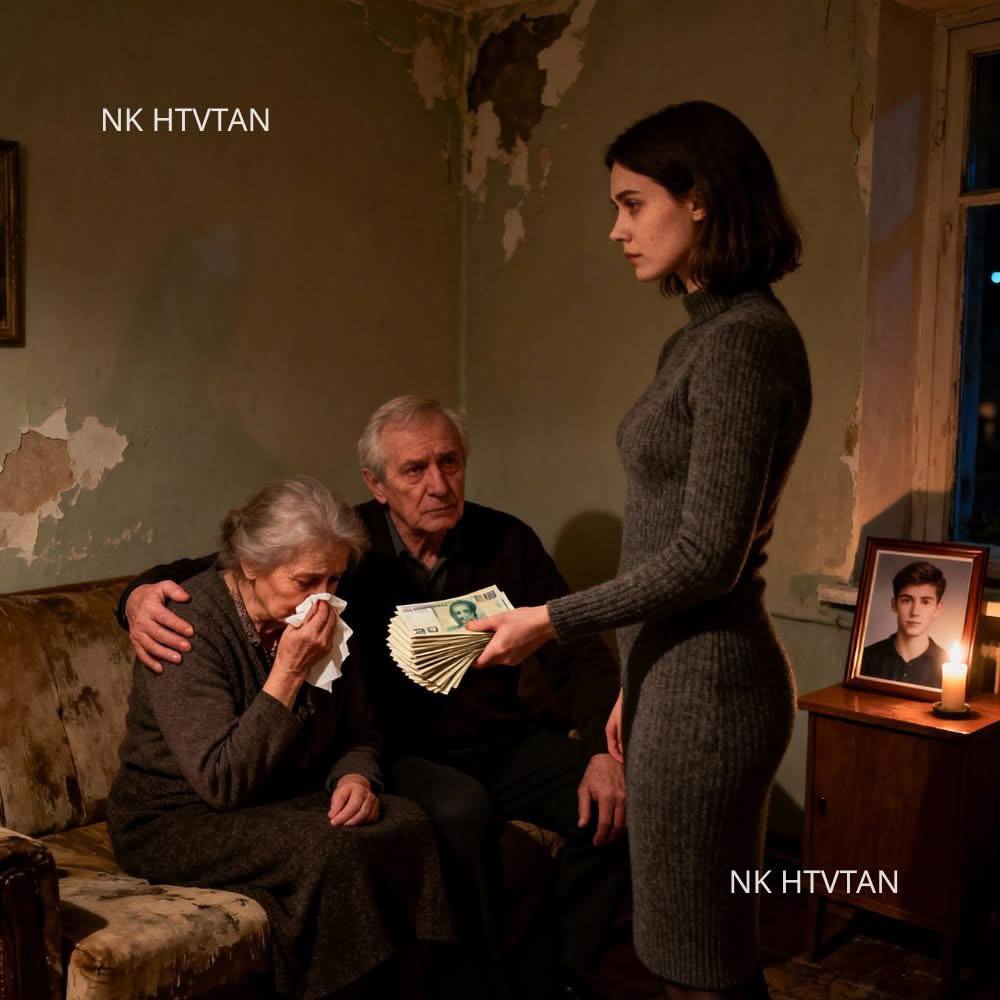
My husband died five years ago. Every month I sent 200 euros to my in-laws to pay off a debt. One day, my downstairs neighbor told me, “Stop sending them money and check the security camera.” The next day I reviewed the footage. What unfolded before my eyes left me frozen.
The smell of peeling paint mixed with the stench of drains that hadn’t been cleaned in years hit me as soon as I turned off the scooter engine at the foot of the staircase. This old corrala had survived in the heart of Madrid for more than seventy years, as worn and decrepit as the people slowly wasting away inside it. I leaned my burgundy Liberty scooter against the wall, right where a red paint mark showed the spot it had occupied for the last five years. Today was the fifth of the month, the day when I, Liria, a 32-year-old widow, was supposed to fulfill my obligation to pay the debt of my late husband—five floors up, no elevator.
I adjusted my bag. My hand brushed the thick envelope in the inner pocket. Two hundred euros. An insignificant amount for the wealthy, but one-sixth of my meager salary. Money for Gael’s milk, his English classes, his after-school football. Five years ago, so that Damián could go work in Germany, his parents had withdrawn all their retirement savings—12,000 euros—and given them to him. The day Damián died, his mother pointed her finger at me, accusing me that because of me her son had been forced to emigrate and ended up losing his life, leaving them—two elderly people—with nothing.
She forced me to take responsibility for repaying that amount in installments of 200 euros a month for five years. I clenched my teeth and accepted, considering it the last act of love for my husband and a way to have peace while raising my son. The staircase was a deep, dark well, barely lit by weak rays of sunlight filtering through the broken glass of the light shaft. The echo of my footsteps rang on the worn tiles.
Tap, tap, tap. Each step was a dead weight. On the first floor, the concierge always had the radio blasting. On the second, the smell of burnt lentils drifted from a communal kitchen. On the third, a young couple shouted at each other about the rising electricity bill. By the fourth floor, silence was almost total, and the fifth, where my in-laws lived, was a world apart, eerily still. I stopped on the fifth-floor landing, wiping sweat from my forehead.
My chest felt tight, my heart pounding—not only from the climb but from the vague unease that always seized me in front of that rust-eaten blue iron door. Apartment 504. The home of Damián’s parents. I knocked three times, firm and clear. Knock, knock, knock. Silence. I knew they were home. They never went anywhere. Anselmo, my father-in-law, suffered from arthritis. Úrsula, my mother-in-law, constantly complained of headaches and dizziness.
They lived like shadows in that sixty-square-meter apartment, shutters always down, door locked day and night. I knocked again, harder this time. “Dad, Mom, it’s Liria.” Almost a minute passed before I heard slippers dragging inside. The sound of the bolt sliding back was dry, like the creaking of an old man’s bones. The door opened just a crack, enough for a wrinkled, sour face to appear.
It was Úrsula. Barely over sixty, yet she looked far older. Her sunken eyes, ringed with dark circles, always scanned around suspiciously, as if she feared someone might steal her soul. She did not open the door fully, leaving the safety chain on, a cold barrier between her world and mine. “Is it you?” Her voice was hoarse, devoid of warmth.
“Yes. Hi, Mom. I’ve come to bring this month’s money.” I tried to smile, though my facial muscles felt stiff.
“Oh. Give it to me,” she said curtly. I hurriedly opened my bag and took out the envelope. I offered it with both hands through the narrow gap. “Here are the 200 euros for this month, so you can buy your medicines.”
Úrsula extended a bony hand veined with blue and snatched the envelope like a bird of prey. Without counting it or looking at it, she shoved it straight into her robe pocket. The gesture was so automatic that I felt like a debtor, not her daughter-in-law.
“And Gael? Is he doing well?” she asked without looking at me, glancing instead toward the staircase behind me, as if checking whether someone was coming.
“Yes, he’s doing very well. He keeps asking about his grandparents. If you’d like, this weekend I can bring him so he can spend the day with you. I’m almost done paying the debt. I’d like you to be closer to him.”
At that, Úrsula’s face soured. She waved her hand nervously. “No, no. Your father’s leg is bad and my head hurts. A child is too much commotion. We can’t handle noise. You finishing the payments is your business. We’ll call you when we’re better and you can bring him.”
The same excuse as always. In five years, little Gael had set foot in that house only a handful of times, and each time we were ushered out after fifteen minutes with some excuse.
“Well, another time then,” I murmured, swallowing the bitterness rising in my throat.
“Go on, leave now. You’ll catch a chill in this draft and then it’s worse,” Úrsula said, and slammed the door shut. The bolt clicked definitively.
I stood there staring at the cold iron door. No invitation inside, not even a glass of water. I pressed my ear to the door, hoping to hear my father-in-law’s voice or the television—any normal sound of a lived-in home. Nothing. Inside reigned absolute silence, terrifying silence, as if the apartment were a giant tomb swallowing all life.
The wind slipped through the stairwell, chilling my back. I shivered, turned up my collar, and started down the stairs. My heart felt heavy. Damián, you left me this debt. I’m almost done paying it. Why are your parents still so cold to your son and to me?
The question echoed in my mind as I descended into the dark stairwell. I didn’t know that the moment I turned away, a pair of eyes watched me through a half-open shutter—eyes not belonging to an old man, but sharp and calculating.
I reached the courtyard feeling as if I were escaping a suffocating cellar. The pale yellow afternoon sun filtered through the acacia branches, casting patches of light on moss-covered tiles. The courtyard was alive in contrast to the fifth floor’s stillness: children shouting as they played football, women sitting in circles cleaning vegetables and gossiping.
I headed toward my scooter when a wrinkled but firm hand grabbed my wrist. “Liri, is that you, dear?”
I spun around. It was Doña Elvira, the former building president. Though retired, she still carried authority and knew everyone’s business. She sat on a stone bench fanning herself with cardboard, eyes narrowed.
“Yes. Hello, Doña Elvira. Enjoying the breeze?” I said politely.
She ignored the pleasantry, pulled me to sit beside her, glanced around to ensure no one listened, then leaned in and whispered, “Did you go up again to pay the debt to those two?”
Surprised she knew such a private matter, I nodded. “Yes, today was the monthly payment.”
She clicked her tongue, shaking her head with pity and fear. “Poor thing, working yourself to the bone for people who don’t deserve it. Listen carefully. Next month, don’t give them a single cent.”
I frowned. Doña Elvira was nosy, but not cruel. “Why would you say that? I only have a couple of months left. It’s for the 12,000 euros Damián borrowed to go to Germany.”
She squeezed my arm, eyes wide. “They say the dead aren’t always so dead.”
A chill ran down my spine. “What are you saying? My husband died five years ago. We have the death certificate. We even brought his ashes.”
She waved her hand. “I’m not talking about ghosts. I’m talking about living people. Haven’t you noticed? That apartment is quieter than a church during the day, but around one or two in the morning you hear noises. One night I couldn’t sleep, went out to smoke, and saw the shadow of a man going up to the fifth floor. His walk was familiar. Very familiar.”
My heart pounded. “That limp, shoulder slightly slumped—just like Damián after his motorcycle accident.”
I froze. “You’re mistaken.”
“I’m old, not senile,” she snapped. “He wore a cap and mask. He pulled out a key and opened the door like it was his home. If you don’t believe me, check it. There’s a security camera between the fourth and fifth floors. Ask for the footage.”
She let go and resumed fanning herself. I walked to my scooter with trembling legs. Her words echoed. Not so dead.
That night, after putting Gael to bed, I sat at my computer, mind racing. I called my cousin Bruno, a computer whiz. The next day he showed me the footage.
There it was. A man climbing the stairs at 1:45 a.m. Limping. Using keys. Entering apartment 504. Month after month.
“It’s him,” I whispered.
I copied the files. I watched again and again. The man I had mourned for five years was alive.
From there everything unraveled: the empty urn filled with stones, the financial trail, the neighbors’ testimonies, the recordings in the abandoned warehouse, his confession caught on tape.
The trial came swiftly. Damián was sentenced to twelve years for aggravated fraud and falsification. His parents, due to age, received conditional sentences but were forced to repay every cent.
I walked out of court under a bright blue sky. Five years of lies had ended. I had my freedom back.
I sold my old apartment, bought a small bright one, and rebuilt my life. One afternoon Gael told me, “Mom, I got a perfect score in math.”
I smiled, holding his hand as we walked under the trees. The past stayed behind prison walls. Ahead of us stretched a new, peaceful future.
I silently thanked every storm that had passed, because through them I learned my strength—and that true happiness is not blind sacrifice, but knowing how to fight to protect what you love.