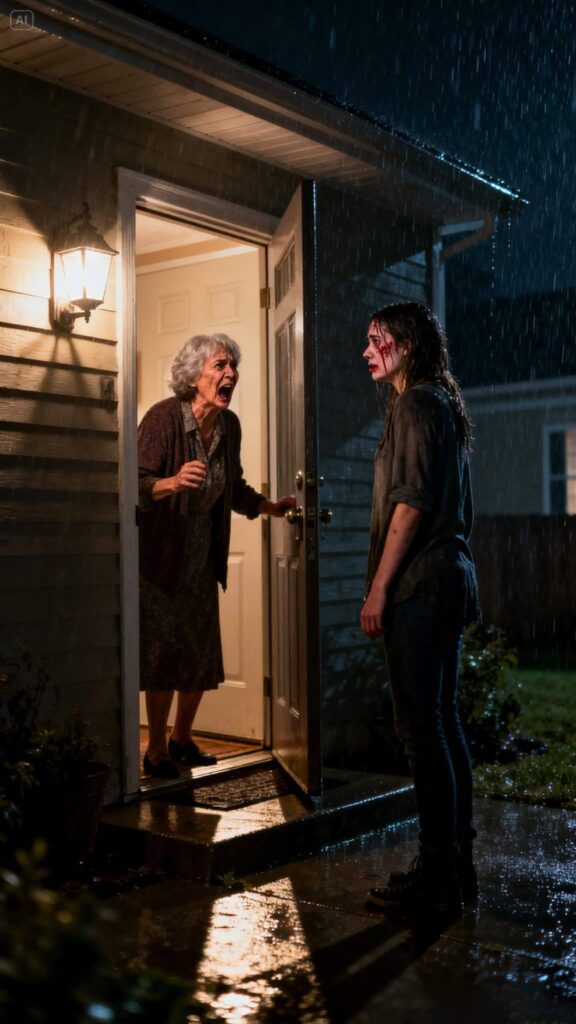
At 1:00 AM, the heat in Riverton, Arizona, hadn’t broken. It hung over the asphalt like a heavy, suffocating blanket, carrying the scent of dry sagebrush and the distant, insect-like whine of teenagers racing motorcycles down the highway. My porch light flickered, a dying bulb pulsing against the darkness of the front yard, casting long, erratic shadows across the cacti.
I was awake, nursing a lukewarm cup of tea, staring at the empty street. Then came the sound that would cleave my life into “before” and “after.”
It wasn’t a knock. It was a collision. A frantic, uneven pounding against the wood that spoke of terror before a voice ever cried out.
“Mom! Please! Open up!”
My blood turned to ice. It was Lena.
I threw the deadbolt and yanked the door open. Before I could even draw a breath to ask what was wrong, my daughter collapsed into my arms. She was a dead weight, smelling of metallic copper and fear. I caught her, my hands slipping on the fabric of her blouse.
I pulled her into the light of the hallway. Her lower lip was split wide open, weeping blood down her chin. Her left eye was swollen shut, the skin purple and tight like a grape about to burst. Her hands were wrapped around her midsection, clutching her stomach as if she were trying to physically hold her shattered pieces together.
In that second, the mother in me wanted to scream. I wanted to weep and rage. But the mother in me was forced to take a backseat to the other woman who lived in this house.
I carried her to the sofa, laying her down gently and covering her shivering frame with an afghan. Then, I looked up at the end of the hallway. Hanging there, pressed sharp enough to cut skin, was my uniform. The silver badge of a Riverton Police Sergeant glinted in the semi-darkness.
I knew, with a cold and terrifying clarity, that tonight I couldn’t just be a mother. I had to be an officer. Because the monster who did this wasn’t just going to break my daughter’s heart; he was going to try to break her life. And I was the only thing standing in his way.
“Mom,” Lena whispered, a sound that bubbled through blood. “Don’t let him in.”
I locked the door. Then I turned back to her, my face a mask of stone.
“He isn’t getting in,” I said, my voice dropping to that low, dangerous register I saved for the worst nights on patrol. “And you, my love, are never going back.”
To understand the storm that was about to make landfall, you have to understand the terrain. My name is Patricia Calder—most folks call me Pat—and I have worn a badge in this dust-choked town for over two decades. Riverton isn’t big, but it’s loud. It’s the kind of place where privacy is a myth and rumors travel faster than the monsoon winds.
Lena is twenty-six. She grew up chasing lizards in our xeriscaped backyard, singing along to the radio, promising me she’d never let the desert swallow her whole. But lately, the light inside her had dimmed. She had grown withdrawn, her visits becoming shorter, her eyes constantly darting to her phone as if waiting for a bomb to detonate. I told myself it was just the stress of adulthood. I lied to myself.
And there is one more piece on the chessboard: the land. My father, a man with hands like leather and a soul like iron, left us a prime parcel of acreage just outside the town limits. It sits in Lena’s name. It is her inheritance, her safety net, her future.
I didn’t know it then, but that dusty plot of earth was the reason my daughter was bleeding on my couch.
I fetched a damp towel from the kitchen, the cool water turning pink as I dabbed at her lip. My heart hammered against my ribs like a trapped bird, but my hands remained steady.
“I need to take you to the ER, Lena,” I said softly.
“No,” she whimpered, trying to sit up and failing. “He said… he said if I told anyone…”
“I don’t care what Eric said.” I said his name like a curse. “Dr. Patel is on tonight. I trust her. We are going.”
My car was in the shop, a victim of a blown transmission, so I called a cab. While we waited, Lena’s phone, which sat on the coffee table, lit up. It buzzed. Then again. And again. It danced across the wood, vibrating with rage.
I looked at the screen. Eric.
Don’t open your mouth if you want to keep everything.
Answer me.
You think you can run?
My blood boiled, a hot, toxic heat rising in my chest. I reached for the phone, intending to save the messages, but Lena snatched it back with trembling fingers.
“Mom, don’t! Please. It will only make it worse.” Her voice was ragged, soaked with a terror so profound it made me nauseous.
“I’m here, honey. You’re safe now,” I soothed, squeezing her uninjured hand.
But inside, I made a silent vow. This night would not vanish into the ether of “domestic disputes.” This night would be recorded. I was going to build a paper trail so thick, so heavy, and so undeniable that it would bury Eric beneath it.
The cab arrived. As I helped Lena into the back seat, I looked out into the darkness of the street. I felt eyes on us. The night felt predatory.
The fluorescent lights of Riverton General cut through the gloom like a scalpel. Dr. Anakah Patel, a woman I had shared countless coffees with after grueling shifts, met us at the intake doors. She didn’t ask questions. She took one look at Lena’s face, at the way she guarded her ribs, and she signaled for a gurney.
“Room Four,” she told the nurse, her voice clipped and professional. “Trauma protocol.”
Inside the exam room, the air smelled of rubbing alcohol and latex. The nurses gently cut away Lena’s blouse. When the fabric fell away, a collective gasp sucked the air out of the room. A dark, ugly bruise, the color of an impending storm, bloomed across her ribs and stomach.
“He kicked me,” Lena whispered, staring at the ceiling, tears leaking from the corners of her eyes. “I was on the floor, and he just… kept kicking.”
Dr. Patel’s jaw tightened, but her hands remained gentle as she palpated the injury. “We need X-rays and a CT scan immediately. We need to rule out splenic rupture.”
As they prepped her for imaging, I stepped up to the charge nurse. “I need a camera,” I said. “And I need a copy of everything. Every note. Every observation. Every image.”
“We usually wait for a subpoena, Pat,” she said hesitantly.
“I am not asking as a Sergeant,” I said, leaning in, my voice trembling with suppressed violence. “I am asking as a mother who is collecting evidence for a war. Do not make me get a warrant for my own daughter’s medical records.”
She nodded, eyes wide. “I’ll get the camera.”
While the CT machine hummed in the next room, Lena squeezed my hand. “Don’t let him find me, Mom.”
“He won’t,” I promised, brushing hair off her sweaty forehead. “Not while I’m breathing.”
By 4:00 AM, we had discharge papers. No internal bleeding, but two cracked ribs and a severe concussion. I walked out of that hospital with a manila folder tucked under my arm. It contained high-resolution photographs of my daughter’s battered body. It was a dossier of pain. It was the first brick in the wall I was building.
We got back to the house just as the sun was bleeding over the horizon, painting the desert in hues of violent orange. As I helped Lena up the walk, my neighbor, Dolores Park, was already out sweeping her driveway.
Dolores paused, her broom hovering. She took in Lena’s shuffled gait, the bandages, the swollen face. She hurried over, her face lined with worry.
“Pat,” she whispered. “I heard… I heard pounding last night. Is she okay?”
I hesitated. In Riverton, information is currency. But Dolores was good people.
“It was Eric,” I said quietly. “He hurt her.”
Dolores’s grip on the broom handle tightened until her knuckles were white. “That man has no soul,” she hissed. Then, her eyes lit up with a sudden realization. “Pat… my porch camera. It points right at your walkway. It records 24/7.”
I felt a surge of adrenaline. “Did it catch her arrival?”
We pulled out her phone right there on the sidewalk. We scrolled back to 10:02 AM. And there it was. Crystal clear high-definition video of Lena stumbling up my path, looking over her shoulder, terrified. The audio picked up her sobbing. It picked up the desperation in her knock.
Hearing those sobs again made my chest ache, but I knew this was gold.
“Send it to me,” I said. “And keep the original. You might have to testify.”
“Anytime,” Dolores said fiercely. “Anything you need.”
I settled Lena into my bed, the blackout curtains drawn. I sat at my kitchen table, laptop open, and saved the video file to three different encrypted drives.
For the first time since the knock on the door, I felt the scales tip slightly. We had medical records. We had video surveillance.
But Eric was smart. And he was greedy. I knew the violence was just the symptom. I needed to find the disease.
My phone buzzed at 2:00 PM. It was Caleb Morton, a clerk at the County Recorder’s office. I had known Caleb since high school; he was a quiet man who lived for paperwork.
“Pat,” his voice was tight, dropped to a whisper. “I shouldn’t be calling you. But… your name and Lena’s just crossed my desk on a land transfer filing.”
My stomach dropped. “What transfer? We haven’t sold anything.”
Caleb sighed, the sound crackling over the line. “According to this paperwork, your daughter signed the deed to the west acreage over to a woman named Tara Quinn yesterday afternoon. But Pat… I’m looking at the signature. It looks wrong. And the notary stamp? It’s from a guy who wasn’t even on duty yesterday.”
I was in my car thirty seconds later.
I drove to the county office with a singular focus. Caleb met me at the counter, glancing around nervously before sliding a photocopy across the glass.
I looked at the document. The rage that filled me was cold and absolute.
The signature was a clumsy forgery. It was shaky, trying too hard to mimic Lena’s looping cursive. And my signature—required as a co-signer on the trust—was laughable. It was slanted the wrong way.
“This came in from Eric,” Caleb whispered. “He brought it in himself. Told the front desk girl that you asked him to file it because you were on shift.”
I clenched the paper, crumpling the edge. My father had worked himself into an early grave to buy that land. He had envisioned a home for Lena. A legacy. And Eric was trying to steal it with a ten-cent pen and a lie.
“Who is Tara Quinn?” I asked.
“I don’t know,” Caleb said. “But the address listed is an apartment complex on the south side.”
“I need certified copies, Caleb. Of everything. The timestamp, the intake log, the document itself.”
“Be careful, Pat,” he warned, handing me the stack. “This is felony fraud. If he’s desperate enough to forge a deed, he’s desperate enough to do anything.”
“He already has,” I said grimly.
I walked out into the blinding afternoon sun. I wasn’t just fighting a domestic abuser anymore. I was fighting a thief. And now I had his motive.
The next stop was Malloy’s Trading Post, the pawn shop Eric ran on the edge of town. It was a place where desperate people went to sell their memories for rent money.
I pushed through the door. The bell chimed, a cheerful sound that clashed with the smell of stale cigarette smoke and gun oil. Two of Eric’s cronies were leaning against the counter. One of them, a man with a jagged scar on his chin, smirked.
“Well, look who it is. The Mother-in-Law.”
I didn’t break stride. I walked past them, pushing through the swinging door into the back office.
Eric was sitting behind a battered metal desk, counting a stack of cash. He looked up, and for a split second, I saw fear. But he masked it instantly with a sneer of bravado.
“Sergeant Calder,” he mocked, leaning back. “You here to pawn your badge? Or just here to nag?”
I didn’t shout. I didn’t scream. I walked to the desk and dropped a heavy manila folder onto the metal surface. It landed with a dull thud.
“Open it,” I said.
He hesitated, then flipped it open.
He stared at the photos of Lena’s face. He stared at the still frame from Dolores’s camera. He stared at the copy of the forged deed.
“You think this scares me?” Eric laughed, but the sound was brittle. “I’ve got lawyers, Pat. Expensive ones. That deed is legal. Lena signed it. She gave it to me.”
“We both know that’s a lie,” I said, my voice steady. “And now Caleb Morton knows it’s a lie. And the notary knows it’s a lie. You forged a police sergeant’s signature, Eric. You crossed a line you can’t walk back from.”
He stood up, his face flushing red. “That girl needed discipline! She was holding out on me. That land is worth money, and I need capital. Don’t think your badge will save you.”
“The badge isn’t saving me,” I said, leaning in until we were nose to nose. “The badge is the reason you’re going to prison. From this moment on, it’s not your rules. It’s the law.”
I turned and walked out. behind me, I heard the sound of glass shattering against the wall.
He was rattling. Good. Rattled men make mistakes.
By Friday, the Riverton rumor mill was churning at maximum capacity. At the grocery store, the whispers followed me down the cereal aisle. She’s using her power to get even. Lena made it up. Eric is just a businessman trying to survive.
Each whisper was a thorn, but I kept my head high.
That night, an envelope was shoved under my front door. No stamp. No return address. inside was a scrap of notebook paper with uneven, jagged handwriting.
SHUT UP OR YOU WILL LOSE HER FOR GOOD.
My hands trembled as I read it. Not from fear—from fury. I slipped the note into a plastic evidence bag, labeled it with the date and time, and added it to the dossier.
I called Captain Joel Ramirez, my shift commander.
“Joel,” I said. “I need extra patrols on my street. Lena is here. Eric is escalating.”
“You’re walking a dangerous line, Pat,” Joel said, his voice heavy with concern. “But I’ve got your back. I’ll put a unit on rotation every hour. Just… keep everything documented. Don’t go vigilante on me.”
“I’m building a wall, Joel,” I said. “I’m not going to shoot him. I’m going to bury him in paper.”
I realized then that the case had a missing link. I had the violence, I had the fraud, but I needed the leverage. I needed Tara Quinn.
The name on the deed. The woman Eric was trying to gift my daughter’s inheritance to.
I did some digging. Tara was a bartender at the Silver Spur, a dive bar on Hidalgo Street known for cheap whiskey and bad decisions.
On Thursday night, I left Lena with Dolores and drove to the bar. I didn’t wear my uniform. I wore jeans and a ballcap, slipping into a corner booth in the shadows.
Around 10:00 PM, Tara started her shift. She was pretty in a rough, tired way—too much makeup, sad eyes, and a nervous habit of checking her phone. She looked like someone who was waiting for a promise that was never going to be kept.
I waited until the crowd thinned, then approached the bar.
“Tara?”
She looked up, guarding. “Yeah? What do you want?”
I slid an envelope across the sticky wood. “I think you should look at this.”
She opened it. Inside were copies of the forged deed with her name on it, stapled to a printout of Eric’s gambling debts which I had pulled from public records.
“He promised you the land, didn’t he?” I asked softly. “He told you it was a fresh start. A way out of here.”
Tara’s face went pale. She looked at the papers, then at me. “Who are you?”
“I’m Lena’s mother,” I said. “And I’m the woman whose name he forged next to yours. Tara, look at the debt. He isn’t giving you that land. He’s using your name to hide assets before he declares bankruptcy. He’s setting you up to take the fall for the fraud.”
She stared at the numbers. The realization washed over her face—the heartbreak of a woman realizing she was just a pawn.
“He… he said he loved me,” she whispered. “He said Lena was crazy.”
“He beat Lena until she couldn’t see out of her left eye,” I said, pointing to the photo peeking out of the file. “That’s how he loves.”
Tara looked at the photo. She flinched. She looked at the deed. Then she looked at me, tears welling in her eyes.
“You have one chance to walk away clean,” I told her. “Testify. Tell the court he made you do it. Tell them about the forgery.”
She hesitated for a long, agonizing moment. Then, she nodded. “I’ll do it. But you have to promise I’ll be safe.”
“I promise.”
The final piece of the puzzle clicked into place.
We met at the law office of Marcus Hale on a Tuesday morning. Marcus was the best civil litigator in the county—a man who wore three-piece suits in the desert heat and argued with the precision of a surgeon.
We spread the evidence across his long oak conference table. It was a mosaic of ruin.
Exhibit A: The medical records from Dr. Patel.
Exhibit B: The video footage from Dolores.
Exhibit C: The text logs and the threatening note.
Exhibit D: The forged deed and the affidavit from Caleb.
Exhibit E: The sworn deposition of Tara Quinn, notarized that morning.
Marcus walked down the line, tapping each pile. “This isn’t a case,” he said, looking up at me with a rare smile. “This is an execution.”
“We need a protective order immediately,” I said.
“Done,” Marcus said. “I’ll have Judge Keaton sign the TRO by lunch. We’re freezing his assets, nullifying the deed, and filing for divorce all in the same motion.”
That afternoon, the temporary restraining order was served. Eric was barred from coming within 500 feet of Lena, me, or Tara. For the first time in weeks, I slept for more than three hours.
But the real battle was the hearing.
The courthouse was packed. The rumors had done their work; half the town had shown up to see the ‘Sergeant vs. The Son-in-Law.’ The wooden benches groaned under the weight of curious neighbors.
When Judge Raymond Keaton entered, the room fell silent. Eric sat at the defense table with a slick, court-appointed lawyer who looked like he’d rather be anywhere else. Eric looked smug, wearing a suit that was too tight, whispering to his counsel.
Marcus rose.
“Your Honor,” he began, his voice booming. “This case is not about domestic squabbles. It is about a systematic campaign of violence, theft, and intimidation.”
He didn’t waste time with rhetoric. He went straight to the evidence.
Dr. Patel took the stand. She projected the X-rays. She described, in clinical detail, the force required to crack a rib. Eric’s smirk began to fade.
Then came the video. The lights dimmed. On the large screen, the timestamp read 10:02 AM. The sound of Lena’s sobbing filled the courtroom. It was a haunting, hollow sound that made the spectators shift uncomfortably. I saw Eric flinch. He couldn’t deny the reality of her terror.
Then, the coup de grâce.
Caleb Morton testified about the deed. He pointed out the mismatched notary logs. He explained, point by blank, how the signatures were fake.
And finally, Tara Quinn.
She walked to the stand shaking, avoiding Eric’s gaze.
“He told me to sign it,” she said, her voice small but clear into the microphone. “He practiced Sergeant Calder’s signature on a notepad for an hour before he got it right. He said… he said Lena was too weak to fight back.”
“You traitor!” Eric shot up from his chair, his face purple. “I gave you everything!”
“Order!” Judge Keaton slammed his gavel down, the sound echoing like a gunshot. “Sit down, Mr. Molloy, or I will hold you in contempt.”
When it was my turn, I stood tall in my uniform. I didn’t look at the crowd. I looked at the judge.
“I have served this community for twenty years,” I said. “I have protected your homes. I have patrolled your streets. But today, I am here as a mother. The man sitting at that table beat my daughter. He stole her inheritance. He threatened my life. He is not a victim. He is a predator. And the law must answer.”
Eric’s lawyer tried to object, tried to claim bias, but he was fighting a landslide with a spoon. The paper trail was too thick.
Judge Keaton didn’t deliberate long. He adjusted his glasses and looked down at Eric with pure disdain.
“Mr. Molloy,” the judge said. “The evidence presented here is overwhelming. I am granting a permanent protective order for five years. The deed transfer is hereby nullified and voided ab initio. The property returns to Lena Calder immediately.”
He paused, looking at the bailiff.
“Furthermore, due to the testimony regarding forgery and assault, I am referring this entire file to the District Attorney’s office for immediate criminal prosecution on charges of felony fraud, aggravated assault, and witness intimidation. Deputies, take him into custody.”
The courtroom erupted.
Eric slumped back, the blood draining from his face. He looked at me, expecting to see triumph. But I just looked at him with a cold, flat stare.
Two deputies—men I worked with every day—approached the defense table. They pulled Eric up. They spun him around.
Click. Click.
The sound of the handcuffs ratcheting shut was the sweetest music I had ever heard.
As they led him out, he looked back at Lena. She was sitting beside me, trembling. But she didn’t look away. She met his eyes. And then, she took a deep breath and turned her head.
In the weeks that followed, the silence in my house changed. It wasn’t the heavy silence of fear anymore; it was the quiet of healing.
Recovery isn’t a straight line. Lena still had nightmares. She still jumped when a car backfired. But she started therapy with Dr. Naomi Winters. She started gardening in the backyard, reclaiming the land that was almost stolen from her.
One evening, I came home to find her humming in the kitchen, making pasta. It was a small thing, a fragile melody, but it felt like a miracle.
I continued my patrols. But something had changed in me, too. When I responded to domestic calls, I didn’t just take statements. I gave the victims my card. I told them about the paper trail. I told them that the law could be a shield if they were willing to pick it up.
If you are reading this, and you feel the shadow of someone else’s hand over your life, listen to me.
Document everything.
Take photos. Save the texts. Back them up to the cloud.
Check your records.
Property deeds, bank accounts, credit reports. abusers thrive in the dark; shine a light on the numbers.
Find your team.
A doctor, a neighbor, a lawyer. You don’t have to fight an army alone.
When I look back at that night—the flickering porch light, the blood on my daughter’s lip—I don’t see a tragedy. I see the moment we decided to fight.
I stood on my porch last night, watching the sun set over the desert. The motorcycles were buzzing down the highway again. The air was still hot. But my house was safe. My daughter was safe.
Eric is awaiting trial in the county jail. He thought he could break us. He thought he could steal our legacy with a pen. He forgot one thing.
He forgot that before I was a Sergeant, and before I was a victim… I was a mother. And that is the most dangerous thing in the world to underestimate.