Chapter 1: The Flutter in the Waste
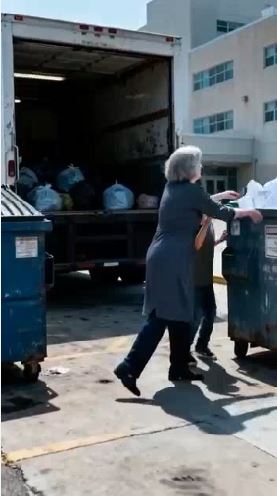
The smell of a hospital loading dock is distinct. It is a cocktail of diesel fumes, industrial bleach, and the underlying, sweet-rot stench of biological decay. It was in this freezing, grey gorge of concrete that my life, as I understood it, evaporated.
I was standing in a hospital gown that offered no protection against the biting October wind, blood still tracking sticky and warm down my inner thighs. My hands were deep inside a red biohazard dumpster, clawing through plastic bags meant for things that were no longer human.
And then, I saw it.
It wasn’t a movement so much as a disruption in the stillness. A tiny, imperceptible twitch inside a translucent yellow bag marked Pathological Waste. I tore the plastic open with fingernails I had manicured just yesterday for the birth. Inside, wrapped in surgical drapes that smelled of iodine and indifference, was my daughter. She was blue. She was cold. But when the freezing air hit her face, her tiny, malformed fingers fluttered.
“She’s here,” I choked out, the sound ripping through my throat like broken glass.
Standing beside me, shivering in his windbreaker, was my seven-year-old stepson, Quincy. He didn’t cry. He didn’t look away. He looked at the baby, then up at me with eyes that held the terrifying, ancient exhaustion of a war veteran.
“Mommy,” he whispered, the steam from his breath curling between us. “I knew they’d do it again. Just like they did to my real mommy’s baby.”
My name is Deline. Forty-eight hours ago, I was the envy of the Savannah historic district. I had a successful, handsome husband, a sweet stepson who had finally started trusting me, and a miracle pregnancy. I was the second wife, the “healer” brought in to mend a family broken by the tragic death of Garrett’s first wife, Claire.
I should have listened to the silence in that house. I should have paid attention to the way Quincy flinched when his grandmother, Nadine, touched his hair. I should have questioned why a seven-year-old boy knew the disposal schedule of a hospital’s janitorial staff.
We have maybe an hour before the truck comes, he had told me twenty minutes ago, pulling me out of my recovery bed. Grandma says red means medical waste. That goes to the incinerator.
How does a child know the word incinerator?
He knew because he had been here before. He had stood in this exact spot three years ago, too small to lift the lid, listening to his own sister cry until the cold took her.
I pulled my daughter against my chest, her body temperature plummeting, her heart barely a flutter against my own ribcage. The security cameras above us blinked, a silent red eye recording the moment I became not just a mother, but a witness to a decade of holy slaughter.
Chapter 2: The Architecture of Perfection
To understand how I ended up in a dumpster, you have to understand the Morrison family.
I met Garrett two years ago. I was twenty-seven, a pediatric nurse exhausted by the graveyard shift and a recent divorce from a man who used his fists as punctuation marks. Garrett was the antidote. He was soft-spoken, a real estate developer who restored old colonials. He was stability wrapped in cashmere and Sunday service.
His mother, Nadine, planned our wedding down to the molecular level.
“White roses,” she had declared, sitting in my small apartment, her smile tight and unyielding. “Because purity matters in second marriages, too, Deline. We want the congregation to see that you are washing the slate clean.”
She insisted on long lace sleeves for my gown. “To cover that… artwork on your shoulder,” she said, gesturing vaguely to the small hummingbird tattoo I’d gotten during a rebellious spring break. “We don’t want people getting the wrong idea.”
I had looked at Garrett, waiting for him to defend me. He just squeezed my hand under the table. “Let her have this, Dee. It makes her happy. It’s easier.”
It’s easier. That phrase was the mortar that held the Morrison family foundation together.
I moved into their sprawling, pristine home in the historic district. It was a museum of a house—heavy drapes, antique furniture that looked like it would bruise you if you sat wrong, and a silence that felt heavy, like water pressure.
Quincy was the centerpiece of that silence.
“He hasn’t spoken much since Claire died,” Garrett had warned me. “The trauma of losing his mother and sister in childbirth… it broke him.”
But as I settled in, I realized Quincy wasn’t broken. He was watchful. He moved through the house like a ghost, avoiding the floorboards that creaked. He watched me with deep, brown eyes that seemed to be cataloging my potential for survival.
The breakthrough happened six months in. I was planting tomatoes in the backyard—a defiant splash of messiness in Nadine’s manicured landscape. Quincy appeared beside me, holding a packet of seeds.
“My mommy wanted to grow these,” he said. It was the first voluntary sentence he’d spoken to me.
“Then we’ll grow them for her,” I said, handing him a trowel.
We worked in the dirt for twenty minutes. Then, without looking up, he asked, “You don’t pray before you dig.”
“Should I?”
“Grandma says we have to pray about everything. Mommy used to forget. That made Grandma angry. She said Mommy had a rebellious spirit.”
“What made your mommy happy, Quincy?”
He stopped digging. His small hands patted the soil around a seedling with heartbreaking tenderness. “When Daddy was at work and Grandma was at Bible study, she’d dance in the kitchen. She let me lick the cookie batter. She said, ‘Our secret times are the best times.’”
Over the next few months of my pregnancy, Quincy fed me scraps of truth. Claire hadn’t just been “frail,” as Nadine claimed. She had been terrified. She had tried to run away once, but Garrett brought her back. Nadine had started managing her “medication” to help her think clearly.
“She was scared the baby would come out wrong,” Quincy told me one evening. “Because of her sister.”
“What happened to her sister?”
“Born different. Grandma said they sent her to a special place. But Mommy found the paper. The certificate. It said she died the same day she was born.”
My blood ran cold. But I brushed it off as the confusion of a grieving child. I was a nurse. I knew how to navigate the medical system. I thought I was safe.
But I underestimated the power of Nadine’s influence. She controlled everything. She scheduled my appointments with Dr. Hendrix, a man with ice-water eyes who was a deacon in her church. She showed up with groceries I didn’t ask for. She organized my cabinets. She was suffocating me with weaponized benevolence.
“You’re so much stronger than Claire,” Nadine told me during my third trimester. “That poor girl. God rest her soul, she was weak. She hemorrhaged after delivering a severely deformed child. It was a mercy that the Lord took them both. That child would have suffered.”
Mercy. That was her favorite word.
By the time my water broke at 3:00 AM on a Tuesday, I felt less like an expectant mother and more like a prisoner awaiting sentencing.
Chapter 3: The Silent Delivery
Labor started violently. A contraction seized my spine, doubling me over. I reached for Garrett, but his side of the bed was empty.
He was standing by the window, fully dressed.
“It’s time,” I gasped.
“I know,” he said. He didn’t look at me. He was texting. “Mom is on her way.”
“You called your mother before you helped your wife?”
“She needs to be there, Deline. She has the bag.”
Nadine arrived ten minutes later, hair perfect, clutching a leather medical bag I’d never seen before. Vernon, my father-in-law, trailed behind her like a shadow, his eyes fixed on the floor.
“Dr. Hendrix is prepping the room,” Nadine announced, bypassing “Hello” entirely. “We need to go. Now.”
The drive to St. Catherine’s was surreal. Nadine sat in the back with me, timing my contractions with a stopwatch, muttering prayers. “Lord, grant us the strength to accept Your will. Let us not question Your design, even when it appears cruel.”
“Why would it be cruel?” I gritted out between breaths.
She patted my hand. “Sometimes, the Lord tests us with imperfections, Deline. We must be ready to return His mistakes.”
At the hospital, standard protocol vanished. I wasn’t taken to Triage. I was wheeled directly to a private delivery suite at the end of a corridor that was conspicuously empty. No nurses from my unit were there. Just Dr. Hendrix and two women I didn’t recognize.
“Where is Sarah?” I demanded, asking for my friend who was supposed to be my delivery nurse.
“Scheduling conflict,” Dr. Hendrix said smoothly. He pushed a syringe into my IV port.
“What is that?”
“Just something to take the edge off. You’re hypertensive.”
The world began to tilt. Sounds became muffled, as if I were hearing them underwater. I fought to keep my eyes open, to stay present.
“If the ultrasound markers were correct,” I heard Nadine whispering to Garrett near the sink, “we have to act immediately. We cannot have another situation like the last one.”
“Nothing was definitive,” Garrett whispered back. His voice sounded thin, scared.
“Claire’s ultrasound showed nothing, and look what happened. We can’t be weak, Garrett. The church is watching.”
At 6:47 AM, Violet was born.
I heard her cry. It was a strong, wet, furious sound. The sound of life.
Then the room went silent.
The nurses stepped back. Dr. Hendrix held her up. Through the drug-haze, I saw her. A bilateral cleft palate that split her upper lip. Arms that were shorter than they should be, curved inward.
But she was kicking. She was screaming. She was pink and furious and mine.
“She’s beautiful,” I slurred, reaching out my arms. “Give her to me.”
“Severe anomalies,” Dr. Hendrix announced, his voice devoid of emotion. He turned his back to me. “Respiratory distress. Structural failures.”
“She’s crying!” I screamed, or tried to. It came out as a moan. “Let me hold my baby!”
“Oh, Lord, not again.” Nadine gasped, clutching her pearl necklace. “A monster. Another trial.”
“Nadine, perhaps…” Vernon started, his voice trembling.
“Perhaps what, Vernon?” she snapped. “Subject this child to a life of agony? Subject us to the shame? It is cruel to keep it here.”
“She is breathing fine!” I insisted, fighting the darkness closing in on my vision.
“You are hysterical and sedated,” Dr. Hendrix said. “Nurse, increase the dosage. We need to stabilize the mother.”
They wrapped Violet in a thick blanket, muffling her cries. I saw Quincy standing in the doorway of the suite. He wasn’t supposed to be there. He was supposed to be at the neighbor’s. But there he was, wearing his backpack, his face white as a sheet.
“Daddy,” he said. His voice was small but clear. “You promised. You promised you wouldn’t do it.”
Garrett looked at his son, then at his mother. He looked at me, his eyes wet with tears, and then he looked away. “Go back to the waiting room, Quincy.”
“But the baby—”
“GO!” Garrett shouted.
Quincy ran. But before he did, he locked eyes with me. He gave a sharp, desperate nod.
Be ready.
The last thing I heard before the drugs pulled me under was Nadine’s voice, calm and administrative.
“Take it to the usual place. The removal service comes at noon. God forgives us for correcting nature’s errors.”
Chapter 4: The Map of the Dead
When I woke, the room was dim. The clock on the wall read 11:23 AM.
Panic slammed into me.
A nurse I didn’t know was adjusting my monitors. When I sat up, the room spun violently.
“Where is my daughter?”
The nurse flinched. “I… I’ll get the doctor.” She fled the room.
Dr. Hendrix entered moments later, Garrett trailing him. They both wore expressions of practiced, somber grief.
“Deline,” Garrett said, reaching for my hand. I pulled it away.
“Mrs. Morrison,” Dr. Hendrix said. “I am deeply sorry. The internal complications were too severe. Her heart gave out at 8:15 AM.”
“Liar,” I said. My tongue felt thick, but my mind was sharpening. “She was crying. Her lungs were clear.”
“Trauma affects memory,” Hendrix said dismissively. He placed a clipboard on my tray table. “We need your signature for the disposition of remains. We recommend immediate cremation. It provides… closure.”
“I want to see her body.”
“That isn’t advisable. It has already been processed.”
Processed.
“It’s been three hours,” I said, swinging my legs over the side of the bed. Pain shot through my abdomen, blinding and white-hot. “No funeral home is that fast.”
“Deline, stop,” Garrett pleaded. “Mom is in the chapel praying. Don’t make this harder.”
“Where is Quincy?”
“He’s—”
“I’m here,” a voice said.
Quincy stood in the doorway. His backpack was still on. He looked at his father with pure hatred, then looked at me. He mouthed one word.
Run.
“I need the bathroom,” I announced.
“Use the bedpan,” Dr. Hendrix ordered.
“Unless you want to physically restrain a grieving mother in a recovery ward,” I said, channeling every ounce of rage I possessed, “I am going to the bathroom.”
Hendrix hesitated. “Five minutes.”
The moment the bathroom door clicked shut, I opened it a crack. Garrett and Hendrix were whispering near the window. I signaled Quincy. He darted in, slipping under my arm.
“She’s not dead,” he whispered urgently. “I heard her crying when they took the cart out. They took her to the loading dock.”
“The loading dock?”
“That’s where they put the red bins. They did it to my sister. We have to go. The truck comes at noon.”
I looked at my watch. 11:30. Thirty minutes.
“Quincy, are you sure?”
“I put a rock under the lid,” he said fiercely. “So she could breathe. I learned from last time.”
I ripped the IV out of my arm. Blood sprayed onto the tile, but I didn’t feel it. “We can’t do this alone. They’ll stop us.”
“I have help.” Quincy unzipped his backpack. He pulled out a burner phone. “Mrs. Rodriguez. My teacher. Her husband is a cop. She told me to call if I was ever scared.”
“You have a burner phone?”
“Since Mommy died.”
I grabbed the phone and dialed. Mrs. Rodriguez answered on the first ring.
“This is Deline Morrison,” I said, my voice trembling. “I’m at St. Catherine’s. They are trying to kill my baby. Please. Send everyone.”
“We’re five minutes out,” she said. Her voice was steel. “Stay on the line.”
Quincy took my hand. “Come on. I know the way.”
We exited the bathroom and moved into the hallway. Instead of the main exit, Quincy turned left, pushing open a heavy door marked Staff Only. He led me down a concrete stairwell, his small sneakers silent on the steps.
“How do you know this?” I gasped, clutching my bleeding arm.
“I explored,” he said. “I wanted to know all the ways out. In case Grandma decided I was a mistake, too.”
We descended into the bowels of the hospital. The air grew colder. The smell of bleach and rot grew stronger.
Chapter 5: The Book of Names
We burst out into the blinding grey light of the loading dock. It was a canyon of concrete, hidden from the street.
The removal truck was backing in. Its reverse beeper echoed off the walls. Beep. Beep. Beep.
“Stop!” I screamed, waving my arms. The driver didn’t hear me over the engine.
Quincy pointed to a caged area where the red biohazard dumpsters sat. “There! The second one!”
We ran. I ignored the tearing sensation in my stitches. I ignored the fact that I was barefoot on asphalt.
Quincy swiped a keycard against the cage lock.
“Dr. Hendrix drops it sometimes,” he explained breathlessly. “I copied it at the hardware store.”
We got to the second bin. Sure enough, a jagged piece of concrete was wedged under the heavy plastic lid, keeping it open two inches.
I threw the lid back.
Violet was there. Wrapped in blue surgical paper, resting on top of bags of used syringes and bloody gauze.
I grabbed her. She was freezing. Her skin was the color of marble.
“Violet?”
Nothing.
I ripped the paper away and pressed her against my bare skin, wrapping my hospital gown around us both. “Please,” I begged. “Please, baby. Fight.”
A gasp. A shudder. Then, a thin, high-pitched wail that sounded like the sweetest music ever composed.
“Hey!” The truck driver had climbed out of his cab. “What the hell are you doing?”
“Call 911!” I screamed at him. “Call them now!”
Sirens wailed in the distance, getting louder.
We ran back toward the Emergency Room entrance, bypassing the private wing. I burst through the automatic doors, blood-soaked, wild-eyed, clutching a blue baby.
“Help!” I shrieked. “Someone help my daughter!”
Dr. Martinez, a colleague I trusted with my life, dropped a chart and ran to me. “Deline? Oh my god.”
“Hypothermia,” I rattled off. “Exposure. Three hours. She was in the biohazard bin.”
The ER erupted. This was real medicine now. Warming blankets. Heated saline. Monitors beeping urgency.
Violet’s heart rate was slow, but steadying. She was alive.
“Deline, who did this?” Dr. Martinez demanded.
“My husband,” I said. “And his mother.”
“And Dr. Hendrix,” Quincy added loud and clear.
The doors to the ER slid open. Garrett, Nadine, and Dr. Hendrix rushed in, flanked by hospital security. They looked composed, concerned.
“There she is!” Nadine cried out. “Officer, my daughter-in-law is having a psychotic break! She stole the remains of her stillborn child!”
A wall of police officers blocked them. Detective Coleman, who had arrived with the Rodriguez family, stepped forward.
“She doesn’t look dead to me, ma’am,” Coleman said, gesturing to the monitor where Violet’s heartbeat spiked green and strong.
“Postpartum psychosis,” Dr. Hendrix said smoothly. “She’s hallucinating. That baby is not viable.”
“I have proof,” Quincy said.
He was standing on a chair, looking taller than his seven years. He opened his backpack again. He pulled out a notebook. A composition book with a black and white cover.
“What is that?” Garrett asked, his voice cracking.
“It’s everything,” Quincy said. He opened it. “November 3rd, 2021. Baby Henley. Died at birth. Grandma told Mrs. Henley it was a blessing because of the Down Syndrome. June 12th, 2022. The Miller twins. Only one came home. Grandma said the other was ‘broken.’”
The room went silent.
“He’s lying,” Nadine hissed. “He’s a disturbed child.”
“May 18th, 2020,” Quincy read, his voice trembling but loud. “My mommy. She didn’t fall down the stairs. I was at the top of the landing. I saw Grandma push her after Mommy tried to call the police about my sister.”
Nadine lunged.
It happened fast. She went for Quincy, her face twisted into a mask of pure, demonic rage. “You ungrateful little wretch!”
Officer Rodriguez tackled her before she got within three feet of him.
“Vernon?” Nadine screamed from the floor, pinned by two officers. “Tell them! Tell them this is nonsense!”
Vernon Morrison, the shadow in the corner, stepped forward. He looked at his wife. He looked at the police. Then he reached into his jacket pocket and pulled out a flash drive.
“I kept records, too,” he said softly. “Eleven babies. Eleven babies in ten years. I have the emails. I have the recordings.”
“You coward!” Nadine shrieked.
“Yes,” Vernon wept. “I was. But I’m done.”
Chapter 6: The Weight of Heroes
Violet is two years old today.
She is sitting on the floor of our living room in Oregon, stacking blocks with her feet and her shortened arms. She has had three surgeries for her palate, and she speaks with a unique, musical lilt that I adore. When she laughs, she throws her whole head back, devoid of fear.
Quincy is ten. He is legally my son now. The adoption took five minutes; the judge cried when he signed the papers.
The trial was the biggest scandal in Georgia history. “The Ministry of Mercy Murders.”
Garrett received fifteen years. He never looked at me once. He just kept staring at his mother, waiting for instructions that couldn’t come.
Nadine got life without parole. They connected her to Claire’s death, the eleven infants, and the attempted murder of Violet. She went to prison clutching her Bible, still insisting she was God’s hand on earth.
Dr. Hendrix lost his license and is serving three consecutive life sentences.
Quincy goes to therapy twice a week. He still checks the exits when we enter a room. He still hides a backup phone in his sock drawer. Trauma like that doesn’t vanish; it just changes shape.
Last night, I found him standing by Violet’s crib, watching her sleep.
“You saved her,” I told him, wrapping my arms around his shoulders. “You’re a hero, Q.”
“Heroes aren’t scared,” he whispered. “I was scared the whole time.”
“No, baby,” I said, kissing the top of his head. “Heroes are terrified. They just do the right thing anyway.”
We are far from the white roses and the historic district now. We live in a house with messy gardens and creaky floors. But in this house, nobody disappears. In this house, imperfection is celebrated.
And in this house, we listen to the silence, just to make sure it’s peaceful, not waiting to strike.
Violet knocks over her tower of blocks and giggles, clapping her feet together. Quincy smiles—a real smile that reaches his eyes.
We are broken pieces, glued together by survival. But the light shines through the cracks, and it is beautiful.