Chapter 1: The Coldest Homecoming
The drive from Fort Bragg had taken longer than expected, a grueling three-hour crawl through a North Carolina winter that had arrived with a vengeance. The interstate was a treacherous ribbon of slush and gray ice, demanding every ounce of my focus. My knuckles were white against the steering wheel of my truck, but my heart? My heart was lighter than it had been in six months.
For half a year, my life had been defined by mud, MREs that tasted like cardboard, and the deafening roar of artillery simulators. I was Sergeant Jenna Flores, 32 years old, a creature of discipline and orders. But today, I was just a wife driving home for Thanksgiving.
I pictured Brady. Even after five years of marriage, the thought of him softened the edges of my military stoicism. Brady Mitchell—my husband, the man with the soft smiles and the real estate “consulting” job that seemed to involve more golf than actual sales. I didn’t mind carrying the financial load; I was the protector, the provider. That was my role. I just wanted him to be there, waiting with a hug that smelled of dryer sheets and home.
I pulled into a Walmart parking lot just off the highway, merging into the chaotic swarm of last-minute holiday shoppers. The automatic doors blasted me with artificial heat and the tinny strains of Mariah Carey. I navigated the aisles with tactical precision: a twenty-pound Butterball turkey, a bag of russet potatoes, and two expensive bottles of Cabernet. I wanted this Thanksgiving to be perfect. I wanted to roast that bird, fill the house with the scent of sage and rosemary, and pretend, just for a weekend, that we were a normal family.
I also grabbed a small carton of peach yogurt for Victor, Brady’s stepfather. The pancreatic cancer had ravaged his appetite, turning a once-robust man into a shadow, but he loved peaches. Maybe he could keep that down.
When I finally turned onto our street, the neighborhood looked like a Norman Rockwell painting. The Smiths had their inflatable reindeer bobbing in the wind; the Johnsons had lined their walkway with candy cane lights. It was warm. It was inviting.
But my house was dark.
A small knot of anxiety tightened in my gut. I told myself Brady was probably napping, or maybe watching the game in the den. I parked the truck, grabbed the grocery bags, and unlocked the front door.
“Brady? I’m home!” I called out, kicking the door shut behind me to block the biting wind.
Silence answered me. Not the peaceful silence of a resting home, but the heavy, oppressive silence of a tomb.
And then, the cold hit me. It was a physical blow. I dropped the grocery bags. The wine bottles clanked together, a sharp, jarring sound in the quiet. I could see my breath puffing out in front of me in the entryway light. I walked over to the thermostat. The screen was blank. I tapped it.
System Off. Current Temp: 52°F.
Why on earth would the heat be off in November?
“Brady!” I called again, my voice sharper, slipping into my command tone.
That’s when I smelled it. Underneath the stale, frigid air, there was something else. Sharp, acrid, undeniable. It was a scent I knew from field hospitals and bad situations. The smell of ammonia. The smell of human waste.
The knot in my stomach turned into a rock. I dropped my keys and ran toward the living room.
“Victor?”
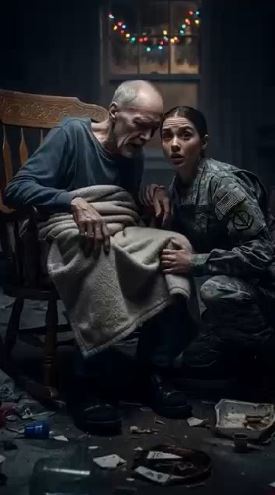
The living room was shadowed, illuminated only by the streetlights filtering through the blinds. But I saw him. Victor Harmon, a man who had once commanded a platoon in Vietnam, a man who had stood six-foot-two and terrified banking interns with a single glare, was curled up on his old wooden rocking chair.
He wasn’t rocking. He was vibrating.
He was wrapped in a single, thin throw blanket—the cheap fleece one Elaine, my mother-in-law, had bought at a discount bin. He looked like a skeleton draped in gray parchment. His lips were cracked and bleeding.
“Victor,” I whispered, rushing to his side. I fell to my knees, the cold hardwood biting into my legs.
He opened his eyes. They were sunken craters surrounded by the dark bruises of exhaustion. When he focused on me, a look passed over his face that shattered my heart. It was shame. Deep, humiliating shame.
“Jenna,” he rasped. His voice sounded like grinding stones. “Angel.”
I touched his forehead. He was freezing to the touch, yet clammy. I looked down. The smell was coming from him. His sweatpants were soaked. The puddle beneath the chair had frozen into a sticky, semi-solid mess. He had been sitting in his own filth for God knows how long.
“I’ve got you,” I said, my voice trembling with a rage I hadn’t fully processed yet. “I’m here. I’m not leaving.”
I stood up, my mind racing through TCCC—Tactical Combat Casualty Care. Warmth. Fluids. Hygiene. I needed to get the heat on. I needed to get him water.
I ran to the kitchen. That’s when I saw it. On the granite island, right next to a fruit bowl containing three rotted bananas, was a piece of lined notebook paper. I recognized the scrawl immediately.
Jenna,
Mom and I decided to hop on that Carnival cruise deal last minute. Mental health break! We needed some sun. Since you’re back, you handle Victor. He’s been moody. Don’t wait up. Back Monday.
— Brady 
I stared at the paper. I read it twice. Three times. Mental health break.
They had turned off the heat to save on the electric bill while they were gone. They had left a seventy-two-year-old man with stage four cancer alone in a freezing house, unable to walk to the bathroom, unable to get a glass of water, while they went to drink Mai Tais on a boat.
They didn’t just leave him. They discarded him like a piece of broken furniture that cluttered up the living room.
I looked back toward the dark living room where a war hero was shivering in his own urine, waiting for death to take him because his family was too busy having fun to care.
Something inside me snapped. The loving wife who bought wine and turkey died in that kitchen. The fatigue from my deployment vanished, replaced by a cold, crystalline focus. I crushed the note in my fist.
I remembered the Soldier’s Creed I had recited a thousand times. I will never leave a fallen comrade.
Victor was my comrade now. And Brady? Brady wasn’t my husband anymore. He was the enemy.
Chapter 2: The Audit of Betrayal
I set the crumpled note down next to the sink, took a deep breath, and filled a glass with water. Operation Thanksgiving was over. The counter-offensive had just begun.
I cranked the thermostat up to seventy-two. The furnace groaned in the basement, protesting the sudden demand before kicking on with a low, dusty rumble. I went back to Victor. He was too weak to walk on his own, so I had to lift him. He felt impossibly light, like a bundle of dry sticks. This was a man who used to bench-press three hundred pounds in his garage. Now, I could feel every rib through his soiled clothes.
“I’ve got you, Victor,” I whispered, guiding him toward the master bathroom. “We’re going to get you cleaned up.”
I ran a hot bath, testing the water with my wrist until it was perfect. I stripped off his ruined clothes, trying to be as clinical and respectful as possible. He squeezed his eyes shut, turning his head away. I knew that look. It was the humiliation of a warrior who had lost the ability to command his own body.
“It’s okay,” I said softly, sponging warm water over his back. “You’re safe now.”
After he was clean and dressed in a pair of Brady’s thick flannel pajamas—which hung off him like a tent—I helped him back to the recliner in the living room. I went to the kitchen and opened a can of Campbell’s chicken noodle soup. I crumbled some saltines into the broth, just the way my mom used to do when I was sick.
I fed him slowly, spoon by spoon. He ate with a desperate hunger that made my chest ache. When he finished, he leaned his head back and closed his eyes. Within minutes, his breathing evened out. He was asleep.
Now, the house was quiet again. But this time, it wasn’t a peaceful silence. It was the silence before an ambush. I needed answers.
I walked into the kitchen and saw the family iPad sitting on the charging dock. Brady usually kept it there to check sports scores. My hands were trembling slightly—not from cold anymore, but from adrenaline. I swiped the screen. No passcode. Brady was too lazy for security.
A banner notification dropped down from the top of the screen. Instagram: You were tagged in a photo by Hannah_XOXO.
My frown deepened. Who the hell was Hannah? And why was she tagging my husband?
I tapped the notification. The app opened, filling the screen with a blast of bright, saturated colors. It was a photo taken on a sun deck. The ocean behind them was a brilliant, sparkling turquoise. In the foreground, holding a fruity cocktail with a little umbrella, was a girl who couldn’t have been older than twenty-four. She had bleach-blonde hair, fake eyelashes, and a bikini top that barely contained her chest.
And wrapped around her waist, wearing oversized aviator sunglasses and a grin I hadn’t seen in years, was Brady. My husband.
The caption read: “Bon voyage with my fav guy! Carnival Cruise -> Bahamas! Living my best life. #SugarDaddy”
I felt the blood drain from my face. My stomach dropped so hard I thought I might throw up on the spot. Sugar Daddy.
My fingers flew across the screen, closing Instagram and finding the Navy Federal Credit Union app. This was the lifeline. Every paycheck I earned from the Army, every hazardous duty allowance, every cent of our savings went into that joint account.
The little loading wheel spun for a second that felt like an eternity. Then the numbers flashed onto the screen.
Available Balance: $12.45.
I blinked. I wiped the screen, thinking maybe a smudge was covering the other numbers. Maybe it was supposed to be $12,000. Or even $1,200.
But no. Twelve dollars and forty-five cents.
I tapped on “Checking History.” The list of transactions scrolled past my eyes like a casualty report.
Nov 20 – Carnival Cruise Line: $1,800.00
Nov 20 – Carnival Drink Pkg: $600.00
Nov 21 – Seminole Hard Rock Casino ATM: $500.00
Nov 21 – Seminole Hard Rock Casino ATM: $200.00
Over five thousand dollars withdrawn in cash at a casino.
I grasped the edge of the granite counter to keep from falling. That money… that was the roof fund. Three months ago, Brady had told me the flashing around the chimney was shot. He said the contractor needed a deposit. He had said, “Babe, don’t worry about it while you’re deployed. I’ll handle the house. You just stay safe.”
I had transferred six thousand dollars from my personal savings into the joint account for that roof. I had worked extra shifts, taken every overtime opportunity, eaten mess hall slop instead of ordering out, just to save that money.
There was no roof repair. There was no contractor. There was just Brady, a twenty-year-old girl named Hannah, and a slot machine in Florida.
He hadn’t just cheated on me. He had robbed me. He had stolen the roof over our heads to finance a week of debauchery while his stepfather lay dying in a freezing house.
I looked at the phone in my hand, the device that had just delivered the death blow to my marriage. With a guttural cry, I hurled it across the kitchen. It hit the drywall next to the refrigerator with a sickening crack, shattering into pieces that skittered across the tile floor.
The noise startled me into silence. I slid down the cabinets until I hit the floor, pulling my knees to my chest. The tears finally came—hot, angry tears that burned my cheeks.
But as the tears fell, the soldier in me began to wake up. The initial shock of the ambush was fading. Now I needed to assess the damage. I needed a plan. And most of all, I needed allies.
I looked toward the living room where Victor slept. We were the only two left, and we had nothing left to lose.
I walked back into the living room. Victor was awake. He was gripping the armrests of the recliner, his knuckles white, pushing himself up.
“Dinner is served,” I said, trying to keep my voice light.
“Thank you, Sergeant,” he rasped.
We sat in the dark for a moment. Then he spoke.
“I saw the look on your face when you came in,” he said, his voice thin but clear. “It’s not just the smell. She’s waiting for me to die, Jenna. Elaine. She’s been waiting for six months.”
I stiffened. “Is that why she left?”
Victor let out a dry, hacking laugh. “She left because I’m taking too long. She calls me a broken ATM. Said looking at me ruins her appetite.” He pointed a trembling finger toward the wall above the fireplace. “Look.”
I turned. There was a rectangular patch on the floral wallpaper that was a shade lighter than the rest. A nail stuck out, empty.
“Where is it?” I asked. I knew what used to hang there. His shadow box. His medals. The Bronze Star. The Purple Heart.
“eBay,” Victor whispered. “She sold them last week. Said she got five hundred bucks for the lot. Told me nobody cares about old metal anymore.”
My blood ran cold. Selling a veteran’s medals wasn’t just greed. It was a desecration.
“I’m going to get them back,” I promised, my voice low and dangerous.
“Leave it,” he said, wincing as a spasm of pain shot through his abdomen. His face went gray.
“The pain?” I asked, instantly switching into medic mode. “Where are your meds?”
I scanned the side table. I found the bottle labeled Morphine Sulfate Oral Solution.
“Here,” I said, grabbing the dropper. “When was your last dose?”
“This morning,” he gasped. “Before she left.”
I looked at the bottle. It was half full. But as I pulled the dropper out, I paused. I’ve handled morphine. It’s supposed to have a certain viscosity, a thickness like syrup. The liquid in the dropper was clear, perfectly clear, and it dripped too fast.
I brought the dropper to my nose. Nothing. Morphine has a bitter, chemical smell. This smelled like… tap water. I put a tiny drop on the tip of my tongue. Tasteless.
I stared at the bottle in horror. “Victor… did she fill this?”
He nodded, eyes squeezed shut. “She said the pharmacy raised the price. Co-pay was too high. She said she had to stretch it out.”
“Stretch it out?” I roared, slamming the bottle down. “This is water, Victor! She’s been giving you water for stage-four pancreatic cancer pain!”
“She needed the money,” Victor whispered, his voice laced with a bitterness sharper than the pain. “She needed a new bag. A Coach bag for the cruise.”
The room spun. Elaine had tortured a dying man, denying him relief in his final, agonizing days, so she could buy a purse.
“Sit down, Jenna,” Victor ordered.
I sat. He reached out his hand, his grip surprisingly firm.
“You think I’m just a senile old man?” he said. “You think she took everything?”
“She drained the accounts, Victor.”
“She took the checking account,” Victor corrected. A ghost of a smile touched his lips—a terrifying smile. “She took the joint account. She took the scraps. I let her.”
“What do you mean?”
He leaned forward. “I have a trust. A revocable living trust. I set it up ten years ago, before I even met Elaine. The portfolio is sitting at Vanguard right now. Stocks, bonds, the sale of my first house in Virginia.”
My eyes widened.
“Three million dollars,” he whispered. “And she doesn’t know it exists.”
Chapter 3: The Nuclear Option
“Three million?” I repeated, my voice barely a whisper.
“She thinks I’m a washed-up bank manager who made bad investments,” Victor wheezed. “I let her think that. I wanted to see if she stayed for me or the money. She failed the test. And Brady… Brady failed the moment he was born.”
He squeezed my hand. “They broke the code, Jenna. I don’t have much time. Maybe a day. But that is enough time for a final mission. I want to rewrite the will. And I want you to help me burn their world to the ground.”
“I’m with you, Victor,” I said. “What are your orders?”
“Get Patricia.”
The next few hours were a blur of calculated action. Step one was evidence. I took photos of the house, the empty fridge, the thermostat, the “water” morphine bottle, and Victor’s condition.
Step two was human intelligence. I visited Edith, the nosy neighbor across the street. Within ten minutes and two cups of Earl Grey tea, I had a witness statement on my voice recorder confirming she saw them leave with “the blonde girl” and heard Brady say, “The old man is fine, he prefers the quiet.”
Step three was the legal strike. Patricia Reynolds, Victor’s attorney, arrived by noon. She was a sharp woman in her sixties with a bob cut that looked like it could slice steel. When she saw the state of Victor, her professional mask slipped into pure horror. But when she heard about the Trust, she was all business.
“If Victor passes under the current will,” Patricia explained, “fifty percent goes to Elaine, fifty percent to Brady.”
“Change it,” Victor commanded from his chair. “Strike them out. All of it. I want Jenna to be the sole beneficiary and the executor. And I want half the liquid assets donated to the Wounded Warrior Project.”
“I can draft the amendment right now,” Patricia said, her pen flying across her legal pad.
While she worked, I moved to the final phase: The Bait.
I texted Brady: Please answer. It’s Victor. He’s in bad shape. I think he’s dying. You need to come home. Ambulance is on the way.
I waited. The dots appeared. Then the reply:
Babe, chill out. Don’t be dramatic. Mom says he’s just looking for attention. We’re in the middle of a dinner show. He’s tough. Handle it. We’ll be back Monday.
I screenshotted it. Proof of abandonment.
But I needed one more thing. I needed them to say it to his face.
I called Melissa, Brady’s sister. She answered via FaceTime. The background was chaotic—neon lights, a piano bar, people singing “Sweet Caroline.”
“Oh my god, Jenna!” Melissa screamed over the noise. She was wearing a tiara that said Vacation Mode.
“Put your mother on,” I shouted. “Victor is dying.”
Elaine grabbed the phone. She was flushed, holding a blue drink. “What is it now, Jenna? We are trying to enjoy the Captain’s Dinner.”
I angled the phone down so they could see Victor in the background, his chest heaving. “Look at him, Elaine. He has hours. You need to fly back tonight. There’s a 6:00 AM flight from Nassau.”
Elaine rolled her eyes. “Are you crazy? Do you know how much last-minute tickets cost? They’re like eight hundred dollars a seat. He’s been ‘dying’ for six months. Besides, these tickets are basic economy. They’re non-refundable. We’d lose everything.”
I felt the blood in my veins turn to ice. “Non-refundable,” I repeated. “You’re worried about a refund while your husband takes his last breath?”
Brady leaned in. “Babe, seriously. Just give him some more morphine. We’ll be back Monday.”
“I can’t give him morphine, Brady,” I whispered dangerously, “because your mother filled the bottle with tap water.”
Silence on their end. Then Elaine hissed, “You’re lying. You’re just jealous. Do your job and let us enjoy our vacation.”
The screen went black.
I lowered the phone. Victor was looking at the blank TV screen where their reflection had been. A single tear rolled down his cheek. It wasn’t pain. It was heartbreak.
He looked at me, then at Patricia. He gave a single, sharp nod.
“Execute the mission.”
Victor signed the papers with a shaking hand. It was jagged, raw, but undeniable. Victor Harmon.
“It’s done,” he whispered. “Rest now, Dad. I’ve got the watch.”
That night, the house was quiet. Victor was fading. “Peaches,” he whispered around 2:00 AM.
I went to the kitchen, found a can of peaches, and heated them with butter and cinnamon. I fed him three spoonfuls. It was the only peace he had found in months.
“Help me,” he whispered, fumbling with his ring finger.
I helped him slide off his heavy gold Marine Corps signet ring. He pressed it into my hand.
“Take it,” he wheezed. “You are my only child. Do not let them have it. Do not let them sell my life for a cruise ticket.”
“I won’t,” I vowed.
At 0300 hours, Victor took a shallow breath, and then… nothing. The silence was absolute. I stood up, closed his eyelids, and slipped the oversized ring onto my thumb. I curled my hand into a fist.
I didn’t cry. I stood at attention in the living room and offered a slow, somber salute.
“Mission accomplished, sir.”
Chapter 4: The Court Martial
Sunday was a blur of calculated erasure. I had Victor cremated immediately—no service, no viewing. I wasn’t going to give Elaine the satisfaction of playing the grieving widow in black lace.
I packed my entire life into boxes. I scrubbed the house until it smelled of bleach and judgment. I didn’t sleep. I sat in the dark, polishing my boots until they shone like obsidian mirrors.
Monday morning, 0900 hours. The sun was blinding off the snow.
I put on my Dress Blues. It’s a ritual. You aren’t a wife or a victim when you wear the uniform; you are an instrument of the state. I pinned my rack of ribbons to my chest, the Combat Medical Badge sitting high and proud.
I set the stage in the living room.
I pulled the dining table to the center. To the left: the iPad with the FaceTime recording queued up. Next to it: the bank statements and the fake morphine bottle. In the center: the heavy brass urn containing Victor.
And to the right: my Sig Sauer P320. Unloaded. Cleared. But present. A symbol.
I sat in Victor’s rocking chair, facing the door. Hands on knees. Back straight. Waiting.
10:15 AM. The rumble of Brady’s SUV. The slam of car doors.
“Man, it is freezing out here!” Brady’s voice muffled through the door.
“I need a shower,” Elaine whined. “Boat water ruins my hair.”
“Babe, wait till you see the tan lines,” a giggly voice added. Hannah.
The key scratched the lock. The door swung open.
They spilled into the house like a toxic oil slick—Brady, sunburned and bloated; Hannah in a stained tracksuit; Elaine looking hungover. They brought the smell of stale piña coladas with them.
“Jana, we’re home! Hope you didn’t miss me too—”
Brady froze. He had walked into the living room and seen me.
Me, in full dress blues, face like stone. The urn. The papers. The gun.
“Jana?” he stammered. “What… what is this? Why is there a gun?”
Elaine pushed past him. “Oh, stop being dramatic. She’s probably back from a parade. Where is Victor? I hope you changed his sheets.”
I stood up. The leather of my boots creaked.
“Victor isn’t in his room, Elaine,” I said. My voice was calm, carrying the weight of a gavel.
“Well, where is he? Hospital?”
I pointed a single white-gloved finger at the brass urn. “He’s right there.”
Elaine squinted. Then her mouth opened like a fish. “He’s… dead?”
“Cremated,” I said. “As per his final orders. No service. No viewing.”
Elaine let out a shriek that sounded like a siren and collapsed onto the sofa. “My Victor! How could you let this happen? You killed him!”
Brady stepped forward, face red. “You let him die alone! What kind of sick game is this?”
“I called,” I said coldly. “You told me the tickets were non-refundable.”
“Liar!” Elaine screamed. “I never said that!”
I picked up the remote. “I thought you might say that.”
I pressed play. Victor’s skeletal face filled the 60-inch TV screen.
“My name is Victor James Harmon… They turned off the heat. They left me without food… I heard my wife say the tickets were non-refundable… Let the record show, I owe them nothing.”
The room went deathly silent. Elaine was shaking. Brady looked like he was going to vomit.
“That,” I said, “was his closing argument. And here comes the verdict.”
Patricia walked out from the kitchen hallway. She placed her leather portfolio on the table.
“I am Patricia Reynolds,” she announced. “I am here to execute the Last Will and Testament.”
“The old man didn’t have a dime,” Brady scoffed, eyeing the gun nervously.
“That is what he allowed you to believe,” Patricia said. “In reality, the Harmon Trust holds assets valued at approximately $3.2 million.”
Elaine gasped. “Three million? That money is mine! I’m his wife!”
“Actually, Mrs. Mitchell, you are not,” Patricia read from the document. “To my wife, Elaine, and her son, Brady, I intentionally leave nothing. The entirety of the estate is to be divided: 50% to the Wounded Warrior Project, and 50% to Jenna Flores, who is also the sole trustee.”
“You gave her a million and a half dollars?” Brady choked. “She’s not even blood!”
“She was holding his hand while you were holding a margarita,” Patricia snapped. “You have twenty-four hours to vacate the premises. This house is now a trust asset, and Jenna has issued an eviction notice.”
“You can’t do this!” Elaine screamed. “I’ll sue you! I’ll tell everyone you abused him!”
I held up the amber bottle. “I had the contents of this tested. The lab report says 100% tap water. Tampering with a controlled substance is a felony, Elaine. The Fayetteville Police Department has this report. You don’t need a civil lawyer; you need a criminal defense attorney.”
Elaine clutched her chest and slumped back.
I looked at Brady. “Get out.”
“Jenna, baby, please,” he tried, stepping toward me. “We can fix this. The money is community property…”
I grabbed the stack of Instagram photos and threw them in his face. “This is where our money went. Five thousand for the roof fund? Spent on slots. Eighteen hundred for a cruise? You stole my savings to play sugar daddy.”
Hannah, standing by the door, did the math instantly. No inheritance. No house. Broke boyfriend.
“I’m out,” she said, turning on her heel. “My Uber is three minutes away.”
“Hannah, wait!” Brady yelled, but the door slammed.
“You have twenty-four hours,” I said to Brady. “Take your golf clubs. Take your mother. Dismissed.”
I walked out the front door into the biting cold. It felt purifying now.
Brady ran out after me, slipping on the snow in his socks. “Jenna! Where are we going to go? It wasn’t my idea! It was Mom!”
“You’re thirty-four, Brady,” I said, opening my truck door. “You chose the buffet over the man who raised you.”
I pulled the wedding rings off my finger. They scraped my skin, but then they were gone. I threw them into the deep snowdrift.
“You went AWOL on this marriage, Brady. I am hereby discharging you dishonorably.”
“That’s cold,” he whispered, shivering.
“No,” I said, starting the engine. “The price you’re paying? That’s cheap. Victor paid with his life. You’re just paying with your comfort.”
I drove away. In the rearview mirror, I saw Elaine stumbling out, screaming at Brady. They were already tearing each other apart.
I touched the heavy gold ring on my thumb. Yea, though I walk through the valley of the shadow of death, I will fear no evil.
I wasn’t afraid. I was free. And I was finally going home.
Mission Accomplished.