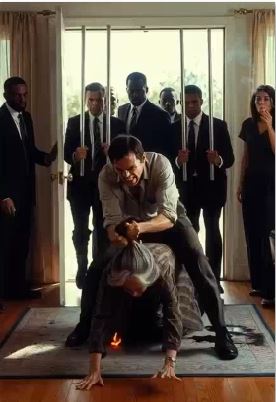
The smell of gasoline is not something you ever truly get used to, even after forty years as an ER nurse. It is sharp, chemical, and invasive; it clings to the mucous membranes of your throat and settles in your lungs like a toxic fog. But in the sterile halls of St. Jude’s Hospital, that smell usually meant a car accident victim had just been wheeled in. It meant trauma. It meant work.
Here, in the living room where I had once bounced my grandson on my knee, it meant the end of my life.
I am Martha, sixty-five years old, my knees arthritic and my back aching, kneeling on the Persian rug my late husband, Henry, and I bought in Istanbul three decades ago. The rug was soaked. The dark, intricate patterns were now bleeding together under a sheen of fuel.
My scalp burned with a white-hot intensity. Travis, my son-in-law, had his fingers twisted deep into my gray hair, wrenching my head back so hard my neck cracked. Above me, the ceiling fan spun lazily, indifferent to the horror unfolding beneath it.
“Sign the papers, you old hag!” Travis screamed. His voice was a jagged tear in the air, high-pitched and vibrating with the manic energy of a three-day methamphetamine bender. Spittle flew from his mouth, landing on my cheek. “Do you want to die here? Do you want to burn? Because I don’t care! I swear to God, Martha, I will light this whole place up!”
His eyes were terrifying. The pupils were blown out, swallowing the iris, leaving two black holes that looked into a void where a human soul used to be. His skin was pasty, covered in a sheen of cold, chemical sweat. He was trembling—not with fear, but with the electric, uncontrollable jitters of withdrawal and psychosis.
In his right hand, he held a cheap, translucent plastic lighter. He flicked the wheel. Click-hiss. A small, yellow flame danced into existence, terrifyingly cheerful against the gloom of the room. He lowered it inches from the gasoline-soaked rug.
“Travis, please,” I rasped, my voice barely a whisper. The fumes were making me dizzy. “You don’t have to do this. We can talk.”
“No more talking!” he shrieked, yanking my hair harder. Tears pricked my eyes, blurring my vision. “I need the money! The transfer! Now! You think you can hoard that land while I’m starving? While I’m hurting?”
The papers lay on the coffee table, a cruel juxtaposition next to a coaster Henry had made in his woodshop. It was a Power of Attorney and a Deed of Sale for the ten acres of farmland I had inherited from my father. It was my nest egg. It was supposed to be my safety net for assisted living, so I wouldn’t be a burden. It was the only thing standing between me and destitute poverty.
Travis wanted to sell it for quick cash. Pennies on the dollar to a predatory developer, just enough to feed the monster in his veins for a few months.
“The pen!” Travis roared, shoving the lighter closer to my face. The heat of the flame licked at my skin. “Pick up the damn pen!”
My heart hammered against my ribs like a trapped bird. I wasn’t just afraid of dying; I was afraid of the sheer senselessness of it. To survive decades of trauma care, to survive the death of my husband, only to be incinerated by a junkie in my own sanctuary.
But the physical threat wasn’t the deepest cut. That particular wound was reserved for the figure standing in the corner, watching the scene unfold with the dispassionate gaze of a stranger.
I looked past the flame, locking eyes with the person who should have been my protector. Travis’s thumb slipped on the lighter, the flame flickering out for a split second before he struck it again, bigger this time. He lowered it until the heat warped the air above the fuel. “Last chance, Martha,” he hissed. “Count of three. One…”
“Two…” Travis growled, his hand shaking so badly the flame danced wildly.
I didn’t look at the fire. I looked at Lisa.
My daughter was leaning against the doorframe leading to the kitchen. She looked so thin, her collarbones protruding sharply against her stained t-shirt. Her once-lustrous brown hair was dull and matted, pulled back into a messy bun. She took a long, slow drag from a cigarette, blowing the smoke toward the ceiling, mingling the scent of tobacco with the overpowering gasoline fumes.
“Lisa,” I gasped, the word scraping my throat. “Lisa, baby, please. Help me. He’s going to kill me.”
I waited for the spark of recognition. I waited for the mother-daughter bond, that primal connection that I had felt the moment they placed her pink, squalling body on my chest thirty years ago. I waited for the girl I had nursed through chickenpox, the girl I had worked double shifts to put through nursing school, to wake up.
Lisa flicked the ash onto the hardwood floor. She didn’t look scared. She didn’t look angry. She looked bored.
“Just sign it, Mom,” she said. Her voice was flat, a dead thing devoid of any moisture or emotion. “Don’t make him mad. You know how he gets when he’s waiting for a fix.”
The world seemed to tilt on its axis. The betrayal hit me harder than Travis’s fist ever could. It was a physical blow to the chest, stealing the air from my lungs more effectively than the fumes.
“He’s pouring gasoline in our house, Lisa!” I cried out, desperation cracking my voice. “He’s your husband! He’s threatening to burn your mother alive!”
Lisa sighed, rolling her eyes as if I were a toddler throwing a tantrum over a toy. “And we need the money, Mom. God, stop being so dramatic. What are you going to do with that land anyway? You’re old. You’re retired. You can’t take it with you when you die.”
She took another drag, her eyes narrowing. “Just sign the damn paper so we can get paid and get this over with. I’m tired.”
I’m tired.
Those two words shattered whatever hope I had left. The drugs hadn’t just taken her health; they hadn’t just taken her career or her looks. They had surgically removed her soul. The daughter I loved was dead, replaced by this hollowed-out husk that viewed her mother not as a person, but as an obstacle to a dopamine hit.
Travis laughed—a manic, high-pitched sound that grated on my nerves. “See? Even your daughter knows you’re useless. You’re just taking up space, Martha. Sign it!”
He grabbed my wrist, forcing the pen into my trembling fingers. He shoved my hand toward the paper. “Do it, or I drop this lighter. I swear, I’ll do it. We’ll all go up. I don’t care anymore.”
I looked at the paper. The words swam before my eyes. Transfer of Title. Irrevocable.
I looked at Lisa one last time. She was checking her fingernails, indifferent to the fact that her husband was seconds away from committing murder-suicide.
Something inside me broke. It wasn’t my spirit—that had been forged in the high-pressure fires of the ER. It was my heart. It simply ceased to function as a vessel for love and turned into a stone of resignation.
“Okay,” I whispered, tears leaking from my eyes. Not for myself, but for the memory of the family I had lost long before today. “Okay. I’ll sign.”
Travis whooped, a sound of victorious delirium. “That’s it! That’s a good girl!”
I pressed the tip of the pen to the paper. My hand shook uncontrollably. The ink bled into a small, dark blot. I started to form the letter ‘M’.
Ding-dong.
The sound was so cheerful, so mundane, so utterly out of place in our gasoline-soaked hell, that time seemed to freeze. The pen slipped from my fingers and rolled across the table. Travis went rigid, his head snapping toward the front door, the lighter still burning in his hand.
——————————–
The chime echoed in the silence that followed. Ding-dong.
Travis’s face contorted, shifting from manic triumph to paranoid terror in a heartbeat. He scrambled back, extinguishing the lighter and shoving it into the pocket of his filthy jeans.
“Is that the cops?” he hissed, his voice dropping to a strangled whisper. He grabbed me by the collar of my blouse, yanking me up. “Did you call the cops, you witch? Did you trigger a silent alarm?”
“No,” I choked out, my hands raised in surrender. “I didn’t call anyone. I swear.”
Travis released me, shoving me back down onto the soaked rug. He looked at Lisa. “Check the window. Don’t open the blinds.”
Lisa moved with a sluggish urgency, peering through the crack in the curtains. She frowned. “It’s just a car. A big black car. I don’t see any lights.”
“It must be Rocco,” Travis muttered, talking to himself, pacing in a tight circle. “He said he’d come by at noon to collect. He’s early. He hates waiting.”
He ran a hand through his greasy hair, his eyes darting around the room. The power dynamic had shifted. The abuser was now the frightened prey. He grabbed a heavy aluminum baseball bat from behind the sofa—his ‘home security’ system.
“You stay here,” he ordered Lisa, pointing the bat at her. “And you,” he snarled at me, “if you make a sound, if you scream, I’ll come back in here and finish what I started. Understanding?”
I nodded, clutching my chest.
Travis marched to the front door, puffing out his chest, trying to summon the bravado of a tough guy. He was a small man, withered by chemicals, but he thought he was a king. He unlocked the deadbolt and yanked the door open, ready to launch into a tirade of excuses or threats to his dealer.
“Listen here, Rocco, I told you I’d have the mon—”
The sentence died in his throat. It was choked off as if an invisible hand had clamped around his windpipe.
From my vantage point on the floor, through the archway, I saw Travis stumble backward. His face, previously flushed with rage, drained of blood until he looked like a corpse. He dropped the bat. It clattered loudly on the hardwood, rolling away uselessly.
Standing in the doorway was not a low-level drug dealer named Rocco.
It was a wall. A wall of human muscle.
Five men stood on my porch. They were dressed in sharp, dark suits that cost more than my house. The fabric strained against their shoulders and thighs. They didn’t look like junkies or street thugs. They looked like professional soldiers of a private war.
In their hands, they didn’t hold guns. That would have been too impersonal. They held machetes—long, gleaming blades that caught the midday sun—and heavy iron pipes that rested casually at their sides.
But it was the man in the center who made the air in the room drop ten degrees.
He was shorter than the others, but his presence was monolithic. He wore a charcoal suit with a silk tie. His hair was slicked back, graying at the temples. I recognized him instantly from the evening news, though usually, his face was blurred or hidden behind a lawyer’s briefcase.
Vincent “The Hammer” Moretti. The head of the Moretti crime family. The man who arguably ran the city from the shadows of his Italian restaurants and construction firms.
Travis backed up until he hit the hallway wall, his knees knocking together. “Mr… Mr. Moretti,” he stammered, his voice cracking. Vinnie Moretti stepped over the threshold, his polished leather shoe crunching on a piece of grit. He didn’t look at Travis. He looked past him, his dark eyes scanning the room until they locked onto me.
“I… I don’t owe you anything,” Travis squeaked, raising his hands in a pathetic gesture of surrender. “I deal with Rocco. I swear, I didn’t know—”
Vinnie Moretti moved with a speed that belied his age. He didn’t speak. He simply swept his left arm out in a backhand motion. It was casual, almost dismissive, yet the impact sounded like a gunshot.
CRACK.
Travis flew sideways, his head snapping back, and crashed into the entryway table before sliding to the floor, whimpering. He curled into a fetal ball, clutching his jaw.
Vinnie didn’t even break stride. He walked into the living room, followed by his five silent sentinels. The room suddenly felt very small.
His dark eyes took in the scene instantly. He saw the overturned chair. He saw Lisa cowering in the corner, her cigarette burning down to her filter. He saw the gasoline stain spreading on the rug. And he saw me—bruised, disheveled, smelling of fuel, kneeling on the floor.
The terrifying, stony scowl on his face vanished.
He stopped directly in front of me. To my utter shock, and the visible horror of my daughter, the most dangerous man in the city—a man rumored to have buried enemies in concrete foundations—dropped to one knee.
He ignored the gasoline soaking into his expensive trousers. He reached out a hand, manicured and steady, and gently took my trembling arm.
“Madam Martha,” he said. His voice was surprisingly soft, a rich baritone layered with genuine respect. “Are you hurt?”
I stared at him, my brain unable to process the shift in reality. “I… who… why are you…”
“You don’t remember me,” he said, a small, sad smile touching his lips. “But I remember you. Ten years ago. St. Jude’s Hospital, the north parking lot. Late December.”
The memory flickered in the back of my mind. A bitter cold night. My shift had ended at 2:00 AM. I was walking to my car when I saw a heap of old clothes slumped against a sedan.
“An old woman collapsed,” Vinnie continued, his eyes intense, searching mine. “She had a heart attack in the freezing cold. Everyone walked by. Security thought she was just a homeless lady sleeping it off. But you stopped.”
I gasped. “The lady in the blue coat.”
“My mother,” Vinnie said. His voice wavered slightly, thick with emotion. “She had dementia. She had wandered off from the care home. You found her. You didn’t just call 911. You started CPR right there on the asphalt. You gave mouth-to-mouth to a stranger who looked like a beggar. You stayed with her, wrapped your own coat around her until the ambulance came.”
I remembered. I remembered the fragility of her ribs under my hands. I remembered whispering to her that it would be okay.
“The doctors said if you hadn’t acted in that minute, she would have been gone,” Vinnie said. “You saved her life, Martha. You gave me two more years with my Ma. Two years to say goodbye. Two years to hold her hand.”
He stood up, helping me to my feet with the tenderness one might show a piece of fine china. Then, the warmth vanished from his eyes as he turned to look at Travis, who was trying to crawl toward the kitchen.
Vinnie sniffed the air, his nostrils flaring. “Gasoline?”
I nodded, the tears finally spilling over, hot and fast. “He… he wanted me to sign over my land. He was going to burn the house down with us inside.”
Vinnie’s face darkened. A vein throbbed violently in his temple. The air in the room grew heavy with impending violence. He turned to his men.
“This punk put his hands on Madam Martha,” Vinnie said, his voice low, vibrating with a deadly frequency. “He threatened to burn down the house of the woman who saved my mother.”
One of the henchmen, a giant with a scar running down his neck, stepped forward, hefting a machete.
Vinnie held up a hand to pause him, then looked at me. “Madam Martha,” he said formally. “I came here today to bring you a gift for my mother’s birthday. Instead, I find a pest infestation.” He turned to the scarred man. “Take him out back. Make sure he understands the consequences of fire.”
“No! No, please!” Travis shrieked as two of the men grabbed him by his ankles. They dragged him across the floor like a sack of garbage. “Lisa! Help me! Mr. Moretti, I’ll pay! I’ll pay you double!”
Lisa stayed pressed against the wall, her hands over her mouth, eyes wide with terror. She didn’t move to help him.
The kitchen door swung open, and they dragged Travis into the backyard. The door swung shut, muffling the sounds, but not enough.
We heard thuds. Wet, heavy crunches. And then, a sound I will never forget—a long, high-pitched wail that was abruptly cut short, followed by the sound of something heavy breaking.
Vinnie stood stoic, adjusting his cufflinks. He didn’t seem to hear the screams. His attention turned to Lisa.
My daughter was shaking uncontrollably, the ash from her cigarette falling onto her shoes. She looked small, pathetic, and utterly trapped.
“And this one?” Vinnie asked me, tilting his head toward her. His expression was one of pure disgust. “She is family?”
I looked at Lisa. I looked for the little girl who used to bring me dandelions. I looked for the teenager who cried when her hamster died. I looked for the young woman who had sworn to care for patients.
I saw none of them. I saw a stranger who had stood by and watched as her husband prepared to incinerate me. I saw a woman who had chosen the needle over her own blood.
“She stood there,” I said, my voice trembling but gaining strength. “She told me to sign. She watched him pour the gas. She said she was tired of waiting for me to die.”
Vinnie’s lip curled. “There is a special circle in hell for children who betray their parents. Dante wrote about it. The lowest circle.”
He looked at his remaining men. “Do we teach her a lesson too, Madam Martha? Do we show her what it means to be ‘tired’?”
The room fell into a suffocating silence. Lisa looked at me, her eyes pleading. “Mom… Mom, please… I was scared. I didn’t mean it.”
“Liar,” Vinnie barked, making her flinch.
“Mom!” she cried.
I closed my eyes. I felt a phantom pain in my chest, the severing of the umbilical cord for the final time.
“No,” I said softly.
Vinnie looked at me. “Are you sure? Disrespect must be punished.”
“I’m sure,” I opened my eyes, looking at Lisa with a finality that felt like a tomb door sliding into place. “She’s not my daughter anymore. I don’t know who she is. Just… get her out of my sight.”
Vinnie nodded slowly. He turned to Lisa. “You heard the lady. You are no longer welcome in this sanctuary.”
He took a step toward her, and she flinched. “Get out. If I ever see you near this house, or near Madam Martha again, you won’t walk away. Do you understand?”
Lisa didn’t pack a bag. She didn’t say goodbye. She unlocked the front door and ran. She fled down the driveway, stumbling, leaving her husband in the backyard, her mother in the living room, and her humanity somewhere in the ashes of her addiction.
Vinnie watched her go, then turned back to me. He snapped his fingers, and the man holding a large fruit basket and a thick envelope stepped forward. “Now that the trash is taken out,” Vinnie said, “we can discuss the future. You are under the protection of the Moretti family now. And the Morettis take care of their own.”
Vinnie stayed for an hour.
He had his men clean up the gasoline, using industrial solvents they seemingly produced from thin air. They opened the windows to air out the fumes. They fixed the rug as best they could.
He handed me the envelope. I opened it to find a stack of cash—enough to repair the damage, replace the rug, and live comfortably for a year.
“I can’t take this,” I had said.
“It’s not charity,” Vinnie had replied, pressing a heavy, black card into my hand. It had a single phone number embossed in gold. “It’s a retainer. For being the only decent person in a city of wolves.”
As he walked out to his car, leaving me in the quiet, safe wreckage of my home, I reflected on the dark irony of the universe.
I had birthed a daughter who became a monster’s accomplice. I had nursed a stranger who birthed a son that became my protector.
I walked to the window and watched the black sedans pull away. I touched the bruise forming on my arm where Travis had grabbed me. It hurt, but the fear was gone.
Blood, I realized as the sun began to set, isn’t what binds us. Biology is an accident. Family is defined by action. It is defined by honor. It is defined by who stands between you and the fire.
I had lost a family today. My daughter was gone, lost to the streets and her own demons. But in the strange, violent math of the world, I had gained a guardian.
I went to the kitchen, made a cup of tea, and sat in my chair. For the first time in years, the house was quiet. It was lonely, yes. But it was safe. And as I looked at the black card on the table, I knew that I would never be afraid again.
The debt was paid. The contract was signed. Not in ink, but in loyalty.