I became a single mother when Lily was just four months old, in the sort of quiet, devastating way that happens in movies but feels impossibly loud in real life.
It was a Tuesday. I remember because the garbage truck was groaning down the street, the brakes squealing like a dying animal. I walked into the kitchen, shifting Lily from one hip to the other, sleep crusted in my eyes, expecting to see him making coffee. Instead, the coffee pot was cold and dry. The air in the house felt thinner, less occupied.
There was a note on the kitchen counter, anchored by the salt shaker.
It read: “I can’t do this. I’m sorry.”
That was it. Seven words to dismantle a life. The paper was torn from a yellow legal pad, the handwriting hasty and jagged, like he was afraid if he took too long to write it, the ink might bind him to us forever. He had packed his bags while we slept—while his daughter breathed soft, milky breaths in the crib next to our bed—and he had slipped out into the gray dawn.
The truth was, he couldn’t handle the weight of it. He was a man who still thought weekends were for sleeping in and paychecks were for beer. The sleepless nights, the colic, the constant, demanding reality of another human life depending on him—it terrified him. So he ran.
He left me with a colicky infant, a leased apartment, and a mountain of bills that sat on the counter like vultures waiting to feed.
Those early years are a blur of exhaustion in my memory, a gray montage of fatigue. I worked double shifts at The Rusty Spoon, a diner on the edge of town where the neon sign buzzed with an angry electrical hum and the coffee tasted like burnt hazelnuts. I pulled sixteen-hour days, my feet swelling inside cheap, non-slip shoes, serving eggs to truckers who called me “sweetheart” and didn’t tip, just to keep the lights on and formula in the cupboard.
My mother was my lifeline. She was the only reason we didn’t drown. She looked after Lily while I was at work, rocking her to sleep when she cried, feeding her the bottles I had prepped at 4:00 AM. I would come home smelling of grease and sanitizer, my back throbbing, but the moment I walked through the door and saw Lily’s face—her eyes lighting up, her chubby hands reaching for me—the pain would recede.
But let’s be honest: love doesn’t pay the electric bill. There were nights when I cried myself to sleep, muffling my sobs in the pillow so I wouldn’t wake the baby. There were days when I had to choose between paying the gas bill or buying Lily new shoes because her toes were curling in her old ones. We played “camping” when the power got cut off, eating cold beans by candlelight, pretending it was an adventure and not a failure.

We survived. We clawed our way up from the bottom.
Now, Lily is fifteen. She is my entire world, the axis upon which my life spins. Everything I do is for her. I’m still at the diner, though now I’m the shift manager. I still have swollen feet. But we have a small rental house with a yard. We have food in the fridge. I’m building a future for her where she can go to college, travel to Paris, become a doctor or an artist or whatever she dreams of.
I thought the hardest part was over. I thought the sleepless nights were behind us.
But I was wrong. The hardest part wasn’t the poverty. It was the silence.
Part II: The Wall of Silence
It started about two months ago, insidious and slow, like mold creeping behind wallpaper.
Lily had always been a bright kid. Chatty. Full of energy. She would come home from school and dump her backpack, launching into a ten-minute monologue about her history teacher’s terrible tie or the drama in the cafeteria.
But suddenly, the broadcasts stopped.
She would walk through the front door, shoulders slumped, dragging her backpack as if it contained rocks. She would kick off her shoes and head straight to the stairs.
“How was your day, bug?” I’d ask from the kitchen.
“Fine,” she would mumble, not looking at me.
“Just fine? Did you get that biology test back?”
“It was fine, Mom.”
Then the door to her room would click shut.
Then, the bathroom ritual began.
Every single day after school, at exactly 4:00 PM, Lily would disappear into the main bathroom upstairs. She would lock the door with a decisive click.
At first, I thought it was just teenage vanity. Long showers, experimenting with hair products—normal stuff. But it went on too long. An hour. Sometimes ninety minutes.
I would stand outside in the hallway, laundry basket in hand, pressing my ear against the painted wood. I could hear the faucet running—a constant, rushing stream of water meant to mask other sounds. I could hear drawers opening and closing.
And sometimes, if I held my breath, I could hear the other sounds. The hitching breath. The stifled gasps.
“Lily?” I would knock, keeping my voice light. “Honey, are you okay in there? You’ve been in there a while.”
Silence. The water would run louder.
“Lily, please answer me. You’re scaring me.”
“I’m fine, Mom!” Her voice would come through muffled and thick. “Just leave me alone. I’m taking a bath.”
But when she finally emerged, she didn’t look like someone who had taken a relaxing bath. Her face would be scrubbed raw, red and blotchy. Her eyes would be puffy slits. She would keep her head down, avoiding eye contact as she rushed past me to the sanctuary of her bedroom, locking that door too.
I tried everything. I tried the “cool mom” approach. Hey, want to order pizza and watch a movie? I tried the authoritarian approach. Lily, we need to talk about your attitude. I tried the emotional approach. Baby, I miss you.
Nothing worked. The wall between us grew taller and thicker every day.
My mind, naturally, went to the darkest corners.
Was she hurting herself? I checked the razor blades in the bathroom when she wasn’t there; none were missing. Was she bulimic? I listened at the door for the sounds of sickness, but I only heard water. Was she pregnant? God forbid, was she dealing with morning sickness or taking tests in secret?
The tension in the house was suffocating. We were two ghosts haunting the same hallways, separated by secrets I couldn’t decipher. I stopped sleeping. I lay awake at night, staring at the ceiling fan, terrified that I was failing her just like her father had failed us.
Then came the Thursday that broke the dam.
Part III: The Breaking Point
It was a gray, rainy afternoon. The diner had been dead—just a few regulars nursing endless cups of coffee to get out of the drizzle. My manager, a kind man named Sal who knew I was struggling with Lily, told me to clock out early.
“Go home, Anna,” he said. “Make some hot cocoa. Talk to your girl.”
I grabbed my purse and drove home, hope fluttering in my chest. Maybe if I caught her before the ritual started, before she locked herself away, we could connect.
I unlocked the front door quietly. The house was silent.
Usually, even if she wasn’t talking to me, I could hear the bass of her music thumping through the ceiling. Today, nothing.
“Lily?” I called out, setting my keys on the table. “Honey, I’m home early!”
No answer.
I frowned. Her shoes were by the door. Her backpack was dumped in the hallway, spilling textbooks onto the rug.
I walked up the stairs, the wood creaking under my feet. I pushed open her bedroom door, expecting to see her curled up with her phone.
The room was empty. The bed was unmade.
Then I heard it.
From down the hall, behind the closed bathroom door, came a sound that stopped my heart. It wasn’t the running water this time. The faucet was off.
It was a sob. A raw, guttural sound of pure misery that sounded like it was being ripped out of her throat.
I froze. That wasn’t a teenage mood swing. That was despair.
Panic shot through me like a bolt of electricity. I crossed the distance to the bathroom door in two strides and hammered on the wood.
“Lily! Lily, open this door right now!”
The sobbing stopped instantly. A terrified silence followed.
“Mom?” Her voice was small, shaky, caught completely off guard.
“Yes, it’s me. Open the door, sweetheart. Please. You’re scaring me.”
“I can’t. I’m busy. Just go away, please.”
“I am not going away,” I said, my voice rising. “I have stood outside this door for two months. I am done. Either you open this door, or I am taking the screwdriver to the lock.”
“Mom, don’t—”
“One.”
“Please!”
“Two.”
“Don’t come in!”
“Three.”
I didn’t wait for the screwdriver. Adrenaline is a powerful thing. I threw my shoulder against the door. It was an old house, the jamb was soft wood, and the lock was flimsy. With a loud crack, the door flew open, banging against the bathtub.
I stumbled into the room and stopped dead.
The scene before me made no sense.
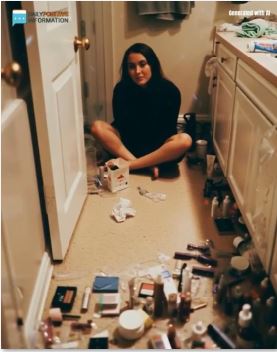
Lily was sitting on the cold tile floor, legs sprawled out. The room looked like a cosmetics bomb had gone off.
Surrounded her were old makeup bags—my old makeup bags—that I hadn’t touched in a decade. Tubes of dried-up mascara, cracked compacts of blush, lipsticks worn down to the nub. Hairbrushes, bobby pins, and hair ties were scattered like shrapnel.
In front of her, propped up against the cabinet, was a tiny handheld mirror. And taped to the frame of the mirror was a photograph.
I leaned closer, squinting. My breath hitched.
It was a picture of me. Not me now—tired, worn-out Anna. It was me at fifteen. It was my sophomore yearbook photo. I was smiling at the camera, my hair teased into that perfect 90s blowout, my eyeliner thick and precise, my skin flawless. I looked confident. I looked beautiful.
“Lily…” I whispered, dropping to my knees beside her. “What is all this?”
She looked up at me. Her face was a mess. She had tried to apply the old makeup, but it was smeared by tears. Mascara ran down her cheeks in black rivers. Her lipstick was smudged across her chin. She looked like a broken doll.
She crumbled.
“I’m sorry, Mom,” she wailed, burying her face in her hands. “I’m so sorry. I tried.”
“Sorry for what?” I pulled her hands away from her face, ignoring the makeup smearing onto my own skin. “What are you doing?”
She took a shuddering breath, her chest heaving. She looked at the photo, then at me, with eyes so full of self-loathing it physically hurt me to witness.
“The girls at school,” she choked out. “Madison. Brooke. They sit behind me in homeroom.”
My stomach tightened. I knew those names. The popular girls. The ones with the expensive clothes and the perfect Instagram lives.
“They make fun of me every day,” Lily whispered. “They laugh at my hair because it’s frizzy. They point at my acne. They ask me why I wear the same three hoodies every week. They call me ‘Goodwill Hunting’.”
Rage, hot and white, flared in my gut. I wanted to burn the school down.
“But that’s not the worst part,” Lily continued, wiping her nose. “Last week… Madison found your yearbook photo online. Someone posted an old class archive on Facebook.”
She pointed a shaking finger at the picture taped to the mirror.
“She printed it out. She passed it around the cafeteria at lunch. She stood on a chair and held it up next to me.”
Lily closed her eyes, fresh tears leaking out.
“She said, ‘Look everyone. It’s a tragedy. Lily is the cheap, knock-off version of her own mother. Looks like the trashy genes won out.’”
The air left the room.
“She called me the ‘Great Value’ version of you, Mom. She said you used to be hot, and I turned out to be a disappointment.”
I felt like I had been slapped.
“So,” Lily gestured helplessly to the makeup scattered on the floor. “I’ve been coming in here. Every day. I found your old stuff in the closet. I’ve been trying to learn. I watch tutorials on my phone. I try to fix my hair like yours. I try to do the eyeliner.”
She picked up a dried tube of mascara and threw it across the room.
“But I can’t do it! I look stupid! I look like a clown!”
She looked at me, her soul bare.
“I don’t want to disappoint you, Mom. I don’t want you to look at me and wish I looked like you. I don’t want you to be ashamed that I’m your daughter.”
Part IV: The Mirror of Truth
I sat there on the cold tile, the smell of old powder and teenage heartbreak filling the air.
I reached out and took the photo off the mirror. I looked at the girl in the picture. Fifteen-year-old Anna.
“Do you know who this girl is?” I asked softly.
Lily sniffled. “You. When you were pretty.”
“No,” I said firmly. “This girl was miserable.”
Lily looked up, confused.
“Look at her eyes, Lily. Really look.”
I held the photo up.
“I spent two hours every morning on that hair. Two hours. I woke up at 5:00 AM. I put on layers of makeup because I was terrified—terrified—that if anyone saw my real face, they would know how scared I was. My dad was drinking then. My mom was working all the time. I was failing math. I felt stupid and small and worthless. So I painted a mask on.”
I tore the photo in half.
Lily gasped. “Mom!”
“It’s just paper, Lily. That girl? She wasn’t happy. She was hiding. Beauty was my armor, but it was heavy. It was exhausting.”
I took a makeup wipe from the counter. I turned to Lily.
“May I?”
She nodded slowly.
I gently wiped the smeared mascara from her cheeks. I wiped the lipstick from her chin. I cleaned her face until she was just Lily again. My Lily. With her dad’s nose and my chin and her own beautiful, freckled skin.
“Madison is a bully,” I said, my voice shaking with suppressed anger. “She is cruel because she is insecure. Happy people don’t stand on chairs to humiliate others.”
I cupped her face in my hands.
“You are not a cheap version of me. You are the upgrade. You are the premium edition. You are smart—you get straight As without even trying. You are funny. You are kind. You rescue stray cats and you help me with the bills even though you shouldn’t have to know about bills.”
I kissed her forehead.
“I have been so busy working, so busy trying to keep us afloat, that I failed to build a fortress around you. I failed to tell you every single day that you are enough. And for that, I am so sorry.”
We sat there for a long time, holding each other on the bathroom floor.
“We are going to fix this,” I said finally. “Not your face. Your face is perfect. We are going to fix the situation.”
“Please don’t call the school,” Lily pleaded, the fear returning. “It will make it worse. They’ll call me a snitch.”
“I won’t just call,” I said, standing up and pulling her with me. “I’m going down there.”
Part V: The Mama Bear
The next morning, I didn’t go to the diner. I put on my best slacks and a blazer I saved for interviews. I marched into Northwood High School at 8:00 AM with Lily beside me.
I demanded to see the principal. The secretary tried to tell me I needed an appointment.
“My daughter was publicly humiliated in your cafeteria,” I said, my voice carrying to the back office. “I don’t need an appointment. I need accountability.”
Principal Miller came out. He was a tired-looking man who clearly wanted to avoid conflict. He ushered us into his office.
I laid it all out. The bullying. The photo. The comments.
“We have a zero-tolerance policy,” Principal Miller said, reciting the line from the handbook. “But without proof…”
“There were two hundred witnesses in the cafeteria,” I snapped. “Check the cameras. Check social media. It’s probably still up.”
I leaned over his desk.
“My daughter has been locking herself in the bathroom for two months because she feels unsafe in your school. If you do not address this immediately—if Madison and her friends are not dealt with—I will go to the school board. I will go to the papers. I am a single mother, Mr. Miller. I fight for a living. Do not test me.”
By noon, Madison and Brooke were suspended for three days for harassment and cyberbullying. They were forced to delete the photos.
Part VI: The Fallout and The Drive
The ride home from school that day was suffocating. I had pulled Lily out early; I wasn’t going to make her walk those halls alone immediately after the verdict came down.
“Are you mad?” Lily asked, her voice small from the passenger seat.
I gripped the steering wheel. “Mad? Yes. At the school. At those girls. Not at you.”
“Everyone stared at us when we left the office,” she whispered. “Now I’m not just ‘Goodwill Hunting.’ Now I’m the girl who got her mom to fight her battles.”
I pulled the car over to the side of the road. I put it in park and turned to her.
“Lily, listen to me. There is no shame in having backup. The strongest people in the world have armies behind them. I am your army. And you know what? Those kids staring? They aren’t thinking you’re weak. They’re thinking, ‘Damn, I wish my mom would do that for me.’”
She looked out the window, watching the rain streak the glass. “Do you think it will stop? The bullying?”
“I think it will change,” I answered honestly. “They might stop shouting, but they might start whispering. But here is the difference: You don’t have to listen anymore. Because you know the truth.”
“What truth?”
“That their opinion is garbage. And that you have a safe place to land.”
That night, the house felt different. The secret was out. The bathroom door stayed open. But I could feel the residual tremors in Lily. She was like a person who had walked away from a car crash—uninjured, perhaps, but shaken to the core.
She sat at the kitchen table, picking at her dinner.
“Mom?”
“Yeah, baby?”
“Did Dad leave because I wasn’t cute?”
The fork dropped from my hand. It clattered onto the plate, loud in the quiet kitchen.
“What?”
“I saw pictures of you guys when you were dating. You were so pretty. And he was handsome. And then… I came along. And he left.” She looked down at her lap. “Madison said that pretty people stay together, and ugly things break them apart.”
I stood up. I walked around the table and pulled the chair out next to her. I sat down so our knees were touching.
“Your father left,” I said, choosing my words with the precision of a surgeon, “because he was weak. He was a coward. It had absolutely zero percent to do with you, and one hundred percent to do with his own fear.”
I lifted her chin.
“He didn’t leave because you weren’t cute. He left because he knew he wasn’t strong enough to raise someone as incredible as you were going to be. He looked at you, and he saw a challenge he couldn’t meet. That is his loss. Every single day of his life, that is his loss.”
Lily’s eyes filled with tears again, but these were different. These were tears of release.
“I don’t need him,” she whispered. “I have you.”
“And I,” I said fiercely, “am never, ever leaving.”
Part VII: Beauty Hour
That evening, I made a new rule.
“Wednesday nights,” I announced. “I am leaving work early. I worked it out with Sal. Wednesdays are ours.”
“For what?” Lily asked.
“Beauty Hour.”
Lily flinched, pulling back. “Mom, I don’t want—I don’t want to try to be you anymore. It hurts too much.”
“Not like that,” I corrected gentle. “Not to fix you. To have fun. If you want to learn makeup, we learn it together. The right way. Not to hide, but to express yourself. Not to cover up Lily, but to decorate her. Or we do hair masks. Or we just paint our nails green and eat ice cream.”
The first Wednesday was awkward. We sat in front of the mirror in the bathroom, the same place where she had cried for months.
I bought her some decent makeup—not the expensive department store stuff, but clean, fresh products from the drugstore. No more expired junk.
“Okay,” I said, opening a tube of liquid eyeliner. “The bane of my existence. The cat-eye.”
I tried to apply it on myself first. My hand shook. I ended up with a jagged black smudge that looked like I’d been punched.
Lily giggled. It was a rusty sound, but it was there.
“Here,” she said, grabbing a piece of scotch tape. “The tutorial I watched said to use tape as a guide.”
She applied the tape to the corner of my eye. She took the pen. Her hand was steady. She drew a perfect, sharp wing.
She peeled the tape back.
“Whoa,” I said, looking in the mirror. “Okay, Picasso. Your turn.”
We spent the next hour painting our faces. We tried blue lipstick. We tried glitter. We looked ridiculous, and we laughed until our sides hurt.
For the first time in months, the bathroom wasn’t a place of shame. It was a clubhouse.
Part VIII: The Diner and the Drawing
A few weeks later, on a Tuesday, Lily had a half-day at school. She didn’t want to go home alone.
“Can I come to the diner?” she texted me.
“Of course,” I replied.
She walked in around noon, just as the lunch rush was hitting. The place was chaotic—dishes clattering, orders being shouted, the grill sizzling.
She sat at the counter, pulling out her sketchbook. I was busy, flying between tables, balancing plates, pouring coffee. I was sweating. My hair was escaping my bun. I had ketchup on my apron.
I wasn’t the polished girl from the yearbook photo. I was a working woman in the trenches.
At one point, a rude customer—a man in a suit who clearly thought he was too good for a diner—snapped his fingers at me.
“Hey! More coffee! And take this back, it’s cold.”
I stopped, took a breath, and put on my customer service smile. “I’ll be right there, sir.”
He grumbled something under his breath about “unskilled labor.”
Lily heard him.
I saw her stiffen on her stool. She closed her sketchbook. She turned to the man.
“My mom,” she said, her voice clear and carrying over the noise, “is managing four stations right now. She is working harder in one hour than you probably work all week. She’ll get to your coffee when she gets to it.”
The man turned red. The trucker two stools down chuckled. “She got you there, buddy.”
I looked at Lily. She wasn’t shrinking. She wasn’t hiding. She was defending me.
Later, when the rush died down, I went over to her.
“Thank you,” I said. “But you don’t have to fight my battles.”
“You fought mine,” she said simply. Then she turned her sketchbook around. “Look.”
It was a sketch of me. Not a portrait, but an action shot. Me with the coffee pot, hair messy, apron stained, but looking strong. Looking capable.
“It’s beautiful,” I said, tearing up.
“It’s real,” she said. “You look like a warrior.”
Part IX: Charcoal and Tears
Three months later, the school held its annual Spring Art Showcase.
Lily had always doodled, but since the diner incident, she had been working on something big. She spent hours in her room, not hiding, but creating. Her hands were always covered in charcoal dust.
The night before the show, she had a meltdown.
“It’s not right!” she shouted, tearing a page out of her book. “It doesn’t look like what I see in my head!”
I went into her room. Papers were everywhere. She was crying again, frustration radiating off her.
“Hey, hey,” I soothed. “What’s wrong?”
“I’m trying to draw the reflection,” she said, pointing to her easel. “I’m trying to draw a girl looking in a mirror, but I can’t get the reflection to look… different enough. It just looks like a mistake.”
I looked at the drawing. It was good, but I saw what she meant.
“Stop trying to draw the face,” I suggested. “Draw the feeling. What does she feel when she looks in the mirror?”
Lily paused. She wiped her eyes with a charcoal-stained hand, leaving a smudge on her cheek.
“She feels… strong. But also soft.”
“Then draw that. Don’t worry about the lines. Worry about the shadow.”
She picked up the charcoal stick. She closed her eyes for a second. Then she started to shade.
She worked for three hours straight. I brought her tea and left her alone.
When she came out, she was exhausted, but she was smiling.
“It’s done,” she said.
Part X: The Reveal
The gymnasium smelled of floor wax and cheap perfume. Parents milled around, holding plastic cups of punch, looking at pottery and paintings.
I found Lily standing by her easel near the back.
She was wearing a dress we had picked out together—a vintage floral print that suited her perfectly. Her hair was down, embracing its natural curl, controlled with a little product we’d found during Beauty Hour. She wore a touch of mascara and lip gloss.
She looked beautiful. But more importantly, she looked like herself.
I looked at her art piece.
It was a charcoal drawing. It depicted a girl—clearly Lily, with her curly hair—looking into an ornate mirror. But the reflection wasn’t a girl.
The reflection was a collage of words woven into a shape. The shape of a lioness. But the words weren’t roar or bite.
They were Kind. Smart. Survivor. Daughter.
At the bottom, she had titled it: The Upgrade.
I teared up. “Lily, this is amazing.”
“I won an honorable mention,” she said, pointing to the blue ribbon pinned to the canvas. “The judges liked the… texture.”
Just then, Madison walked by with her clique.
I felt my hackles rise. The Mama Bear instinct never really sleeps.
Madison slowed down. She looked at Lily. She looked at the ribbon. She looked at the drawing.
She opened her mouth. I stepped forward, ready to intervene.
But Lily beat me to it. She didn’t say a word.
She just stood up straighter. She met Madison’s eyes. She smiled—not a mean smile, not a scared smile. A smile of total indifference.
She was letting Madison know: You don’t have power here anymore.
Madison closed her mouth. She looked confused. Then she looked away and kept walking.
Lily looked at me and grinned. It was the smile from when she was five years old—unburdened, light, free.
“Did you see that?” she whispered.
“I saw,” I said. “You made her disappear.”
“No,” Lily said. “I just stopped seeing her.”
Part XI: The Unlocked Door
That night, we were in the kitchen making tacos. The mood was light. The house felt full again. The ghosts of the past few months had been exorcised.
Lily went upstairs to wash the charcoal off her hands.
I waited for the sound. The habit was hard to break. I waited for the click of the lock. The running water. The silence.
But it didn’t come.
I walked to the bottom of the stairs. The bathroom door was wide open.
Lily was humming a song—something by Taylor Swift—while she scrubbed her hands with the sugar scrub we had made last Wednesday.
She saw me in the mirror.
“Mom?” she said, drying her hands on a towel.
“Yeah, baby?”
“I don’t lock the door anymore,” she said casually, tossing the towel into the hamper. “I don’t need to hide in there to feel pretty.”
She turned around. Her face was fresh, clean, and radiant.
“I just needed to know you loved me the way I am. And… I needed to learn to love me, too. I think I’m getting there.”
I walked up the stairs and hugged her tight, tears streaming down my face again. But this time, they weren’t tears of fear or heartbreak. They were tears of relief.
My daughter had walked through the fire of adolescence, through the cruelty of her peers, and the abandonment of her father, and she had come out the other side.
She wasn’t my copy. She wasn’t my shadow. She wasn’t a “Great Value” version of anyone.
She was Lily.
And she was perfect, exactly as she was meant to be.