
The double doors of the courthouse slammed open with a thunderous crash that echoed through the chamber.
A little girl—no more than four years old—came running down the center aisle.
She wore a pink dress smeared with dried mud. One shoe was missing. Her hair was tangled, her cheeks flushed red from running and crying.
“She didn’t do anything! Emma didn’t do anything!” the child screamed with all the strength her tiny lungs could manage.
The judge raised his gavel—then froze midair.
The murmurs died instantly.
Every eye in the courtroom turned toward the small, trembling figure standing alone in the center of the room.
On the defendant’s bench, Emma Parker felt her heart stop.
The tears she had been holding back for weeks finally spilled over. She couldn’t believe what she was seeing.
“Olivia…” Emma whispered.
The little girl turned toward her. For a brief second, their eyes met.
Then, with a determination that shouldn’t exist in someone so young, Olivia lifted her shaking finger and pointed toward the front row.
“It was her,” the girl said, her voice broken but clear.
“My stepmom did it.”
Victoria Morales sat perfectly still in her seat.
She was dressed in black, her hands folded neatly in her lap, her posture composed. Throughout the trial, she had worn the same expression of quiet grief—controlled, convincing.
But now something had changed.
Fear seeped into her eyes like water through a crack.
The judge slammed the gavel three times.
“Order. Order in the court!”
His voice barely cut through the chaos that erupted. Gasps, whispers, frantic shuffling. He declared a thirty-minute recess.
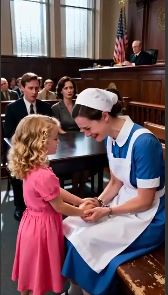
But before anyone could react, Olivia broke into a run toward Emma.
The security guards moved to stop her—until the defense attorney raised his hand.
“She’s the victim’s daughter,” he murmured to the judge.
Emma bent forward as far as the handcuffs would allow.
Olivia clung to her chained hands and whispered something only Emma could hear.
“I saw everything, Emma,” the child said softly.
“I saw what she did.”

Six months earlier, the Morales house had been very different.
Late afternoon sunlight streamed through the tall living-room windows, illuminating mahogany furniture and Persian rugs that Richard Morales had brought back from business trips abroad.
Olivia sat on the floor surrounded by dolls—but she wasn’t playing.
She was watching.
The adults on the couch talked and laughed like actors in a play she didn’t understand.
“Olivia, sweetheart, come here,” Richard said in that special voice he used when he wanted her attention.
“I want you to meet someone very important.”
The woman beside him was beautiful.
Her brown hair shone like a storybook princess’s. She wore an elegant blue dress that looked expensive. When she smiled, her teeth were perfectly white.
“Hello, little one,” the woman said, leaning forward.
“My name is Victoria. Your daddy and I are getting married very soon.”
Olivia looked at her father, confused.
“Does that mean you won’t travel so much anymore?” she asked.
Richard laughed and lifted her into his arms.
“It means Victoria is going to be your new mommy,” he said.
“Isn’t that wonderful?”
Olivia wasn’t sure how she was supposed to feel.
She barely remembered her real mother, who had died when she was two. But Emma had always been there—feeding her, bathing her, reading bedtime stories, holding her through nightmares.
Victoria opened her arms.
“Come to me, sweetheart. We’re going to be very happy together.”
When Olivia stepped forward, Victoria hugged her.
But something about the embrace felt wrong.
It was like hugging a very large, very cold doll.
Victoria smelled like expensive perfume, but beneath it was something else—something Olivia couldn’t name, but that made her want to pull away.
From the kitchen doorway, Emma watched silently.
She had worked in that house for three years, ever since Mrs. Morales passed away. She had seen Olivia take her first steps. She had helped her speak again after the accident.
That child was more than a job.
She was the daughter Emma never had.
Something about the way Victoria looked at Olivia made Emma uneasy.
Whenever Richard turned away to answer a call or check documents, Victoria’s smile vanished. Her eyes studied the child like a problem that needed solving.
“Emma,” Richard called. “Could you bring us some coffee? Victoria and I have a lot to plan.”
“Of course, sir.”
As Emma prepared the coffee, she listened from the kitchen.
Richard spoke excitedly about the wedding, the changes ahead, how happy he was to have a complete family again.
Victoria responded with perfect words—but her tone sounded rehearsed.
“Oh, how sweet,” she said when Richard mentioned Olivia.
“We’re going to be best friends.”
But when Emma returned with the tray, she saw Victoria gripping Olivia’s shoulder too tightly.
The little girl had gone stiff, staring toward the window as if she wanted to escape.
“Coffee,” Emma announced gently, setting the tray down.
“Thank you, Emma,” Richard said without looking up.
“Oh, and I have to travel to Chicago next week. I’ll be gone for ten days.”
Emma saw Victoria’s eyes light up—not with sadness, but with something else.
“So soon?” Victoria said softly. “Olivia and I are just getting to know each other.”
“It’s unavoidable, my love,” Richard replied. “But you’ll have time to bond. Emma will help with everything.”
“Of course,” Victoria murmured.
But the look she gave Emma was anything but friendly.
That night, after Victoria left and Richard worked late in his study, Emma helped Olivia bathe and put on her pajamas—her favorite part of the day.
“Do you like Victoria?” Emma asked while brushing her hair.
Olivia shrugged.
“I don’t know,” she said. “She smells… wrong.”
“Wrong how?”
“Like when Daddy forgets flowers in the vase too long.”
Emma frowned.
Children noticed things adults didn’t.
“And how do you feel about her living here?” Emma asked gently.
“Will you go away?” Olivia asked suddenly, eyes wide with fear.
“No, sweetheart. I’m not going anywhere.”
Olivia hugged her tightly.
“Promise?”
“I promise.”
But as Emma tucked her in that night, she couldn’t shake the feeling that something terrible was coming—and that a four-year-old child might be the only one brave enough to tell the truth.