
Michael Reynolds was certain he had already bought every possible solution.
Top pediatric specialists. Renowned child psychologists. Imported therapies that came with thick binders, charts, and promises written in confident language. His triplet sons—Evan, Lucas, and Noah, all six years old—had access to everything most children would never even dream of.
Yet none of it changed the look in their eyes.
They were quiet. Distant. Polite, but unreachable.
They followed instructions perfectly, spoke only when prompted, and rarely laughed. When they did, it felt rehearsed—like something learned, not felt.
Doctors called it social-emotional delay.
Therapists talked about attachment challenges.
Michael turned it into a project.
Spreadsheets tracked progress. Weekly reports measured improvement. Color-coded goals hung on the wall of a custom-built therapy room inside his oceanfront home in Palm Beach, Florida.
Still, the house remained painfully silent.
That afternoon, Michael returned from a board meeting that had dragged on for hours. His head throbbed with numbers, negotiations, and expectations. He wanted nothing more than to disappear into a hot shower and forget the day.
But as he walked up the stone path toward his mansion, something stopped him.
A sound he hadn’t heard in years.
Laughter.
Not polite giggles. Not forced smiles.
Real, unfiltered laughter.
Michael slowed his steps.
On the lawn, near the old oak tree he’d once considered cutting down, stood a strange scene.
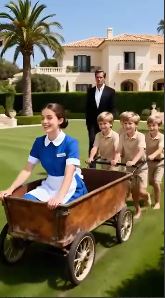
Maria, the housekeeper who cleaned the upstairs bathrooms and folded laundry with quiet efficiency, sat inside an old wooden cart—something Michael vaguely remembered being left behind by a previous owner. She clutched a plain white folder to her chest as if it were priceless.
In front of her, Evan, Lucas, and Noah pushed the cart carefully across the grass, laughing, arguing, negotiating.
“Slow down! You’ll drop the king’s documents!”
“No, I’m protecting them!”
“I’m stronger—I should steer!”
Michael froze.
He couldn’t remember the last time his sons had spoken so freely. Or laughed at all.
How was it possible that the woman who worked silently in the background of his home had achieved in minutes what months of therapy could not?
The diagnosis echoed in his mind.
Difficulty forming emotional bonds.
Since hearing those words, Michael had unknowingly replaced affection with structure. He scheduled time instead of sharing it. He measured connection instead of feeling it. And without realizing it, he had delegated love.
He had once flown in a neurotherapist from New York who promised “significant breakthroughs.” He built a sensory room filled with lights, pads, and monitors. Every invoice came with hope—and every evening ended in disappointment.
The crunch of Michael’s dress shoes against the stone walkway broke the spell.
The laughter stopped instantly.
The boys stiffened. Their smiles disappeared. One step back. Then another.
They looked at him the way employees looked at a boss who had arrived unexpectedly.
Maria jumped out of the cart, startled.
“I’m so sorry, Mr. Reynolds,” she said quickly. “I didn’t mean to—”
Something tightened painfully in Michael’s chest.
“Can I… help?” he asked quietly. “Push the cart?”
The boys didn’t answer.
They looked at Maria.
She smiled gently and nodded.
Michael placed his hands on the cart beside their small fingers. The wheels creaked as they moved forward together.
“Careful,” Maria said playfully. “There’s a sleeping dragon behind the oak tree.”
Evan let out a hesitant laugh.
Lucas invented an invisible bridge they had to cross.
Noah, the quietest, whispered, “Can we deliver good things to people who need them?”
Maria knelt and brushed his hair back.
“You already did,” she said softly. “You made my day brighter.”
That night, Michael sat in his office and closed his laptop before answering emails—something he had never done before.
The next morning, he canceled meetings. Postponed a flight. And waited for Maria to arrive.
She didn’t hesitate.
“Children feel when adults are rushing,” she told him. “They feel fear. They feel pretending. If you want them with you—come without an agenda.”
In the backyard, Maria guided Michael into their world. They crossed imaginary rivers. Built forts from cardboard boxes. Defeated monsters that lived behind patio chairs.
Michael felt ridiculous.
And then—free.
He laughed out loud. He stopped correcting. He followed instead of leading.
And something shifted.
The boys began talking more. Touching his arm. Sitting closer. Leaning into him as if testing whether he would stay.
Three weeks later, a therapist suggested reducing sessions. A pediatrician admitted something rarely written in reports.
“The environment matters.”
Michael felt guilt wash over him.
And relief.
Slowly, Maria stepped back. She had built the bridge—but it was his responsibility now to keep it standing.
One Saturday afternoon, the boys played alone on the lawn. Michael sat nearby, watching.
Evan walked over and rested his head against Michael’s shoulder.
“You’re different now, Dad,” he said.
Michael looked at the massive house behind them.
And finally understood.
Money can buy silence.
But only presence heals it.
In Palm Beach, Florida, a wealthy man learned the name of the only therapy he had never tried before.
Love.