
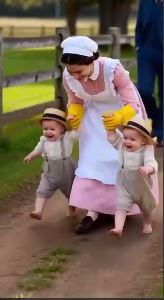
A dirt road cut through the heart of the Riverside Estate, a 200-acre stretch of manicured land that looked more like a private park than a home. The grass on either side was trimmed to perfection. Ancient oak trees cast wide shadows. In the distance, the main house stood tall and cold, elegant as a museum.
On that overcast afternoon, the estate looked peaceful.
It wasn’t.
Sitting alone on the dirt road were two toddlers.
Twin boys, barely two years old, dressed in matching outfits—white shirts, striped overalls, tiny brown shoes. They were holding hands.
And they were crying.
Not whining. Not fussing.
Crying in fear.
Their small bodies trembled as they clung to each other, tears streaking their dusty cheeks.
People passed them.
A gardener walked by, glanced once, and kept going.
A golf cart rolled past. No one stopped.
From behind a massive oak tree, Julian Riverside watched it all.
At thirty-eight, Julian was the sole heir to Riverside Industries, a multibillion-dollar manufacturing empire. Even on his own land, he wore a tailored charcoal suit. Control was his second skin.
This wasn’t an accident.
It was a test.
Twenty minutes earlier, he had ordered the nanny to seat his sons on the road and walk away.
“I need to know who actually cares about my children,” he had said coldly. “And who’s just here for a paycheck.”
Now, as the twins’ cries grew louder, guilt flickered in his chest—but he crushed it.
This mattered.
Then something unexpected happened.

From the side path near the service quarters, a young woman appeared.
She wore a simple maid’s uniform—faded blue dress, worn shoes, hair pulled back neatly. Her name was Elena Brooks, twenty-two years old, recently hired as a live-in housemaid.
She had been carrying folded laundry.
She stopped the moment she heard the crying.
Elena looked down the road and froze.
Two babies. Alone.
Without hesitation, she dropped the laundry onto the grass and ran.
Julian stiffened, watching closely.
Elena reached the twins and immediately knelt on the dirt, bringing herself to their level.
“Oh no, no… hey, hey,” she whispered softly, holding her palms open so they could see she wasn’t a threat. “You’re okay. I’m here.”
One twin reached for her finger.
Then the other.
Elena took both their hands, warm and steady.
“I won’t leave you,” she promised quietly.
The crying didn’t stop right away—but it softened.
She pulled a handkerchief from her pocket, gently wiped their faces, then sat cross-legged on the road, letting them lean against her.
She looked around, worried—not angry, not accusing—just genuinely concerned.
“Where is your grown-up?” she murmured.
No one answered.
So she stayed.
Elena began humming a tune, low and steady. Then she used her fingers to make little shapes in the dirt—circles, stars, funny faces.
One twin hiccupped.
The other sniffed.
Then—laughter.
A small giggle.
Julian felt his breath catch.
The twins laughed again, louder this time.
Something inside him cracked.
He stepped out from behind the tree.
Elena noticed immediately.

Her body shifted—subtly, instinctively—placing herself between the twins and the approaching man.
“Can I help you?” she asked cautiously.
“I’m their father,” Julian said.
Her eyes widened—not with relief, but disbelief.
“Then why,” she said slowly, standing up, “were your children sitting alone on a dirt road crying while your staff walked past them?”
Julian opened his mouth.
Paused.
“I was testing—”
“Testing?” Elena’s voice trembled with controlled anger. “They’re not equipment. They’re babies.”
She didn’t raise her voice. That made it worse.
“You don’t test loyalty with a child’s fear,” she continued. “You protect them.”
For the first time in years, Julian Riverside felt ashamed.
“I needed to know who would stop,” he said quietly.
Elena looked down at the twins, who were now gripping her dress, refusing to let go.
“Well,” she said, “now you know.”
She bent down, lifted both boys—one on each hip—and started walking toward the main house.
Julian followed, silent.
Staff emerged in shock as they saw the maid carrying the boss’s children.
At the steps, Elena set them down gently.
They immediately grabbed her hands again.
“Stay,” one whispered.
Julian looked at her—really looked.
She was tired. Her uniform was old. Her shoes were worn thin.
But his sons trusted her.
“How long have you worked here?” he asked.
“Two weeks.”
“And yet you stopped.”
She shrugged. “I was raised to.”
Julian took a breath.
“Elena,” he said, “I want you to stay. Not as a maid.”
She frowned. “Then as what?”
“As someone my children can trust,” he said. “I’ll arrange training, education, fair pay. You’ll never be alone in this house again.”
She hesitated.
Then looked down at the twins.
“I’ll stay,” she said. “For them.”
Julian nodded.
That evening, termination notices went out.
The staff who walked past crying children were gone.
Elena moved into a room upstairs.
And for the first time since their mother died, the twins slept through the night.
Years later, Julian would say that day changed his life.
He thought he was testing others.
But the truth was simpler.
The maid didn’t pass his test.
She revealed his failure.
And taught him what love actually looks like.